
Crucial Friday! 10 Hot Sentiments That Could Send Indonesian Markets into Turmoil
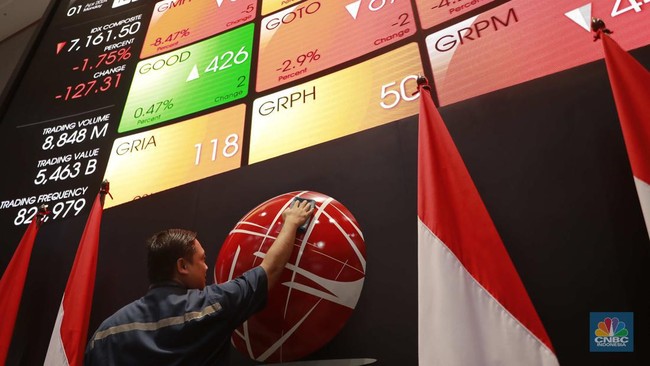
Indonesia’s financial markets are expected to strengthen in unison today. More on the outlook for sentiment in Indonesian financial markets can be found on page three of this article.
The Jakarta Composite Index (JCI) came under heavy selling pressure on Thursday (29 October 2026), closing down 3.49%, or 184.26 points, at 5,098.06.
Selling dominated from the morning, although the index initially opened slightly higher at 5,305.20 and touched the 5,320 area early in the session. The gains did not last: the JCI reversed course and fell sharply before 10am local time.
From midday into the afternoon, the JCI traded in a range of 5,125–5,175. It briefly attempted to recover to the 5,120 area towards the close, but came under renewed pressure in the final minutes and finished near its low.
Trading volume reached 23.3 billion shares, worth Rp11.3 trillion. A total of 98 shares rose, 624 fell and 70 were unchanged. Foreign investors recorded net sales of Rp1.08 trillion.
One of the main drags on the index was PT Bank Central Asia Tbk (BBCA). Shares in Indonesia’s largest privately owned bank fell 6.35% to Rp4,940, giving it a market capitalisation of Rp602.8 trillion.
Pressure also came from other large-cap stocks, including PT Astra International Tbk (ASII), PT Bank Rakyat Indonesia (Persero) Tbk (BBRI), PT Telkom Indonesia (Persero) Tbk (TLKM) and PT Bank Mandiri (Persero) Tbk (BMRI).
The JCI’s plunge on Thursday put pressure on large-cap shares in the market spotlight. Selling continued through to the end of the session, leaving the index unable to hold the psychologically important 5,100 level.
In currency markets, the rupiah recovered against the US dollar at the close on Thursday (29 October 2026), after several days of weakness that had taken it to a record closing low in the previous session.
In the bond market, the yield on 10-year Indonesian government bonds (SBN) eased to 7.643% on Thursday from 7.706% on Wednesday. The decline in yields signals that SBN prices are rising as investors return to the bonds.
Despite the easing, yields remain around their highest level in six years.
US stocks on Wall Street fell on Thursday (29 October 2026), or early Friday in Indonesia, weighed down by a fresh wave of corporate earnings reports that disappointed investors.
The Nasdaq Composite fell 1.38% to 26,184.72, while the S&P 500 lost 0.3% to 7,720.39, ending a three-day rally. The Dow Jones Industrial Average dropped 132.54 points, or 0.25%, to 52,342.56.
Alphabet, Google’s parent company, plunged 12% after its adjusted earnings per share and third-quarter 2026 revenue fell short of analysts’ expectations.
Alphabet also reported negative free cash flow of US$9.07 billion. However, it maintained its forecast for capital expenditure this year of between US$195 billion and US$205 billion.
Another Dow component, Caterpillar, fell by more than 9%, its steepest decline since March 2020.
The industrial giant reported third-quarter 2026 revenue and profit above market expectations, but sales in its construction industries division were slightly below analysts’ forecasts.
Microsoft shares also fell after rising early in the session. Growth in its Azure cloud-computing infrastructure business helped the company post fiscal first-quarter earnings and revenue above analysts’ estimates for the quarter ended in September, according to LSEG data. Nevertheless, the shares ended slightly lower.
AI shares also come under pressure
Shares in so-called neocloud providers of AI-based cloud-computing infrastructure also declined. Microsoft’s lower-than-expected capital spending commitment raised concerns that its infrastructure partners could take longer to bring data-centre capacity online.
CoreWeave shares fell about 5%, while Nebius dropped more than 5%.
The declines came as investors increasingly scrutinised AI-related stocks.
AI-linked technology shares, including the iShares Semiconductor ETF (SOXX) and Roundhill Memory ETF (DRAM), were under pressure for much of October before beginning to recover in recent days.
Both ETFs fell again on Thursday. SOXX lost more than 1%, while DRAM plunged by more than 4%.
Art Hogan, head of market strategy at B. Riley Wealth Management, said trading in technology stocks in October and towards November had been more stable than in August and September. Investors, however, were becoming more selective about the shares they bought.
He said broad concerns about the technology sector were beginning to ease, but company-specific announcements and developments could still trigger significant share-price movements.
Markets digest the Fed’s decision
On monetary policy, the Federal Reserve (Fed) decided on Wednesday to hold its benchmark interest rate in a range of 3.75%–4%.
The decision was in line with market expectations after the US central bank raised rates by 25 basis points in September.
In its statement, Fed officials said inflation remained elevated and stressed the need to gather more information before taking the next policy step.
Meanwhile, the personal consumption expenditures (PCE) price index, the Fed’s preferred inflation measure, showed that price growth accelerated again in September.
Monthly PCE inflation was in line with market expectations. On an annual basis, however, it was slightly below Wall Street’s forecast.
Inflation developments and the Fed’s interest-rate path remain in focus for investors amid pressure from technology companies’ earnings and greater selectivity towards AI-related shares.
At the end of the week, Indonesia’s financial markets face a packed schedule of news, data releases and events.
Wall Street’s decline, strong US economic data and rising US PCE inflation could weigh on Indonesian shares and the rupiah.
Here are some of the market-moving factors today:
- BI will not automatically follow the Fed; Destry prepares measures to support the rupiah
Bank Indonesia (BI) has stressed that its decision on the BI Rate in November 2026 will depend on domestic and global economic developments, rather than automatically following the US Federal Reserve.
BI Governor Destry Damayanti said the central bank had a range of instruments to respond to economic pressures, including the rupiah’s depreciation, which at one point took it beyond Rp18,100 per US dollar.
Destry said the BI Rate would continue to be set in line with developments in domestic economic data and global conditions.
Although the US Federal Reserve kept its benchmark rate at 3.75%–4.00% at its October 2026 Federal Open Market Committee (FOMC) meeting, BI’s November Board of Governors meeting would not automatically follow suit.
“We are data-dependent; we will see how developments unfold. We have many policy instruments,” Destry said after attending the opening of the 2026 Kadin National Leadership Meeting in Jakarta on Thursday (29 October 2026).
In addition to interest rates, BI can use incentives to reduce hedging costs, macroprudential measures and Bank Indonesia Rupiah Securities (SRBI) to support rupiah stability.
“It is not just about interest rates. We have incentives for hedging costs. On the monetary side, we have macroprudential policy and instruments such as SRBI. We have many options, so interest rates are not our only policy tool,” she said.
Destry acknowledged that pressure on the rupiah was linked to increasingly uncertain global markets. A number of emerging-market currencies have also weakened amid heightened uncertainty.
She said global conditions remained characterised by higher-for-longer interest rates. US inflation above 3.5%, against the Federal Reserve’s 2% target, meant another rate increase in December remained possible.
In addition, the US 10-year government bond yield, which briefly reached 5.3%, and rising oil prices amid geopolitical conflict were putting pressure on the global economy and emerging-market currencies.
Destry said the situation had prompted global investors to seek assets perceived as safer, in a move known as a flight to quality. The US dollar remained a preferred choice because it is widely used in international transactions.
- Police name 20 companies as suspects in forest and land fires, including four foreign firms
The National Police’s Criminal Investigation Agency has named 20 corporations as suspects in forest and land fire cases in several parts of Indonesia. Four are foreign companies from Singapore, Malaysia and South Korea.
Criminal Investigation Agency chief Commissioner General Asep Safrudin said the four companies were PT HKI, PT RKA, PT API and PT AI. The other 16 corporations are Indonesian companies.
Police recorded 104 reports involving corporate entities and forest and land fires, with a total burned area of 29,168.78 hectares. The number of corporate suspects could rise as investigations continue.
The suspects face charges under various provisions of Law No. 32/2009 on Environmental Protection and Management, carrying criminal penalties and fines under the applicable articles.
In a related development, the Singapore government summoned senior executives from 10 companies suspected of potentially being linked to Indonesian forest and land fires that caused transboundary haze on Wednesday (28 October 2026). Reports appeared in several Singaporean outlets, including Channel News Asia (CNA), The Straits Times and Mothership.
The executives reportedly pledged to co-operate fully with Singapore’s investigation. The meeting involved three Singaporean ministers, the Attorney-General’s Chambers and the National Environment Agency (NEA).
The companies and representatives listed included:
Bumitama Agri: chief executive and executive chairman Lim Gunawan Hariyanto
First Resources: chief executive and executive director Ciliandra Fangiono
Golden Agri-Resources: chairman and chief executive Franky Oesman Widjaja, also representing Asia Pulp & Paper (APP) Company and Asia Pulp & Paper Company (China)
Indofood Agri Resources: chief executive and executive director Mark Julian Wakeford
Kencana Agri: chief executive and executive director Albert Maknawi
TSH Resources: chairman Kelvin Tan Aik Pen
Wilmar International: chairman and chief executive Kuok Khoon Hong
Sinar Mas Group: senior adviser Bernard Tan
IDX removes five shares from short-selling list, including BBCA and BUMI
The Indonesia Stock Exchange (IDX) has removed five shares from its list of securities eligible for short selling in November 2026. They are PT Bank Central Asia Tbk (BBCA), PT Bumi Resources Tbk (BUMI), PT Astra International Tbk (ASII), PT Barito Pacific Tbk (BRPT) and PT Indofood Sukses Makmur Tbk (INDF).
The decision was set out in IDX Announcement No. Peng-00206/BEI.POP/10-2026, dated 28 October 2026.
The IDX also removed 11 shares from its margin-trading securities list: PT Makmur Berkah Amanda Tbk (AMAN), PT Bintang Samudera Mandiri Lines Tbk (BSML), PT Petrindo Jaya Kreasi Tbk (CUAN), PT Bank Oke Indonesia Tbk (DNAR), PT Dian Swastatika Sentosa Tbk (DSSA), PT Indomobil Sukses Internasional Tbk (IMAS), PT Esta Indonesia Tbk (NEST), PT Brigit Biofarmaka Teknologi Tbk (OBAT), PT Putra Mandiri Jembar Tbk (PMJS), PT Sinergi Multi Lestarindo Tbk (SMLE) and PT Trimegah Sekuritas Indonesia Tbk (TRIM).
The lists determine which shares can be traded and used as collateral in margin and short-selling transactions during November 2026.
The IDX resumed short selling in phases from 15 September 2026, taking into account infrastructure readiness, risk mitigation and the effectiveness of supervision.
- Risk premiums rise as demand at Indonesian debt auctions dwindles
Indonesia’s higher risk premium is reflected in the five-year credit default swap (CDS), which stood at 103.48 basis points on Thursday (29 October 2026). Although down from 106.34 the previous day, it remained above the 91.78 recorded on 14 October 2026.
Josua Pardede, chief economist at Josua Pardede Consulting, said the increase in CDS had also reduced investor demand at government bond auctions. Total bids fell 52%, from Rp64.86 trillion on 13 October to Rp31.09 trillion on 27 October 2026.
Josua said the higher CDS reflected a growing perception of risk in Indonesia. A rupiah nearing Rp18,200 per US dollar, oil prices above US$115 a barrel and uncertainty surrounding MSCI had also made investors more cautious.
BCA chief economist David Sumual likewise said a high CDS prompted investors to demand higher yields. The 10-year SBN yield surged to 7.706% on Wednesday (28 October 2026), its highest level since May 2020.
Josua warned that limiting the amount accepted at bond auctions could help the government manage borrowing costs, but might delay financing needs if market pressure persisted. The government needed to strengthen fiscal credibility and investor confidence to bring down risk premiums and government bond yields sustainably.
- US PCE inflation rises
The US personal consumption expenditures (PCE) price index rose 0.5% month on month in September 2026. This was the largest increase in six months, following a 0.3% rise in August, and was in line with market expectations.
Goods prices rose 0.8%, up from 0.3% the previous month. The main driver was a 1.1% surge in non-durable goods prices, particularly a 9.2% increase in petrol and other energy products.
Core PCE inflation, which excludes food and energy, rose 0.3% month on month. That was its largest increase in four months and matched market forecasts.
Year on year, US PCE inflation rose to 3.6% in September 2026 from 3.4% the previous month. Core PCE inflation also increased, to 3.1% from 3%.
The PCE index is the Federal Reserve’s main inflation gauge for setting monetary policy. Inflation measured by this indicator has remained above the central bank’s 2% target since 2021.
- European Central Bank holds interest rates
The European Central Bank (ECB) kept its key interest rates unchanged at its October 2026 meeting, in line with market expectations.
The ECB held its main refinancing rate at 2.65% and its deposit facility rate at 2.50%.
The central bank warned that high energy prices could fuel inflation while also weighing on economic activity. These risks could intensify if the indirect and knock-on effects on prices become stronger.
Core inflation, however, remained broadly stable, and so far there has been no wage response
Source: jawawa.id (https://jawawa.id/newsitem/crucial-friday-10-hot-sentiments-that-could-send-indonesian-markets-into-turmoil-1793321480)
Originally published by CNBC Indonesia (https://www.cnbcindonesia.com/research/20261029184133-128-780742/jumat-krusial-10-sentimen-panas-ini-bisa-bikin-pasar-ri-bergejolak), translated from Indonesian