
Crossing into Singapore and Malaysia, Indonesia Could Be Dragged into International Law over Forest Fires
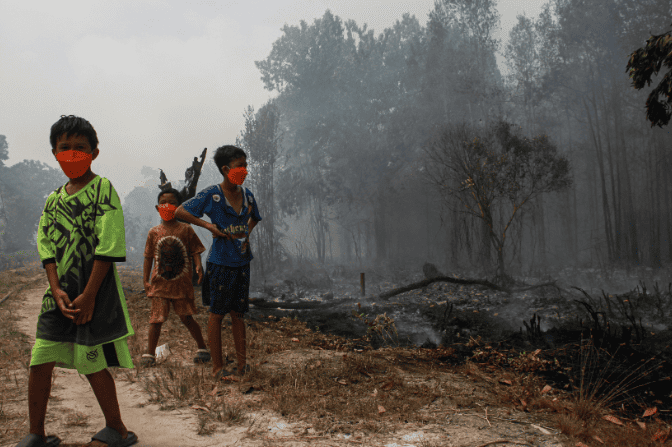
Forest and land fires (karhutla) in several parts of Sumatra and Kalimantan have the potential to develop into an international legal problem if the smoke again crosses national borders and causes impacts for Malaysia or Singapore.
International law expert at Universitas Muhammadiyah Surabaya (Umsura), Satria Unggul Wicaksana, said the phenomenon is known in international law as transboundary haze pollution, namely smoke pollution whose impacts are felt as far as the territory of another country.
“In this case, it becomes what is known in international law as transboundary haze pollution, or smoke that crosses or harms across national borders,” said Satria in an official statement on Tuesday (25/8).
According to Satria, the karhutla problem is not solely related to public health disruption in Indonesia or neighbouring countries. When the source of the fire is within Indonesia’s jurisdiction, questions arise regarding state responsibility for the impacts caused abroad.
He explained that international law recognises the principle of state responsibility. This principle can be applied when an event occurring in the territory of one country causes harm to another country.
“Because we know the hotspots are in Indonesia and cause cross-border harm, that is where state responsibility arises for an action that has implications under international law,” he said.
Satria said there are two aspects the government needs to pay attention to in dealing with this issue, namely responsibility and liability.
On the aspect of responsibility, the government must first ascertain the cause of the hotspots, including investigating whether the fires were triggered by human activity or natural and environmental factors.
However, the large number of hotspots found, according to him, means that allegations of human involvement as well as the possibility of negligence must be seriously investigated. If there is negligence or omission, the state is considered to need to be responsible for the impacts that arise.
“The first is responsibility. Our country should apologise, although this needs to be investigated first. Whether this is the work of humans or due to environmental factors,” he said.
Meanwhile, liability relates to accountability and restoration of the losses that occur. Satria stressed that restoration should not be understood merely as payment of compensation to affected parties.
“Liability, or accountability, restoration is not only in the context of monetary compensation, but also ensuring fundamental improvements or pecuniary reparation to the environmental situation itself,” he asserted.
The Dean of the Faculty of Law said the principle of responsibility for environmental damage has developed in international law, including since the 1992 Rio de Janeiro Convention. The principle has continued to develop in various international environmental law regimes.
He also touched on the principle of strict liability, or absolute responsibility for environmental harm. According to him, this principle is relevant to the state’s obligation to prevent damage as well as to carry out restoration of the affected environment.
At the national level, Indonesia also already has environmental legal instruments that regulate responsibility and restoration of environmental damage. Therefore, the handling of karhutla is considered not to be focused solely on extinguishing fires after they occur.
Law enforcement, said Satria, must also be directed at tracing the parties responsible for the burned areas, including companies or holders of permits and concessions.
“This is where the role of firmness of law enforcement officers is needed to see from the hotspot points who obtained permits or concessions from our government, whether issued by the Minister of Forestry or the Ministry of Environment,” he said.
He asked that the law enforcement process be carried out transparently and without discrimination. Tracing of hotspots must be followed by examination of the status of the area, concession holders, and the possibility of negligence in management and fire prevention.
Satria also reminded that neglect of environmental damage that impacts public health and safety could develop into a far more serious problem.
“If neglect then occurs, this is actually part of what I can directly call ecocide or ecological genocide, where the state deliberately allows its people, in quotation marks, to die through ISPA or other infectious diseases caused by environmental damage,” he asserted.
Source: jawawa.id (https://jawawa.id/newsitem/crossing-into-singapore-and-malaysia-indonesia-could-be-dragged-into-international-law-over-forest-fires-1787629815)
Originally published by Media Indonesia (https://mediaindonesia.com/politik-dan-hukum/925587/melintas-ke-singapura-dan-malaysia-indonesia-bisa-terseret-hukum-internasional-akibat-karhutla), translated from Indonesian