
Cross-Sector Regulatory Harmonisation Key to Boosting Indonesia's Marine Tourism
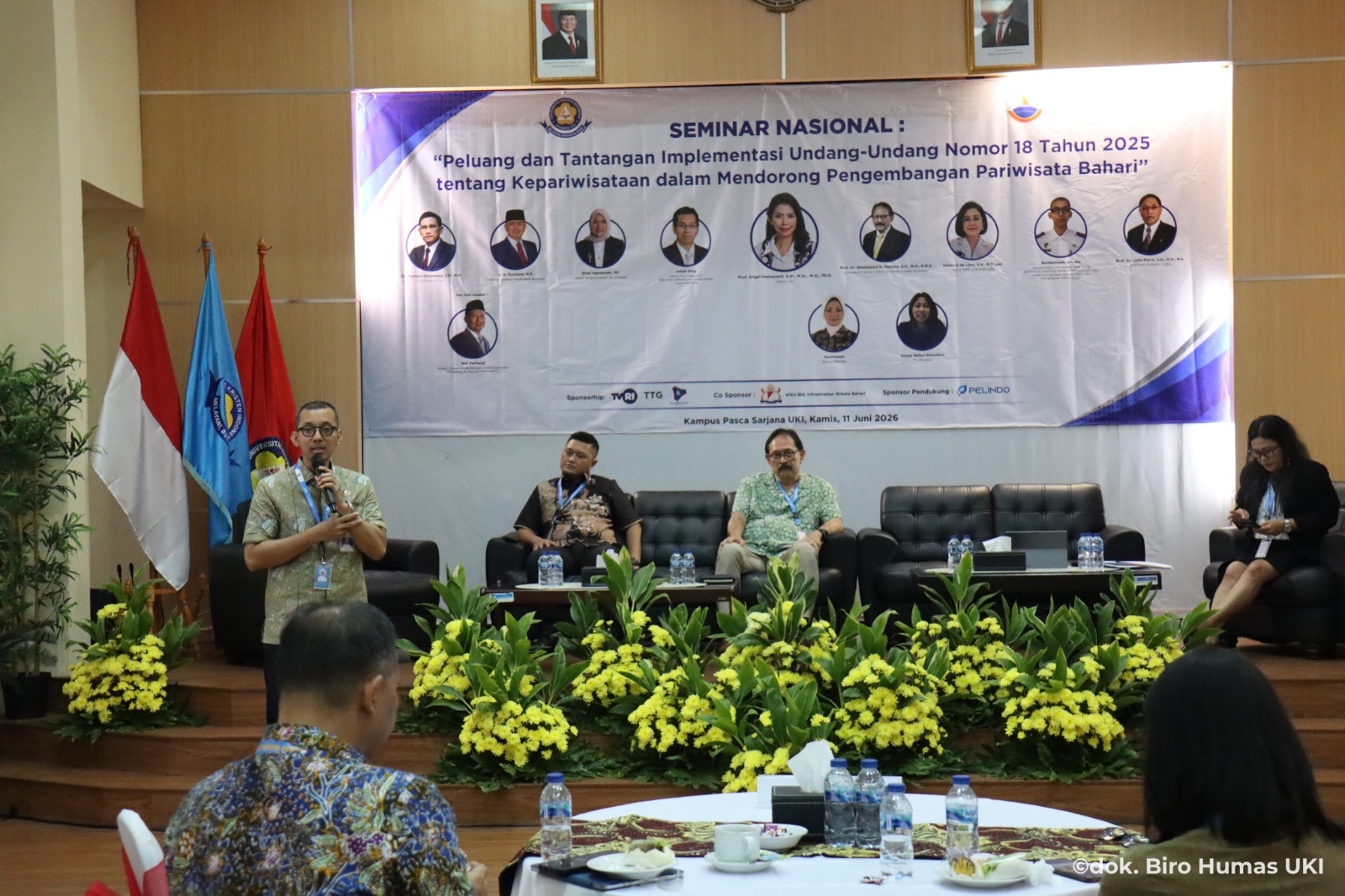
The Doctoral Programme in Law at the Faculty of Law, Christian University of Indonesia (UKI), in collaboration with the Executive Board of GAHAWISRI (Indonesian Marine and Water Tourism Entrepreneurs Association), held a national seminar themed ‘Opportunities and Challenges in Implementing Law Number 18 of 2025 on Tourism to Boost Marine Tourism Development.’ UKI Rector Prof. Angel Damayanti commended the seminar as a contribution from a higher education institution vital for formulating solutions for marine tourism development in Indonesia. ‘This national seminar is a strategic forum bringing together academics and government officials to provide policy recommendations to drive marine tourism development,’ she said during the opening on 11 June 2026 at the UKI Postgraduate Campus in Central Jakarta.
Harmonisation as the Key to Marine Tourism Development
Speaking as a resource person, UKI Faculty of Law Professor Dhaniswara K. Harjono explained that seven main regulations govern marine tourism in Indonesia. These laws are the Tourism Law, the Maritime Law, the Coastal and Small Islands Law, the Environmental Law, the Spatial Planning Law, the Investment Law, and the Environmental Protection and Management Law. ‘Overlapping cross-sector regulations create conflicts of authority between agencies. The central government can formulate national policies and supervise policy implementation at marine tourism destinations,’ he said. Dhaniswara reminded that regional governments need to develop local tourism potential and empower communities living in tourism areas. ‘Protection of the rights of coastal communities and indigenous peoples. Therefore, regulatory integration with institutional strengthening is needed to develop marine tourism potential in Indonesia,’ he explained.
Deputy Chairperson of the GAHAWISRI Executive Board, Hellen S. de Lima, stated that marine tourism is a cross-sectoral field, meaning its regulation does not fall solely within the scope of the Ministry of Tourism. Harmonisation is the key to marine tourism development. ‘Sustainable tourism is important to achieve a balance between economic growth, environmental conservation, and socio-cultural sustainability. Applying the principles of tourism sustainability not only provides long-term economic benefits such as job creation and increased regional income, but also protects biodiversity and local cultural heritage,’ she explained.
Assistant Deputy for Tourism Product Development at the Ministry of Tourism, Itok Parikesit, stated that Law Number 18 of 2025 introduces the concept of a Tourism Ecosystem as the foundation for quality and sustainable tourism development. ‘Law Number 18 of 2025 on Tourism is important because it represents a transformation from an orientation on visitor numbers towards a quality, sustainable, community-empowering, and competitive tourism ecosystem,’ said Itok Parikesit. Presidential Regulation No. 3 of 2022 defines marine tourism as nature-based tourism activities taking place in coastal and marine areas, including beach tourism, seascape tourism, and underwater tourism. According to Itok, improving the quality and quantity of tourism villages is aimed at economic growth and equitable development. ‘It is important to increase the number of tourism villages with international standards, as well as tourism digitalisation and the use of technology to improve tourism effectiveness and quality. One example is the development of the integrated ’Event by Indonesia’ platform for business and leisure events to facilitate access to event information in Indonesia,’ he said.
Furthermore, Head of the Legal and Cooperation Division at the Secretariat of the Directorate General of Sea Transportation, Ministry of Transportation, Nurdiansyah, stated that the biggest challenge in implementing Law No. 18 of 2025 is that many tourism business operators still use traditional vessels. ‘Currently, there is a presidential regulation on the empowerment of traditional vessels. Cross-ministerial policy synergy is needed to support the shipyard industry. The operation and safety of traditional vessels are regulated by the Ministry of Transportation,’ he revealed. The national seminar was also attended by GAHAWISRI Chairman Ismail Ning; representatives from the Directorate General of Marine Management, Ministry of Marine Affairs and Fisheries; Deputy for Industry and Investment at the Ministry of Tourism, Rizki Handayani; Head of the UKI Doctoral Law Programme, Prof. John Pieris; and Acting Dean of the UKI Faculty of Law, Dr. Tomson Situmeang.