
Cross-Sector Collaboration Key to Restorative Economy and Women's Role
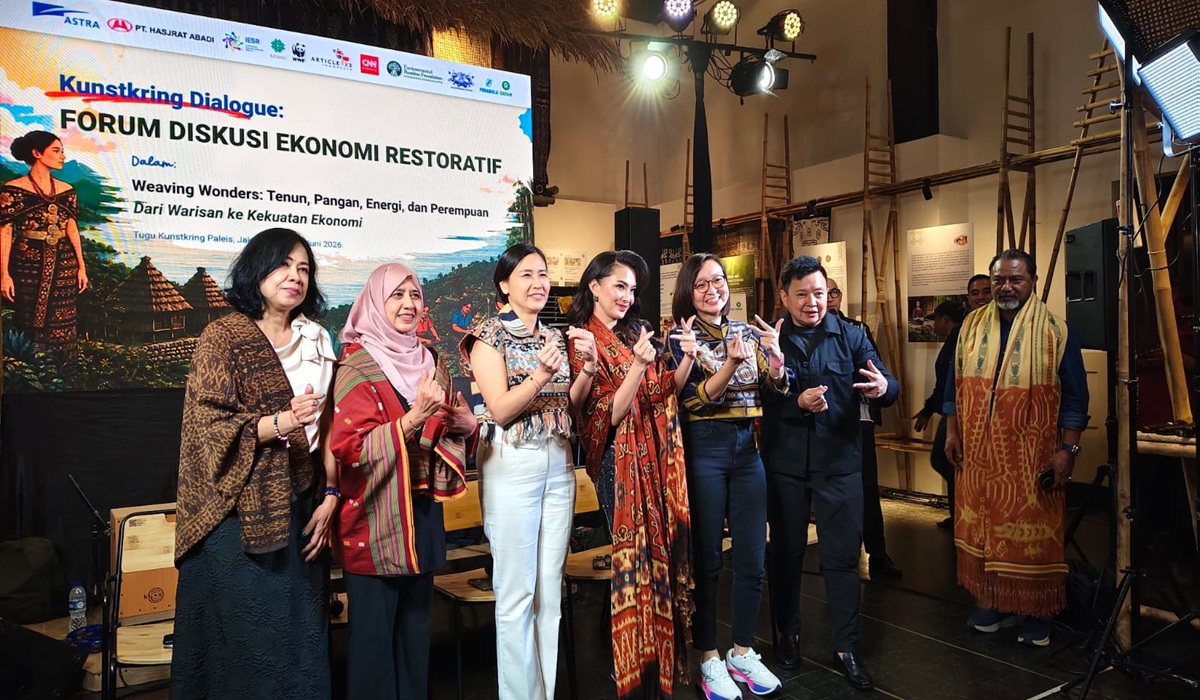
Commitment to collaboration from cross-sector stakeholders is a crucial factor for developing a restorative economic ecosystem in Indonesia, placing women as the main agents of development. This was one of the key recommendations from the ‘Kunstkring Dialogue: Restorative Economy Forum’, held from 24 to 26 June 2026 at Tugu Kunstkring Palais, Jakarta.
The forum, initiated by the Bambu Lingkungan Lestari Foundation (YBLL) together with Penabulu-Oxfam, aimed to unite ideas and commitments from policymakers, academics, practitioners, and indigenous communities to strengthen the role of women in a sustainable economy.
Deputy Minister for Women’s Empowerment and Child Protection (PPPA), Veronica Tan, stressed that efforts to empower women will never be achieved if carried out in a fragmented and partial manner. ‘For example, the authority and capability of the Ministry of Women’s Empowerment and Child Protection are limited. There are authorities in other ministries that will greatly help promote women’s empowerment and the restorative economy,’ said Veronica.
In agreement, Penabulu Foundation Programme Director Rini D. Nasution stated that her organisation invites various parties to collaborate in building an ecosystem that supports women. ‘By strengthening the civil society ecosystem, Penabulu Oxfam invites stakeholders to collaborate in building a restorative economic ecosystem that encourages women as local leaders, rights holders, managers of productive assets, and agents of change in their communities,’ explained Rini.
Beyond collaboration, the forum also recommended policies that position women as key actors, not merely objects of development. Veronica Tan presented data showing that although 80 per cent of Micro, Small, and Medium Enterprises (MSMEs) in Indonesia are dominated by women, they remain marginalised and have not gained equal access to prosperity. ‘Talking about Golden Indonesia must be primarily sourced from access for women, not only as beneficiaries but also as subjects of change. Women must have equal access to basic services, education and health, as well as natural resources,’ Veronica asserted.
The strategic position of women was also emphasised by Deputy Minister of Tourism Ni Luh Puspa. ‘Women are the heart of restorative tourism. How women in villages become centres of environmental conservation and drivers of the family economy is the real strength of the restorative economy,’ she said.
Various concrete programmes have been implemented to address the obstacles faced by women. These include the Women’s Food Gardens (KPP) initiated by the Ministry of PPPA, a bamboo agroforestry programme, and Social Forestry specifically for Women in East Nusa Tenggara (NTT). These programmes focus on environmental conservation, food security, improving welfare, and strategies to reduce stunting and poverty rates.
Governor of North Maluku, Sherly Tjoanda, acknowledged the challenges faced by women, particularly the clash with domestic work. ‘The Provincial Government and the Ministry of Forestry are currently working to provide production land from the social forestry programme. This land can then be used by women’s groups to produce food and support family economic empowerment,’ she said, mentioning that similar programmes will be expanded to North Maluku.
Director General of Social Forestry, Catur Endah Prasetiani, explained that the social forestry programme is affirmative in nature to address inequality in access to land, capital, and markets. Although based on family card administration which is sometimes biased, breakthroughs have been made. One successful example is in NTT. ‘In fact, women who work accessing forest areas are double the number of men. However, there is already one Social Forestry Decree in NTT covering 648 hectares granted to 335 people, of whom 310 are women,’ said Catur.
Chair of the Bambu Lingkungan Lestari Foundation (YBLL), Monica Tanuhandaru, stated that this dialogue forum is part of the exhibition ‘Weaving Wonders: Weaving, Food, Energy, and Women — From Heritage to Economic Strength’ organised by the Uma Nusantara Foundation. The presence of a large number of public officials as panellists demonstrates a high level of commitment to this issue. In addition to public officials, the forum was also attended by academics, entrepreneurs, representatives of indigenous communities, and young innovators in the restorative economy field such as Spedagi, Conservana, Collabit, Kagounga, and Bamboocoop.