
Critical Mineral Processing Opens Opportunity for Indonesia to Dominate Global Supply Chains
JAKARTA — Downstream processing of critical minerals offers Indonesia an opportunity to increase industrial value added while strengthening its position in global supply chains. Processing nickel ore into certain battery products could generate up to 642 times more value than the raw material.
Industry Ministry data show that nickel ore worth about US$30 per tonne can rise in value to US$3,628 per tonne after being processed into mixed hydroxide precipitate (MHP), a battery raw material. This represents an increase of around 120 times, while at certain battery-product stages the value added could reach 642 times.
M Rachmat Kaimuddin, managing director for development investment at PT Danantara Development Management Fund (DDMF), said increasing the value of minerals required more than building processing facilities. Industrial development also needed co-ordinated investment, stronger domestic capabilities and supply chains able to support manufacturing.
“To achieve optimal value added from critical minerals, processing capacity alone is not enough. Co-ordinated investment, stronger domestic capabilities, resilient supply chains and partnerships capable of mobilising capital for development financing and private investment are needed,” Rachmat said in a press release on Friday (23 October 2026).
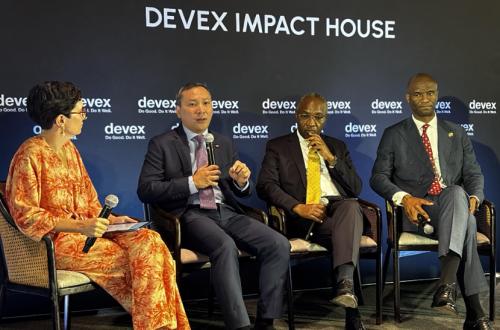
Rachmat made the remarks at a panel discussion, ‘Critical Minerals and Economic Transformation in the Global South’, in Bangkok, Thailand, in mid-October. The discussion was part of the annual meetings of the International Monetary Fund (IMF) and the World Bank. The forum examined how developing countries could secure greater economic benefits from managing critical minerals.
For decades, many developing countries have served as suppliers of raw materials, while greater economic value has been captured through further processing, manufacturing and distribution. The growth of low-carbon industries offers mineral-producing countries an opportunity to play a larger role in global production chains.
International Energy Agency (IEA) data presented in the discussion materials showed that the energy sector accounted for about 75 per cent of growth in demand for major critical minerals in 2025. The increase was driven mainly by electric vehicles, energy storage, power grids and solar-power technology.
Indonesia holds an important position in global mineral supply, particularly for nickel. Data from the US Geological Survey (USGS) show that Indonesia was the world’s largest mined-nickel producer in 2024, accounting for about 62 per cent of global production.
However, high mineral output does not automatically translate into substantial domestic industrial value added. Non-oil and gas mining and quarrying accounted for about 3 per cent of gross domestic product (GDP), while basic metal manufacturing contributed around 1 per cent.
Developing processing industries is one way to increase the economic benefits generated by these mineral resources. Indonesia’s National Economic Council (DEN) estimates that exports of downstream products will reach US$50 billion by the end of 2026, up around 45 per cent from US$34.5 billion in 2024.
Alongside export growth, battery manufacturing offers a further investment opportunity. The Energy and Mineral Resources Ministry (ESDM) estimates that Indonesia’s battery demand will reach 108.2 gigawatt-hours by 2030.
To support electric-vehicle development targets, required battery capacity is projected to reach 780 gigawatt-hours. Available raw-material capacity is currently equivalent to 373 gigawatt-hours, leaving a projected shortfall of about 407 gigawatt-hours.
This highlights the importance of investment across the battery supply chain. In addition to mineral-processing facilities, stronger technology, manufacturing and domestic industrial capabilities are needed to ensure that economic benefits do not come solely from raw-material exports.
At the discussion, Rachmat also shared Indonesia’s experience in mineral downstreaming with participants from ASEAN and Africa. Both regions are seeking to increase the value added to their minerals and expand the role of producing countries in global industries.
The forum also featured Stephen Njuguna Karingi, director of the Macroeconomics and Governance Division at the United Nations Economic Commission for Africa; Patrick Ndzana Olomo, head of economic policy and sustainable development at the African Union Commission; and Ery Wijaya, chief executive of Lestari Advisors Indonesia.
Critical-mineral development needs to be accompanied by investment that increases production capacity, productivity and technological expertise. In this way, downstream processing can not only boost export value but also create jobs and develop higher-value industries at home.