
Crisis Worsens, Parliament Grants President Authority to Deploy Military on Roads
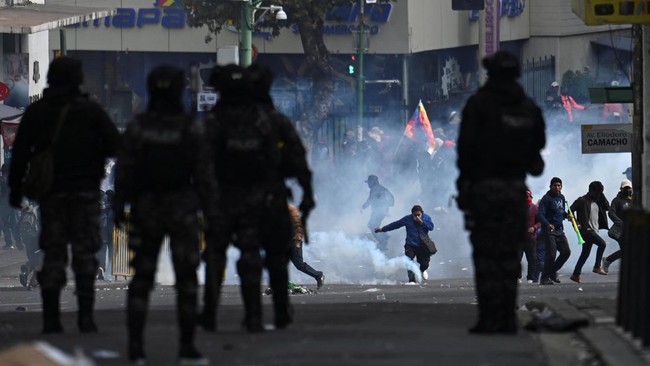
The political crisis in Bolivia has entered a new phase after the country’s parliament approved a law granting President Rodrigo Paz greater authority to deploy the military to dismantle road blockades established by anti-government demonstrators. This step reinforces the government’s hardline stance in facing the wave of protests that has persisted for several weeks.
The law was passed by the Bolivian Lower House on Sunday (07/06/2026) local time following an overnight debate. The regulation had previously received approval from the Senate and now awaits President Paz’s signature to officially take effect.
“This law is hereby passed,” stated the President of the Chamber of Disputies, Roberto Castro, when announcing the voting results, as reported by Al Jazeera.
The ratification of the regulation occurs amidst rising political and social tensions in Bolivia. Over the past few weeks, various community groups have taken to the streets demanding the resignation of President Paz.
Rodrigo Paz, a centre-right leader supported by the United States, is currently facing large-scale demonstrations led by farmers, miners, transport unions, and other social groups. The demonstrators are protesting various government economic policies, including the removal of fuel subsidies which has triggered an increase in energy prices. The unrest was also sparked by rising inflation, low wage levels, and the deteriorating economic conditions felt by the public.
As a form of pressure against the government, demonstrators have established approximately 100 road blockades across various regions of Bolivia in recent weeks. The government stated that these blockades have disrupted the distribution of essential goods and caused shortages of basic necessities. According to Bolivian authorities, the road closures in various areas have triggered food and medicine shortages due to hindered logistics distribution.
Tensions on the ground continue to escalate. On Saturday, dozens of anti-riot police supported by military vehicles fired tear gas while attempting to clear a blockade in the city of San Julian. AFP reported that demonstrators retaliated by throwing stones and burning tyres to halt the progress of security forces.
To date, the Bolivian military has officially only played a supporting role to the police in security operations during demonstrations. However, the new law significantly expands the army’s authority. The newly passed regulation allows military personnel to use force against demonstrators during operations to disperse blockades or secure territories. Furthermore, the law provides what is described as a presumption of legality for soldiers on duty during conflict situations. Under this provision, the actions of military personnel will be considered legally valid unless evidence proves otherwise.
This policy emerges just one month after the Bolivian parliament repealed a 2020 law that previously limited the use of the military to handle public demonstrations. The Paz administration argues that such steps are necessary to restore stability and ensure the smooth distribution of basic necessities amidst the ongoing economic crisis.
Since being elected president last year, Paz has pursued a pro-business economic agenda, promising to lead Bolivia out of its prolonged economic crisis. However, various reform policies implemented by the government have instead triggered resistance from several community groups who feel burdened by the rising cost of living.
Amid increasing domestic pressure, Paz has also received overt support from Washington. The administration of US President Donald Trump, through a regional coalition known as the “American Shield,” has expressed its support for the Bolivian government in facing the protests. Members of the alliance assess that the road blockades have hindered the distribution of essential needs to the Bolivian people.
“We stand with the democratic Paz administration against attempts to drag Bolivia backward through cynical actions that prevent the delivery of food, medicine, and other vital supplies to the Bolivian people through false road blockades,” stated a member of the alliance. This support further reinforces the position of the coalition, which has been pushing for a tougher approach to various security and order issues in the Latin American region.
Source: jawawa.id (https://jawawa.id/newsitem/crisis-worsens-parliament-grants-president-authority-to-deploy-military-on-roads-1780914868)
Originally published by CNBC Indonesia (https://www.cnbcindonesia.com/news/20260608153002-4-741087/krisis-memburuk-parlemen-beri-restu-presiden-gunakan-militer-di-jalan), translated from Indonesian