
Creative economy seen as alternative employment for 82 percent of Gen Z unemployed
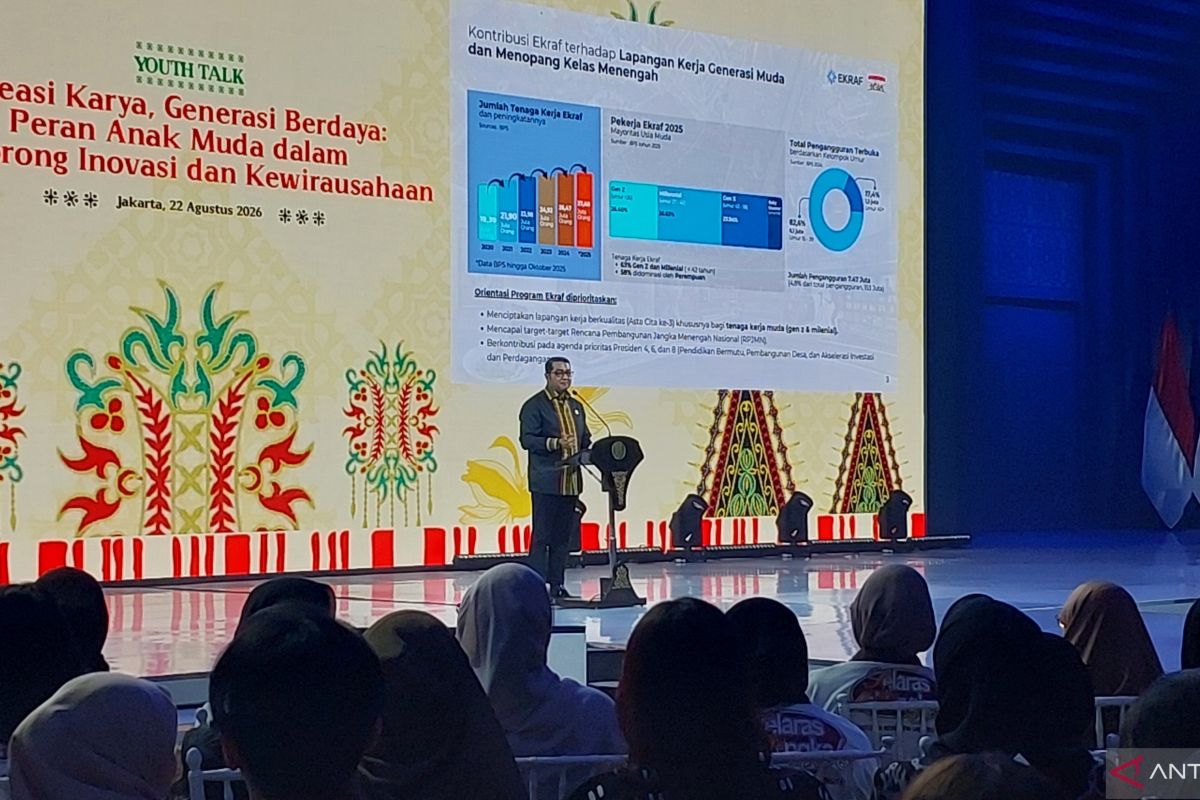
The Creative Economy Ministry (Kemenekraf) sees the creative economy sector as a viable alternative source of employment for young people, particularly given the high proportion of Gen Z and millennials among the unemployed.
Creative Economy Minister Teuku Riefky Harsya said around 82 percent of Indonesia’s 7.5 million unemployed are from Gen Z and millennial cohorts, while 63 percent of the 27.4 million workers in the creative economy sector come from those two generational groups.
“So in fact the creative economy can contribute to reducing open unemployment, 82 percent of which is Gen Z and millennials,” Riefky said in his remarks at the 2026 Karya Kreatif Indonesia (KKI) event in Jakarta on Saturday.
According to Riefky, the creative economy sector has characteristics that match the preferences of today’s young generation. Gen Z and millennials are seen as tending to seek work that aligns with their interests or passions, offers flexibility, and provides competitive income opportunities.
Riefky added that the creative economy sector also has a continually growing labour absorption capacity. Each year, around 1 million to 1.5 million people enter employment in the creative economy sector.
“Every year, data from BPS shows between 1 and 1.5 million people enter employment in the creative economy sector,” he said.
Riefky said young people in creative economy development are positioned not only as targets of development, but also as key actors who create works and build new businesses.
Currently, the creative economy sector contributes around 7.38 percent to national gross domestic product (GDP). The government is optimistic that this contribution can exceed 8 percent before 2029.
To enlarge that contribution while opening new employment opportunities, the government has issued a Presidential Regulation on the Creative Economy Master Plan (Rindekraf) 2026-2045, which encompasses 21 creative economy subsectors.
These creative economy subsectors include fashion, culinary, crafts, games, applications, film, and music, which are designated as priority subsectors for contributing to GDP.
In addition, the government is encouraging the development of new technology- and digital-based subsectors, such as artificial intelligence (AI), blockchain, Web3, cyber security, digital content, content creators, affiliates, and live-streaming-based commerce.
“In its implementation, young people are positioned not merely as targets of creative economy development, but are given a role as key actors in strengthening the creative economy ecosystem,” he said.
He said the government is also continuing to build the ecosystem through talent development, creative infrastructure, access to financing, and market expansion.
With such support, young people are expected to develop their creativity into intellectual property and economically valuable activity.
“Rindekraf is the direction, young people are the talent, and the creative economy is the space to grow and thrive,” Riefky said.
Source: jawawa.id (https://jawawa.id/newsitem/creative-economy-seen-as-alternative-employment-for-82-percent-of-gen-z-unemployed-1787395983)
Originally published by Antara (Indonesian) (https://www.antaranews.com/berita/5706689/ekraf-jadi-alternatif-lapangan-kerja-bagi-82-persen-pengangguran-gen-z), translated from Indonesian