
Creative Economy Ministry outlines funding schemes to boost ecosystem
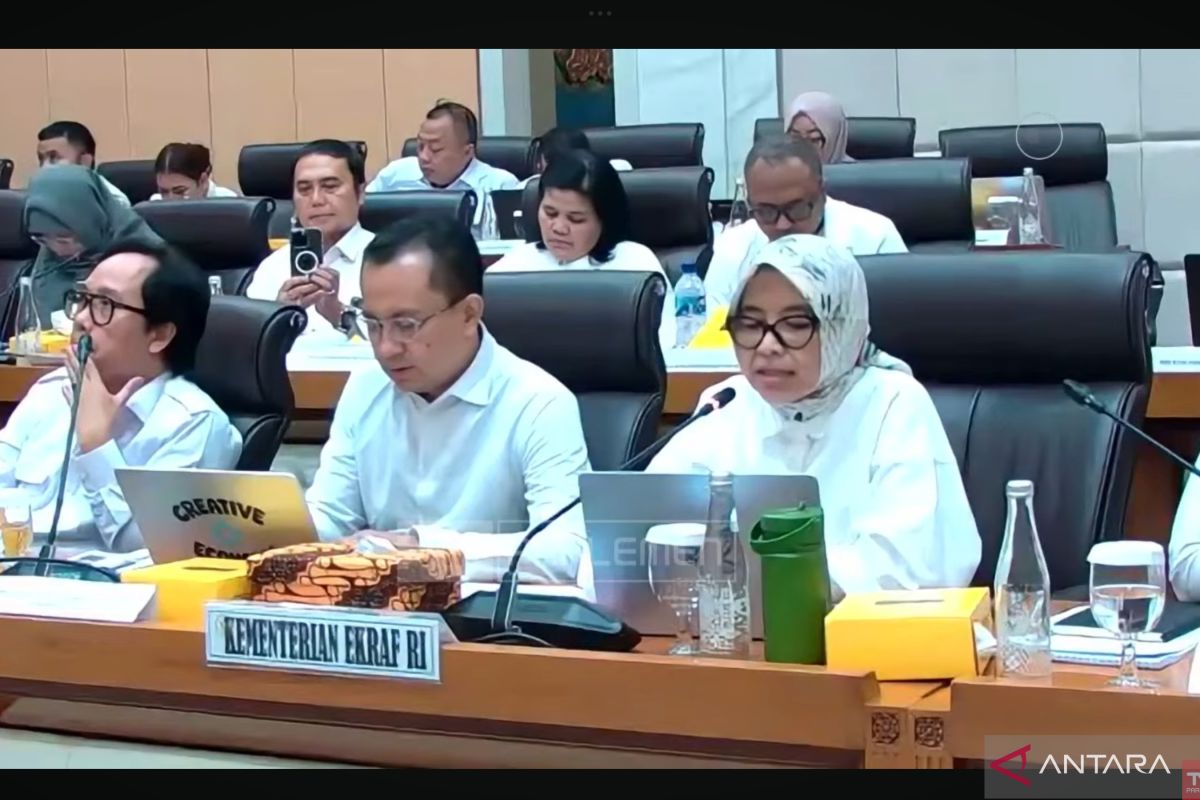
Jakarta (ANTARA) - Secretary of the Creative Economy Ministry Dessy Ruhati stated that the implementation of financing and capital in the creative economy ecosystem can be driven by schemes that develop a sustainable ecosystem and match business maturity. Dessy explained that the instrument being promoted by the ministry is People’s Business Credit (KUR), which has reached tens of thousands of business actors with a continuously increasing financing value. “This shows that KUR remains a primary instrument for developing creative economy MSMEs. However, for us, the success of KUR is not solely measured by the amount of credit disbursed,” Dessy said during a hearing with House of Representatives Commission VII on the theme of “Access to Financing and Capital”, followed online in Jakarta on Monday. Dessy noted that as of the first half of 2026, creative economy KUR had reached 93,182 business actors with a total financing value of Rp5 trillion. However, from the KUR that has been disbursed, real success can only be seen if the financing is able to increase business capacity, expand markets, and encourage business actors to upgrade. Dessy said that besides KUR, an alternative funding scheme being promoted to boost the creative economy ecosystem is security crowdfunding. This scheme has raised total funds of Rp36 billion involving 19 creative economy businesses, providing opportunities for creative businesses with good prospects to obtain direct funding from the public through platforms regulated by the Financial Services Authority (OJK). “The development of financing through this scheme shows that the public is increasingly confident in Indonesia’s creative businesses. Going forward, we will continue to promote this scheme as an alternative financing option that complements the existing system,” Dessy revealed. Meanwhile, for businesses that have grown larger, Dessy assessed that the capital market is a suitable financing access point for a healthier and more sustainable business maturity level. She said the entry of creative economy players into the capital market is an indicator that Indonesia’s creative businesses have increasingly better competitiveness. This proves that there is a financing and capital pathway that allows businesses to develop from start-ups, obtain KUR, grow through investment, to being able to raise public capital. “Thus, the success of financing does not stop when the credit is disbursed, but is measured by the business’s ability to grow sustainably,” she said. Dessy also mentioned that applying the principle of “Right Financing for the Right Business Stage” can serve as a benchmark for business actors to obtain the type of financing that matches their business maturity level. Looking ahead, she said the development of the creative economy ecosystem is no longer solely about the availability of funding sources but about building interconnections between these various schemes so that business actors can find the financing pathway most suited to their needs.