
Cracked Earth in Kalimantan: IPB Professor Responds to Fears of Desertification
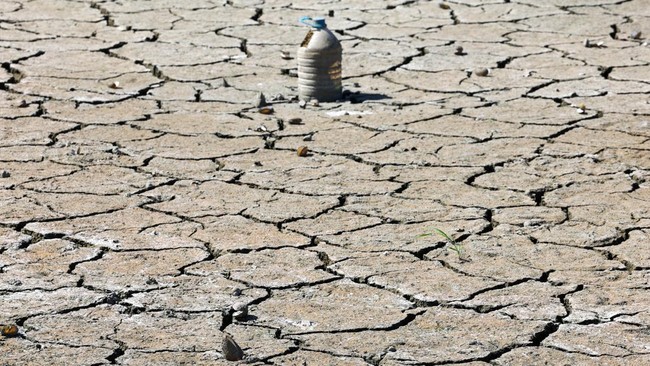
Cracks have appeared in the ground in Dusun Limus, West Kalimantan. The pattern loosely resembles cracked earth found in arid regions of Africa.
The phenomenon does not mean that land in Kalimantan has turned into a desert. Ground cracks can form through natural processes when soil or mud sediment loses water and contracts.
Widiatmaka, Professor in the Department of Soil Science and Land Resources at the Faculty of Agriculture, IPB University, explained that cracking generally occurs in soil or materials containing clay. As these materials lose water, they shrink and create tension until the surface breaks.
He said the most common cause is the drying of clay-bearing soil or sediment. As the material shrinks, its contraction is restrained by the layer beneath it or by surrounding material.
“The tension that emerges then causes the surface to break into a crack pattern,” he said, in a written statement cited on Tuesday (8 October 2026).
According to him, drying can be triggered by a range of conditions, including reduced rainfall, high evaporation, receding floodwaters, or changes in drainage.
Cracks may also be linked to subsidence or ground movement.
In the case of Dusun Limus, he considered the reasonable initial hypothesis to be that the soil or sediment had dried out and contracted. However, the specific cause cannot be confirmed without field inspection.
“It cannot yet be determined whether the drying is mainly due to dry weather, receding floodwaters, or changes in water management and land use,” he said.
He added that the resemblance to African cracked earth should be viewed carefully. The basic mechanism may be similar, in that the material loses water and shrinks. However, environmental conditions and triggering factors are not necessarily the same.
“It is more accurate to describe it as resembling cracked earth in African arid regions, not as evidence that land in Kalimantan has become a desert,” he stressed.
He said drought can be a strong trigger, particularly when water supply falls and evaporation increases. However, the contribution of drought or climate change to the event still needs to be proven through field data and rainfall records.
Human activity may also accelerate drying. He said land clearing can reduce shade, while changes in drainage, water extraction, or mining activity can alter water conditions. However, the involvement of such activities in this case has not been proven.
He noted that ground cracks are not always an environmental threat. However, if cracks recur, spread, are accompanied by land subsidence, vegetation die-off, or a reduction in water sources, the conditions warrant further study.
“Cracks alone are not enough to conclude that there is a serious threat. The condition of the soil, water and land use needs to be examined first,” he concluded.