
CPO Prices Drop, Positive News from India Fails to Provide Support
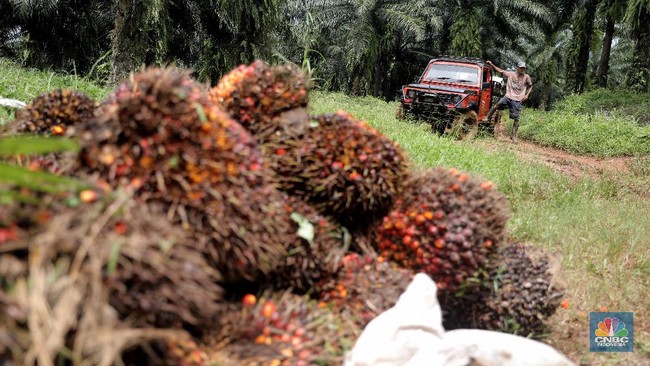
Crude palm oil (CPO) prices were under pressure again at the end of trading this week. Concerns regarding rising stocks in Malaysia, driven by increasing production and weakening exports, have become the primary downward pressure on CPO prices.
According to Refinitiv data, the benchmark CPO contract closed at 4,672 Malaysian Ringgit (MYR) per tonne on Friday (25/09/2026). This price represents a 2.10% drop compared to the previous day’s close of MYR 4,772 per tonne.
On a weekly basis, the pressure was even more profound. CPO prices fell by 4.61% compared to the previous Friday’s (18/09/2026) close of MYR 4,898 per tonne, marking the lowest closing level in over seven weeks.
This sharp decline follows a period in August when CPO prices briefly breached the MYR 5,000 per tonne mark. Refinitiv data shows that CPO prices reached MYR 5,018 per tonne on 21 August 2026, before reversing downwards to current levels.
Malaysian Stocks Pose a Threat
The primary pressure stems from concerns over rising palm oil inventories in Malaysia. Malaysian CPO production continues to increase monthly in September, even as the world’s second-largest producer begins to face below-normal rainfall due to El Niño.
Simultaneously, export demand has weakened. Intertek Testing Services (ITS) data shows that Malaysian palm oil exports between 1–20 September fell by 15.1% to 887,557 tonnes, down from 1.05 million tonnes during the same period last month.
The decline is particularly evident in several key markets. Exports to the European Union dropped to 184,372 tonnes from 284,061 tonnes, while shipments to China fell to 55,000 tonnes from 94,800 tonnes. Conversely, exports to India and the subcontinent rose slightly to 199,630 tonnes from 193,620 tonnes.
The combination of high production and weakening exports suggests that inventories could rise again. Industry players estimate that Malaysian stocks could exceed 3 million tonnes by the end of September, up from 2.82 million tonnes in August, which was already an eight-month high. Reuters also noted that Malaysian monthly stocks have only breached the 3 million tonne mark five times.
Furthermore, Anilkumar Bagani, Head of Research at Sunvin Group, predicts that stocks could exceed 3.1 million tonnes by the end of September if higher-than-expected production continues alongside weak exports.
India Cuts Import Duties, Yet CPO Remains Unsupported
Regarding demand, there was a positive catalyst after India slashed import duties on vegetable oils ahead of the festival season. India is the world’s largest importer of vegetable oils and relies on imports for approximately two-thirds of its requirements.
The Indian government reduced the basic customs duty on CPO to 5% from the previous 10%. The tariff on refined palm oil was also lowered to 27.5% from 32.5%. This policy, effective from 24 September, aims to curb domestic vegetable oil prices.
In theory, the tariff reduction makes CPO imports cheaper and could potentially stimulate demand. However, this sentiment has not been sufficient to offset market concerns regarding high inventories.
The Edge Malaysia predicts that Indian purchasing may slow down following aggressive buying in August and September. Additionally, the price spread between palm oil and soybean and sunflower oils is narrowing, providing Indian buyers with greater incentives to switch to alternative vegetable oils.
Additional pressure comes from competing vegetable oils. On Friday, soybean oil prices on the Chicago Board of Trade fell by 1.13%. CPO price movements often track other vegetable oils as these commodities compete in the global vegetable oil market.
Weakening global crude oil prices also present a challenge. Oil prices fell as markets weighed the possibility of a US-Iran ceasefire amidst concerns over Houthi attacks on Saudi Arabia. The decline in crude oil makes CPO relatively less attractive as a feedstock for biodiesel.
El Niño Could Support Prices
While short-term sentiment remains bearish, the risk of El Niño could serve as a support factor for CPO in the medium term.
Malaysia has experienced below-normal rainfall due to El Niño. However, the impact on production is not yet significant, as weather changes typically require time before affecting palm tree productivity. Industry players expect the impact to become clearer by mid-2027.
Similar risks are evident in Indonesia. The meteorological agency predicts the rainy season in most parts of Indonesia will start in early November, later than the previous October projection. Approximately 61% of Indonesia’s territory is expected to experience a delayed rainy season, with El Niño expected to remain strong until the first quarter of 2027. A palm oil analyst estimates that Indonesian palm production in 2027 could potentially decrease by 2%–8% due to this year’s drought.
MBSB Investment Bank maintains its projection of an average CPO price of MYR 4,400 per tonne for 2026. The investment bank believes that sustained dry conditions could potentially suppress fresh fruit bunch productivity and tighten the CPO supply in 2027.
Consequently, CPO sentiment is currently divided. In the short term, rising production, surging Malaysian stocks, weak exports, and falling prices of competing vegetable oils continue to exert pressure. In the medium term, however, the risk of production declines due to El Niño has the potential to tighten supply and support prices.
Source: jawawa.id (https://jawawa.id/newsitem/cpo-prices-drop-positive-news-from-india-fails-to-provide-support-1790470386)
Originally published by CNBC Indonesia (https://www.cnbcindonesia.com/research/20260927053106-128-771178/harga-cpo-merosot-kabar-baik-dari-india-tak-mampu-jadi-penopang), translated from Indonesian