
CPO Prices Could Climb to US$1,720, Here's Why
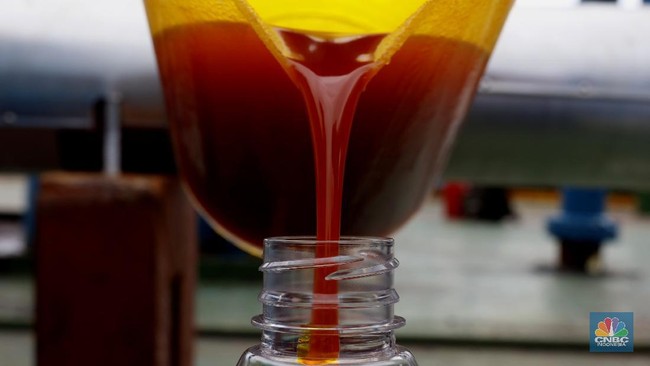
Global crude palm oil (CPO) prices are projected to continue rising in 2027. Executive Director of the Palm Oil Agribusiness Strategic Policy Institute (PASPI), Tungkot Sipayung, estimates that world CPO prices next year will be in the range of US$1,650–US$1,720 per tonne.
“In 2027, the world palm oil market is projected to experience a higher excess demand than in 2026, which is expected to push world palm oil prices still higher than 2026 prices. World CPO prices in 2027 are estimated at around US$1,650–US$1,720 per tonne,” Tungkot told CNBC Indonesia on Monday (31/8/2026).
According to Tungkot, the increase in CPO prices is mainly influenced by world palm oil production, which is expected to be lower in 2027. He said world CPO production, which reached 85.4 million tonnes in 2025, is estimated to fall to 85.2 million tonnes in 2026, and to decline again to around 83.6 million tonnes in 2027.
The production decline, he said, is the impact of El Niño, which has hit Indonesia and Malaysia since the third quarter of 2026 and is expected to continue until the first quarter of 2027, or even the second quarter of 2027.
“The impact of El Niño on Indonesian palm oil production has already begun to be visible in the fourth quarter of 2026, and the greatest impact will occur throughout 2027,” he said.
Tungkot said Indonesia, as the world’s largest palm oil producer and exporter, is also expected to experience a production decline. Indonesia’s CPO production of 51.6 million tonnes in 2025 is projected to fall to around 49.2 million tonnes in 2026 and to decline again to around 47.6 million tonnes in 2027.
A production decline is also occurring in Malaysia, from around 20.2 million tonnes to around 19.5 million tonnes in 2026.
B50 Drives Indonesian CPO Consumption
In addition to the production decline, the increase in Indonesia’s domestic consumption for B50 biodiesel is also a factor driving excess demand in the world palm oil market.
Even without El Niño, Tungkot said Indonesia’s biodiesel mandatory policy has already become an important variable in influencing world CPO prices. With the occurrence of an extreme El Niño, its impact on world palm oil prices is considered even greater.
For 2026, B50, which began on 1 July 2026, requires around 14 million tonnes of CPO. Meanwhile, CPO needs for food are around 10.2 million tonnes and for oleochemicals around 2.2 million tonnes. Thus, Indonesia’s total domestic CPO consumption in 2026 is estimated to reach around 26–27 million tonnes, up from around 24.6 million tonnes in 2025.
Tungkot said that if B50 is fully implemented in 2027, CPO needs for B50 are estimated to reach around 18 million tonnes. With Indonesia’s CPO production projected at only around 47.6 million tonnes, the volume of CPO available for export is certain to be even smaller.
Gapki: CPO Prices Also Influenced by Other Vegetable Oils
Chairman of the Indonesian Palm Oil Association (Gapki), Eddy Martono, said CPO price movements do not depend solely on palm oil supply. The supply of other vegetable oils is also a factor influencing prices.
“Whether CPO prices rise or not depends on the supply of other vegetable oils such as sunflower, soybean oil, rapeseed and canola. If the supply of other vegetable oils is good, it will also put pressure on vegetable oil prices, including palm oil,” Eddy said when contacted separately.
On the domestic supply side, Eddy said CPO stocks at the end of 2026 should still be in the range of 2.5–2.9 million tonnes and there has been no supply tightening.
“End-of-2026 stocks should still be around 2.5–2.9 million tonnes. There is no supply tightening,” he said.
However, 2027 production still has the potential to decline. Based on reports from Gapki branches, a number of regions such as Aceh, North Sumatra, West Sumatra, Bengkulu and North Kalimantan are still experiencing rain.
“I have received reports from the branches that Aceh, North Sumatra, West Sumatra, Bengkulu and North Kalimantan still have rain. So there remains a possibility that 2027 production will decline, because some areas still have rain. The decline is around 3 million tonnes,” he said.
For 2026, Eddy confirmed that production is still sufficient to support B50.
“This year, 2026, means there is no problem with B50 this year,” he said.
Gapki data also shows that CPO and PKO production in January–June 2026 is still growing. Total production reached 30.284 million tonnes, up 15.82% compared with the same period in 2025 of 27.889 million tonnes.
However, consumption and exports also increased. Total domestic consumption in January–June 2026 reached 12.994 million tonnes, up 5.48% year-on-year. Meanwhile, total exports reached 16.595 million tonnes, up 5.79%.
With beginning-of-year stocks of 2.068 million tonnes, total production of 30.284 million tonnes, domestic consumption of 12.994 million tonnes, exports of 16.595 million tonnes, and imports of 32 thousand tonnes, end-of-June 2026 stocks were recorded at 2.844 million tonnes.