
CPI Invites Government and MPR to Discuss Climate Issues Through EKONIKLIM, Here Are the Results
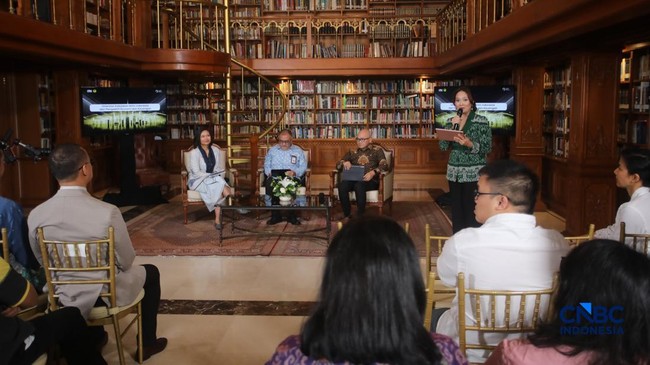
In an effort to raise public awareness of the important links between economic issues—including development, growth, and the financial industry—and environmental issues—including climate change, land use, and energy transition—Climate Policy Initiative (CPI) held the EKONIKLIM Talkshow 2026 with the theme ‘Orientation of Indonesia’s Climate Policy from an Economic and Financial Perspective’ at Wisma Habibie Ainun.
CPI Indonesia economist Albertus Prabu Siagian said that although climate change can hinder development, with the right measures climate change mitigation projects can also become opportunities to drive development through job creation, technological innovation, and new sources of investment. The energy transition can also simultaneously strengthen national energy security.
‘The EKONIKLIM Talkshow 2026 is just one part of CPI’s public initiative called EKONIKLIM. We invite anyone interested in these issues to watch our podcasts, documentary films, and books, which are available more fully on the EKONIKLIM YouTube channel and the CPI website,’ said Prabu, who is also the producer of EKONIKLIM.
Climate change has become a serious challenge that cannot be underestimated. The impacts of the climate crisis are now being felt directly by the public amid increasing extreme weather and hydrometeorological disasters in various regions of Indonesia.
The event was opened by Deputy Speaker of the People’s Consultative Assembly (MPR) Eddy Soeparno, who explained that these natural phenomena are a consequence of high carbon emissions. This has triggered climate change and massive environmental degradation.
‘Today we are talking about climate problems. The climate problems today are not ordinary. If we look from 1970 until now, Indonesia has experienced an average climate increase of more than 6% per year. From 1970 until now, we can feel that the temperature rise has been very drastic. When it rains, the rain is never ordinary,’ he said.
Eddy also gave the example that the series of disasters that occurred in late 2025 in Aceh, North Sumatra, West Sumatra, and as far as West Java and Central Java were real impacts of climate change and environmental damage. He also noted that climate change has affected the melting of snow on the Jayawijaya Mountains in Papua. Currently, only 5% of the snow remains there and it is predicted to disappear completely by 2027.
Amid increasingly complex climate change challenges, Indonesia must strengthen its commitment to the energy transition agenda. Moreover, in addition to being blessed with the world’s largest tropical forests and abundant mangrove ecosystems, Indonesia is also rich in renewable energy potential.
With this wealth of natural resources, Indonesia has great potential as a major player in the carbon market ecosystem. Deputy for Climate Change Control and Carbon Economic Value Governance at the Ministry of Environment, Ary Sudijanto, explained that the development of the carbon market must not disrupt the national emission reduction target or Nationally Determined Contribution (NDC). The government is currently preparing a carbon trading roadmap that will be developed alongside the NDC achievement roadmap.
‘So those will complement each other so that we can utilise the enormous potential of our carbon NDC reduction while still maintaining Indonesia’s commitment to achieving its NDC,’ he explained.
Ary continued that there are three main pillars in the implementation of the national carbon market. The first pillar is strengthening carbon governance in every sector. In this regard, each ministry is responsible for achieving NDC targets as well as managing carbon trading potential.
The second pillar is strengthening carbon market infrastructure. Here, the government already has the Carbon Unit Registry System (SRUK) as a national registration system and a carbon exchange as a venue for carbon trading in the secondary market. SRUK will be the main foundation for the development of the national carbon market. Through SRUK, businesses can carry out buying and selling of carbon units in both domestic and international markets.
With SRUK, for the first time Indonesia has a carbon trading platform that can be accessed by businesses from both within and outside the country. The carbon units traded can be purchased by domestic companies as well as foreign buyers.
The third pillar is strengthening the implementation of agreements in the utilisation of carbon units. This effort can be carried out through voluntary carbon trading schemes as well as the implementation of Article 6 of the Paris Agreement, which is intended to connect Indonesia’s carbon transactions with international markets.
Meanwhile, Assistant Deputy for Food Production and Climate Change at the Coordinating Ministry for Food, Fajar Nuradi, stated that the Coordinating Ministry for Food also coordinates climate change issues related to the environment, forestry, marine affairs, fisheries, and agriculture.
In the context of the carbon market in Indonesia, Fajar explained that SRUK is an achievement and the only platform for recording and processing carbon unit data related to carbon economic value instruments in Indonesia.
‘We ensure that all existing carbon economic value instruments, including carbon trading, are encouraged as widely as possible or as much as possible for the welfare of the community,’ Fajar explained.
In addition, Fajar detailed that many sectors have the potential to conduct carbon trading with emission reduction levels of more than 500 million tonnes of CO2 equivalent per year. The potential value obtained from these emission reductions reaches US$5.8 billion.