
Countries on the Brink of Recession in 2026: From Australia to Saudi Arabia
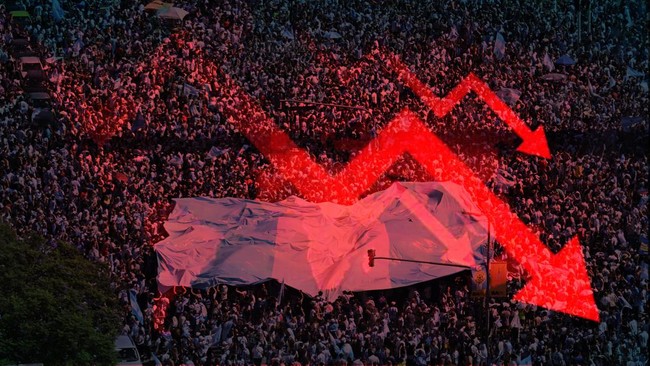
Jakarta, CNBC Indonesia — As 2026 draws to a close, the threat of recession is looming over the global economy. A number of countries are showing signs of economic weakness, and some have already slipped into recession this year.
The threat spans Europe, the Asia-Pacific, Latin America and the Middle East.
The war between the United States (US) and Iran in the Middle East has driven up energy prices, adding to global inflationary pressures. This has prompted several central banks to tighten monetary policy again by raising interest rates.
However, while efforts to curb inflation continue, higher interest rates have made borrowing more expensive, squeezed household purchasing power and constrained business expansion. These successive pressures have sapped growth momentum in a number of economies and increased the risk of recession.
A country is generally considered to be in a technical recession when real gross domestic product (GDP) contracts for two consecutive quarters on a quarter-on-quarter (q-o-q) basis.
Countries That Have Slipped into Recession
According to data from the Organisation for Economic Co-operation and Development (OECD) and Eurostat, Saudi Arabia, Ireland and Romania have recorded recessions in 2026.
Saudi Arabia is among the economies hit by the war in the Middle East. Its heavy reliance on the oil sector has left the economy under severe pressure as energy production and exports have been disrupted.
The Saudi economy contracted for two consecutive quarters in the first half of this year, although it returned to positive growth in the third quarter.
Ireland has also experienced a contraction, partly due to a sharp fall in activity in sectors dominated by multinational companies.
The Irish economy contracted by as much as 7.8% in the first quarter of 2026. Romania, meanwhile, recorded three consecutive quarters of contraction, from the third quarter of 2025 through to the first quarter of 2026. The government’s budget-tightening measures to reduce the fiscal deficit have also weighed on household consumption.
Countries at Risk of Following Them into Recession
While some countries are beginning to recover from recession, similar warnings are emerging elsewhere as 2026 draws to a close.
Australia
The threat of recession in Australia is becoming more apparent as increasing numbers of people lose their jobs amid high living costs and interest rates.
According to the Australian Bureau of Statistics (ABS), the number of employed people fell by 43,500 in October 2026. The unemployment rate rose from 4.7% in September to 4.9% in October, its highest level since 2021.
Former US central bank economist Claudia Sahm warned that a faster rise in unemployment could be an early sign that Australia is heading towards recession.
As more people lose their jobs, purchasing power comes under pressure. This can reduce company sales, curb new hiring and trigger a further wave of redundancies.
The warning is reinforced by Australia’s Sahm Rule recession indicator, which has reached 0.60 percentage points and is approaching the 0.75-point threshold for a recession warning.
Independent economist Saul Eslake warned that the indicator could reach the recession threshold in December 2026 if unemployment continues to rise at the same pace as over the past six months.
France
Unlike Australia, France’s recession risk is growing because business activity is weakening amid political uncertainty ahead of the presidential election in April 2027.
According to CNBC International, the Purchasing Managers’ Index (PMI) data released by S&P Global on Monday, 23 November 2026, showed French business activity falling to a six-month low, with manufacturing under greater pressure than services.
Businesses are also facing weak domestic demand, high operating costs and economic uncertainty, prompting companies to postpone business decisions.
The pressure has also affected the labour market. Private-sector job cuts in France have continued for seven consecutive months.
S&P Global Market Intelligence senior economist Joe Hayes said these conditions raised the risk that France could enter a technical recession in the fourth quarter of 2026.
The French economy contracted by 0.1% quarter on quarter in the third quarter of 2026. If it records another contraction in the fourth quarter, France will enter recession.
Recession Risks Elsewhere
Alongside Australia and France, recession risks are also emerging in Latin America, particularly in Argentina, Chile and Colombia.
Argentina is already said to have entered recession. Reuters quoted economists who based their assessment on a 1.8% fall in Argentine economic activity in the third quarter of 2026, following a 0.6% GDP contraction in the second quarter.
However, whether Argentina is officially in recession will only be known after third-quarter 2026 GDP data are released in December.
Chile and Colombia’s economies contracted by 1.8% and 0.8%, respectively, quarter on quarter in the third quarter. If the contractions continue through the end of the year, both countries will enter technical recession.
Italy is also facing recession risks. Research institute Collegio Carlo Alberto estimates the probability of Italy entering a technical recession in 2027 at 42%. Concerns have arisen because the government’s investment stimulus programme is due to end, while private-sector demand remains weak.
In Russia, the substantial spending required to finance the war poses a challenge to the economy. The Bank of Finland Institute for Emerging Economies (BOFIT) has warned of recession risks if the government cuts spending amid weak economic growth.
IMF Forecasts Contractions in Several Economies in 2026
The bleak outlook for a number of economies is also reflected in the IMF’s latest report.
In its October 2026 edition of the World Economic Outlook (WEO), the IMF forecast that global growth would slow from 3.5% in 2025 to 3.1% in 2026, before rising to 3.4% in 2027.
Amid this slowdown, several countries are projected to record negative economic growth this year.
Middle Eastern countries dominate the list. Disruptions to oil and gas production and distribution caused by the war have hit economic activity in countries dependent on energy revenues.
Kuwait, Iraq, Qatar and Bahrain are projected to see their economies contract by double digits in 2026.
Although the IMF’s projections do not necessarily mean that every country on the list has experienced a technical recession, negative annual economic growth illustrates the severity of the pressures they have faced in 2026.
Source: jawawa.id (https://jawawa.id/newsitem/countries-on-the-brink-of-recession-in-2026-from-australia-to-saudi-arabia-1795600346)
Originally published by CNBC Indonesia (https://www.cnbcindonesia.com/research/20261125102717-128-788216/daftar-negara-yang-masuk-jurang-resesi-di-2026-australia--arab-saudi), translated from Indonesian