
Correcting Indonesia's Halal Industry Strategy
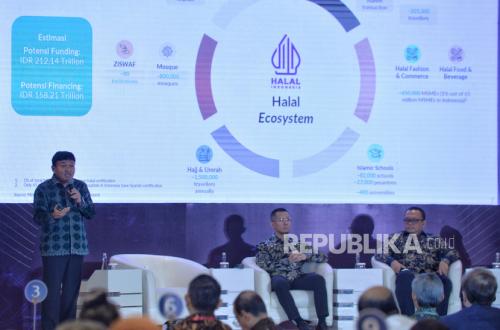
The Head of the Halal Product Assurance Agency (BPJPH), Ahmad Haikal Hassan, accompanied by the Indonesian Ambassador to Malaysia, held a meeting with Malaysian Deputy Prime Minister Dato’ Seri Dr. Ahmad Zahid Hamidi to optimise collaboration on halal industry development. The meeting was a positive signal. Yet it also serves as an uncomfortable reminder: after more than two decades, Indonesia still has to ‘learn to collaborate’ with Malaysia — a country whose Muslim population is less than a tenth of ours, but which has topped the global halal economy rankings for eleven consecutive years.
The question that should have emerged from the negotiating table is not merely ‘what can we do together’, but rather: why has Malaysia left us so far behind, and what has actually been wrong with our strategy all this time?
The answer to that question is hidden behind the aggregate rankings we celebrate every year. The State of the Global Islamic Economy (SGIE) 2024/2025 places Indonesia in third position — a figure that sounds impressive until we look at what lies beneath it.
The halal food sector, which should be the main strength of the world’s largest Muslim-majority country, has slipped to fourth place globally with a score of 78.8 — far behind Malaysia’s 117. Islamic finance, which should be the financing engine of this entire ecosystem, is stuck in sixth place with a domestic market share below 11 percent, while Malaysia has surpassed 40 percent. And what is most striking: according to the same report, the five largest exporters of halal products in the world are not Muslim countries — they are China, India, Brazil, Russia, and the United States. Muslim countries, including Indonesia, are instead the world’s main importers of halal products.
This is the thesis we must honestly confront: Indonesia excels in sectors that grow on their own without state intervention, yet is hollow in the sectors that most require strong policy architecture. The title of ‘largest Muslim country’ does not automatically translate into ‘largest halal producer’ — and as long as we are not honest in acknowledging this, all the strategies we devise will merely be grand structures built on a fragile foundation.
Victories That Need Re-examining
Indonesia is indeed the world champion in the modest fashion sector, surpassing Turkey and the UAE. Muslim-friendly tourism and halal pharmaceuticals and cosmetics also rank second globally. These achievements are real and deserve appreciation. However, a critical question is rarely asked: did this excellence arise from state policy engineering, or from a society left to work on its own?
The honest answer is the latter. Modest fashion grew from the dynamics of young designer communities, social media ecosystems, and organic consumer tastes — not from a government-designed roadmap. It thrived despite the state’s absence, not because of its presence. Meanwhile, the halal food and Islamic finance sectors — the two sectors that most require integrated regulation, consistent fiscal incentives, and active standards diplomacy — are precisely our weakest points.
This is not a coincidence. It is a reflection of a recurring pattern across many sectors: Indonesia excels where the state is absent, and lags where the state’s presence is most needed. Therefore, the question that should guide policy is not ‘how to maintain third place’, but rather: why are the sectors that most need the state the very ones most neglected by it?
Certification: Cost Is No Longer the Problem
The most frequently repeated narrative is that the cost and bureaucratic complexity of halal certification are the main obstacles for micro, small, and medium enterprises (MSMEs). This narrative needs serious correction. The government, through BPJPH, has implemented the Free Halal Certification programme (SEHATI) with a quota of up to one million certificates per year through a self-declare scheme — and this programme continues until 2026. Cost is no longer the main barrier.