
CORE: Strengthening business ecosystem to improve salt farmers' production quality
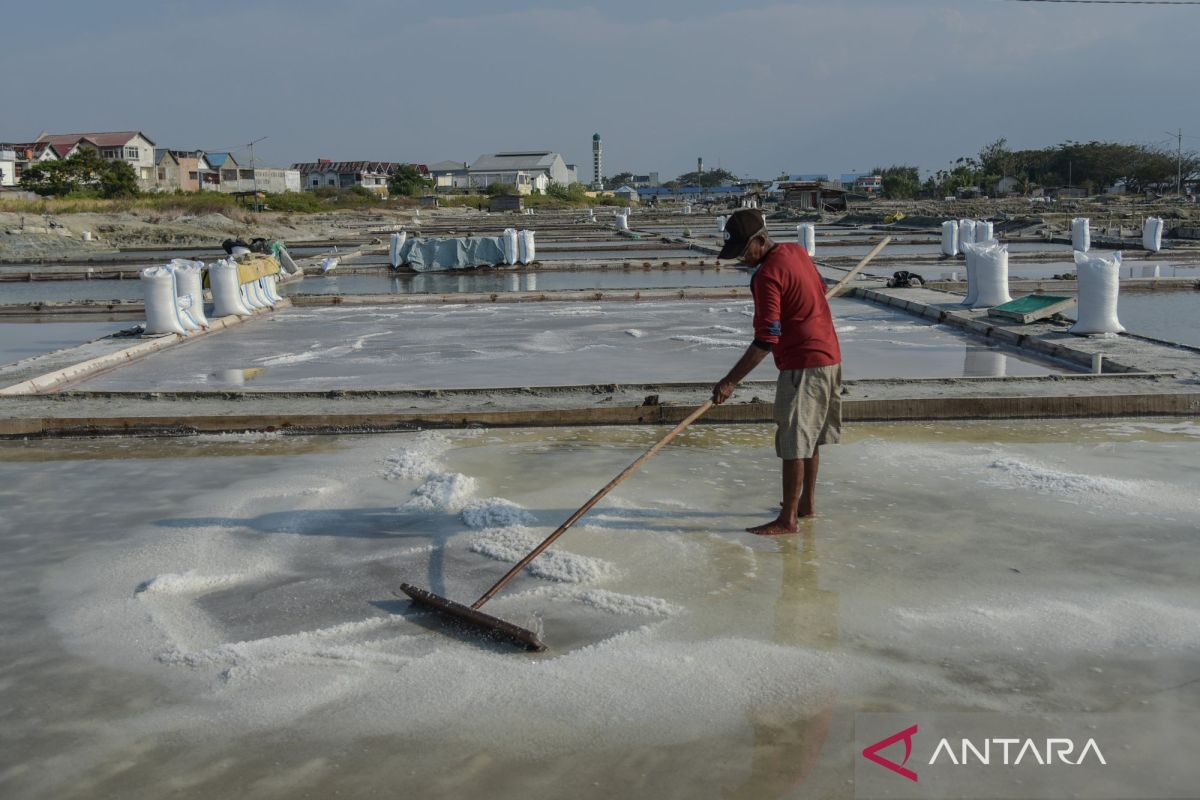
Jakarta (ANTARA) - Eliza Mardian, a researcher at the Centre of Reform on Economics (CORE) Indonesia, believes that strengthening the business ecosystem is necessary so that salt farmers can improve production quality without having to personally bear relatively large technology costs.
According to Eliza, the use of geomembranes, pumps, warehouses, and even washing and purification facilities requires heavy investment if the entire burden is placed on small-scale farmers.
“The business model should not involve farmers bearing the technology costs alone. Geomembranes, which are the base plastic for salt ponds, pumps, warehouses, and salt washing factories are expensive if charged to a mere half-hectare plot,” Eliza told ANTARA in Jakarta on Tuesday.
She believes this investment burden can be shared through a business model involving cooperatives or regional-owned enterprises (BUMD), processing companies, and end-user industries.
Cooperatives or BUMDs, she noted, can manage production plots, while private processors or PT Garam can play a role in providing washing and purification facilities.
On the downstream side, end-user industries can provide market certainty through offtake agreements, which are arrangements to purchase specific volumes provided the salt quality meets agreed requirements.
“Pricing must be tiered. Cleaner salt should be paid more. Without that, farmers have no incentive to upgrade their production,” she said.
In addition to purchase certainty, Eliza noted that storage facilities are necessary because smallholder salt production generally occurs during the dry season, whereas industries require a continuous supply of raw materials throughout the year.
The existence of warehouses, according to her, can maintain salt availability outside the harvest season, ensuring that increased production by farmers is accompanied by a sustainable supply to users.
Therefore, the salt business chain needs to be built with a clear division of roles, ranging from improving the quality of raw materials in the ponds to processing and marketing to industry.
“What needs to be built is a supportive salt business ecosystem, where ponds produce cleaner raw materials, processors enhance quality, and factories secure purchases or cooperation contracts with salt farmer cooperatives,” Eliza said.
Strengthening farmer institutions is also part of the policy of the Ministry of Marine Affairs and Fisheries (KKP).
The 2026 performance indicators for the Directorate of Marine Resources include the development of salt farmer corporations and the improvement of farmer competence.
The KKP has previously prepared a salt pond intensification scheme through cooperatives that can work with PT Garam or end-user industries as buyers.
Purchase contracts serve as a reference for farmers to produce salt of a certain quality, while cooperatives play a role in assisting with access to financing for equipment procurement.
In the 2026 Budget Implementation List (DIPA), the KKP has allocated IDR 2.25 billion for the development of three salt farmer corporations and IDR 1.20 billion for the competency enhancement of 100 salt farmers.
The DIPA also includes IDR 874.56 billion for the revitalisation of 1,500 hectares of salt land and IDR 295.96 billion for the construction of 20 units of salt business infrastructure.
The need for technological support is still evident at the farmer level. In early September 2026, salt farmers in Lamongan, East Java, stated that the limited availability of geomembranes remains a hurdle to improving quality, while salt prices at the farmer level range from IDR 900 to IDR 1,000 per kilogram.
The Lamongan Regency Fisheries Office in 2026 is also conducting coaching and training, as well as providing production assistance in the form of 40 wheelbarrows and 40 pairs of boots to farmers.
Eliza believes that the connectivity between farmers, cooperatives or BUMDs, processing companies, and end-user industries is vital so that the improvement in salt quality also provides market certainty and economic benefits for farmers.
Source: jawawa.id (https://jawawa.id/newsitem/core-strengthening-business-ecosystem-to-improve-salt-farmers-production-quality-1788869230)
Originally published by Antara (Indonesian) (https://www.antaranews.com/berita/5731623/core-penguatan-ekosistem-usaha-tingkatkan-mutu-garam-petambak), translated from Indonesian