
CORE: Indonesia's manufacturing recovery requires boosting demand and reducing costs
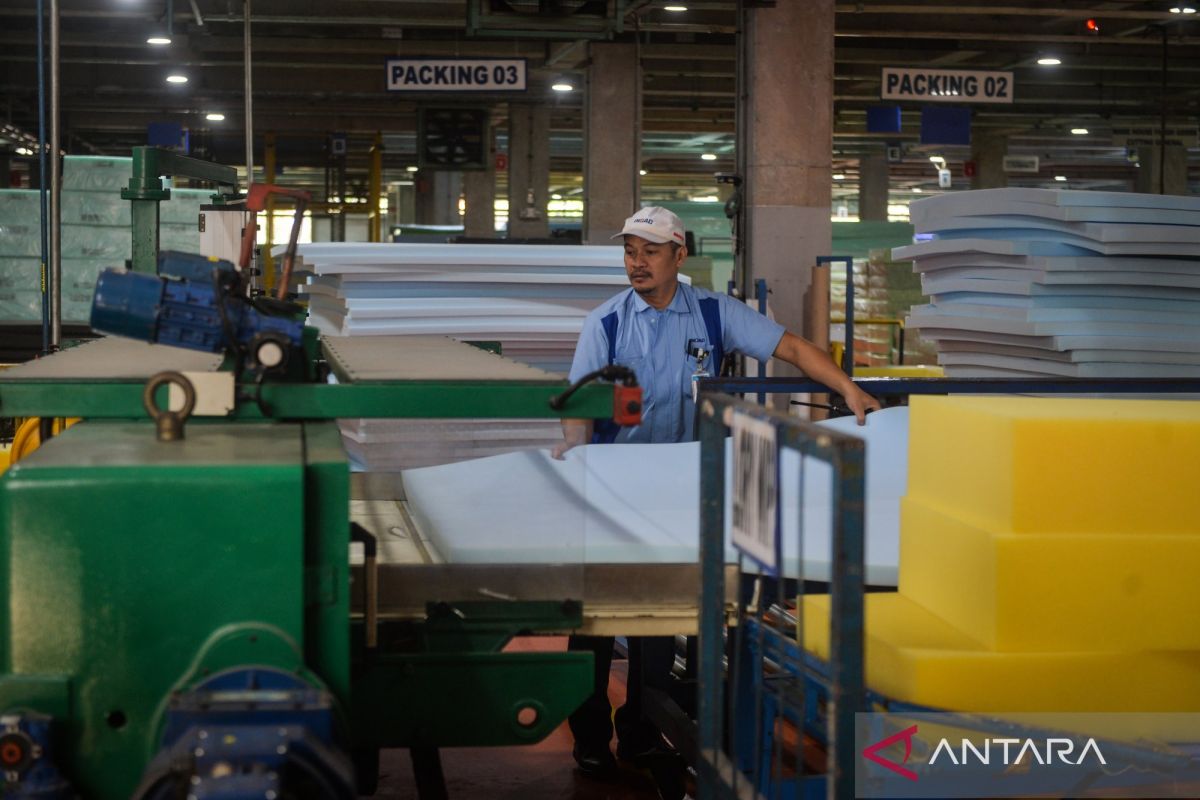
Jakarta (ANTARA) - Yusuf Rendy Manilet, an economist from the Centre of Reform on Economics (CORE) Indonesia, believes that the recovery of the manufacturing industry must be achieved through strengthening demand and reducing production costs.
This was stated in response to Indonesia’s manufacturing Purchasing Managers’ Index (PMI) performance for August 2024, which was recorded at 49.8. As is well known, the manufacturing PMI uses 50 as a benchmark; a figure above 50 indicates an expansion phase, while a figure below 50 signifies a contraction.
“The weakness is primarily occurring in production and labour absorption. What needs to be noted is that production has declined in five of the last six surveys. This condition reflects a combination of weak domestic demand, competition from cheap imports, and rising production costs due to the weakening rupiah and surging energy prices,” Yusuf told ANTube in Jakarta on Thursday.
According to him, pressure on purchasing power is also reflected in the slowdown of consumer credit.
On the other hand, the dependence of several industries on imported raw materials means that the weakening of the rupiah exchange rate also increases production costs. Nevertheless, Yusuf sees several early signals of improvement in the manufacturing sector.
The new orders index has returned to above the 50 level for the first time in three months, while industrial optimism has reached its highest level in seven months.
“This means the market is starting to move, but business players are still waiting for a more consistent recovery in demand before increasing production and recruiting labour,” he said.
Therefore, according to Yusuf, recovery policies need to be directed towards strengthening demand while simultaneously reducing production costs.
From the demand side, the government needs to maintain the purchasing power of the lower-middle class and optimise government spending on domestic products through the consistent application of Local Content Requirements (TKDN).
Supervision of illegal imports and dumping practices also needs to be strengthened through safeguard instruments and evidence-based anti-dumping duties.
From the production side, energy price certainty, logistics efficiency, and exchange rate stability are crucial factors for increasing industrial competitiveness.
Yusuf also believes that export opportunities through the Indonesia-European Union Comprehensive Economic Partnership Agreement (IEU-CEPA) need to be immediately translated into industrial readiness.
He noted that the textile, footwear, electronics, and wood product sectors have the potential to gain new sources of demand from the European market. However, these opportunities require readiness in terms of product standards, production capacity, certification, and access to financing.
Regarding fiscal stimulus, Yusuf stated that the government still needs to provide additional stimulus, but it must be targeted, temporary, and linked to measurable results.
With limited fiscal space and volatile financial market conditions, overly broad stimulus is considered risky as it could incur significant fiscal costs without providing an optimal impact.
He suggested tax incentives based on realised investment, such as accelerated depreciation or additional tax reductions for the purchase of machinery and factory modernisation.
Specifically for labour-intensive industries, Yusuf believes that interest subsidies on working capital credit could be linked to labour absorption and retention.
Such support is deemed relevant when working capital financing, particularly for the micro, small, and medium enterprise (MSME) segment, remains under pressure.
From the consumption side, assistance to low-income groups is also considered important as it can more rapidly drive demand for domestic manufactured products.
Regarding the import of raw materials, Yusuf said that relaxation can be carried out selectively by distinguishing between raw materials and goods that are not yet available domestically and finished goods that compete directly with local products.
“Licensing for raw materials that cannot yet be produced domestically should be accelerated, and import duties can be adjusted so that production costs are more competitive. Conversely, protection against finished goods remains necessary to safeguard the national industrial market,” he said.
He emphasised that such policies must consider the interconnectedness between upstream and downstream industries.
For example, relaxing yarn imports could help the garment industry, but at the same time, it could potentially pressure the domestic spinning industry.
Therefore, every decision regarding import relaxation needs to be based on an accurate commodity balance, accompanied by time limits and periodic evaluations.
Source: jawawa.id (https://jawawa.id/newsitem/core-indonesias-manufacturing-recovery-requires-boosting-demand-and-reducing-costs-1790258597)
Originally published by Antara (Indonesian) (https://www.antaranews.com/berita/5757177/core-pemulihan-manufaktur-ri-perlu-dorong-permintaan-dan-tekan-biaya), translated from Indonesian