
CORE: I-EU CEPA Could Boost Indonesia’s Export Penetration in Europe
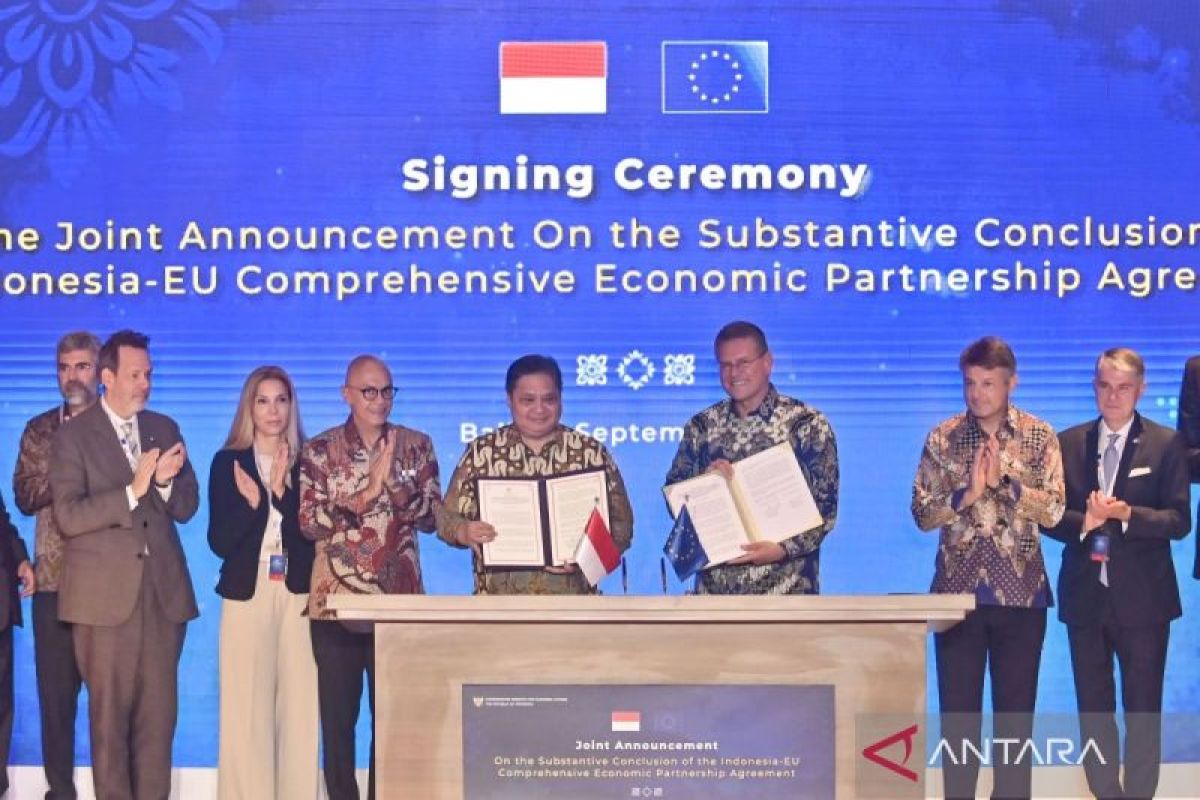
Jakarta (ANTARA) – Center of Reform on Economics (CORE) Indonesia Executive Director Mohammad Faisal said the Indonesia-European Union Comprehensive Economic Partnership Agreement (I-EU CEPA) could increase Indonesia’s export penetration in European countries.
“It is about ensuring that we can achieve better export penetration in one of our main markets, Europe,” Faisal said in Jakarta on Wednesday.
He said the agreement was intended to promote exports to Europe, which has long been one of the main destinations for Indonesian products.
“We export a lot there, in products somewhat similar to those we send to the United States: textiles and textile products, furniture and footwear,” Faisal said.
He added that even if the benefits did not come through goods trade, the comprehensive agreement could still bring gains in other areas, such as services and investment.
Faisal said Indonesia should use the I-EU CEPA to attract investment from European countries or secure benefits in services.
“There could be technical assistance, because we know their standards are difficult to meet. We should be helped to reach those standards, rather than asking the EU to lower them,” he said.
Trade Minister Budi Santoso is seeking to accelerate the conclusion of the I-EU CEPA before the EU’s Generalised Scheme of Preferences (GSP) expires in 2027. The GSP provides certain tariff preferences for Indonesian export products.
Budi said the government aims to sign the agreement by the end of October 2026. After signing, it will expedite ratification so that the pact can take effect in January 2027.
He said the government was targeting completion of the process to ensure Indonesia was not affected by the end of the EU’s GSP scheme.
The Indonesian Government has met with EU ambassadors in a meeting led by Coordinating Minister for Economic Affairs Airlangga Hartarto. According to Budi, Indonesia and the EU have agreed that the agreement can be completed by the end of October.
Indonesia and the EU are still working through several issues related to the agreement. Budi said Indonesia had, in principle, completed its part, while discussions on the EU side were continuing.
One outstanding matter concerns the language of the agreement documents. Indonesia wants the documents to be signed in both Indonesian and English.
If the agreement is completed according to the target, he said, ratification will be expedited, with the I-EU CEPA expected to take effect in early 2027.