
Copyright Bill Must Protect the Economic Rights in Journalistic Works
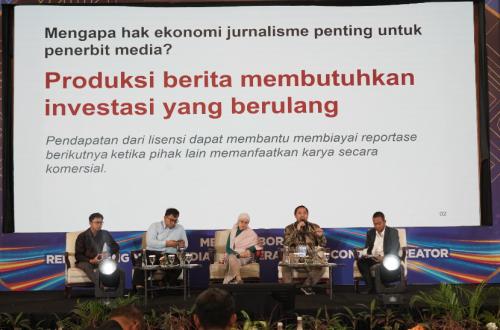
SURABAYA — Copyright protection for journalistic works has become a key issue amid the development of artificial intelligence (AI) and the use of content by digital platforms. The Copyright Bill is considered to need clearer provisions on media companies’ economic rights, guarantees of fair compensation for journalists as creators, and rules governing the use of journalistic works by AI systems.
The issue was discussed at the Indonesia Digital Media Conference (IDMC) 2026, during Panel Session 4, entitled “Journalistic Works to Gain Copyright: Opportunity or Challenge?” The session was moderated by Tribun Jatim Editor-in-Chief Tri Mulyono.
The panel featured Luqman Hakim, First Legal Analyst at the Directorate General of Intellectual Property (DJKI); Wahyu Dhyatmika, chairman of the Indonesian Cyber Media Association (AMSI); Mustafa Layong, executive director of the Press Legal Aid Institute (LBH Pers); and Lyza Anggraheni, CEO and producer of Basbeth Bercerita and commissioner of Matta Cinema.
According to a press release received on Thursday (29 October 2026), Wahyu Dhyatmika stressed the importance of journalism’s economic rights to sustaining news production. Journalistic work requires investment and recurring expenditure. Revenue from content-use licences could therefore provide one source of funding for media outlets to continue their reporting.
Wahyu said the Copyright Bill should clarify protection for journalistic works while building a fairer ecosystem for content use in the AI era. New rules should also clarify the scope of protection and use, as well as licensing procedures for journalistic works.
Wahyu proposed establishing a collective licensing body to represent media outlets in negotiations with digital platforms and distribute revenue according to content use. Such a joint mechanism would be particularly important for local media, which have limited resources to negotiate and manage licences independently.
However, collective management requires a valid mandate from members, accurate data on content use and a transparent revenue-sharing mechanism. Membership of a media association alone does not automatically authorise it to manage the economic rights of all its members.
Luqman Hakim explained that copyright protection covers both moral and economic rights. Moral rights concern attribution and the creator’s reputation, while economic rights confer the authority to exploit a work commercially and distribute it.
In relationships between journalists and media companies, ownership and management of rights must be assessed in accordance with the applicable law and agreements.
Luqman cautioned against assuming that publication of a work automatically transfers all its economic rights to a media company. Article 36 of Law No. 28 of 2014 on Copyright must be considered when determining the status of works created in an employment relationship or on commission.
Luqman also stressed the importance of understanding the limits on the use of journalistic works. The use of current news and quotations for particular purposes are subject to specific rules.
As he explained, crediting the source does not in itself constitute permission to reproduce an entire article or use it commercially. The purpose, proportion, context and economic impact should all be considered when assessing whether the use of a work is fair.
From the perspective of press freedom and creators’ rights, Mustafa Layong said that protection of media companies’ economic rights must be matched by guarantees of fair compensation for journalists and creators. Rules on journalists’ rights as creators should be clarified and should not depend solely on employment contracts between journalists and media companies.
Mustafa also highlighted the need for clarity on the status of works created with AI assistance. He said human intellectual contribution should be considered when determining whether a work qualifies for copyright protection.
The use of AI as an assistive tool should not automatically remove a work’s status as a human creation, while works generated entirely by AI require clearer rules.
In proposing revisions to the regulations, Mustafa urged that AI service providers be brought within the scope of rules covering digital platforms. The boundaries of fair use should also be clarified, particularly for systematic, large-scale and commercial use of content that could divert readers from original news sources.
Uses such as automated summarisation, algorithmic recommendations, machine learning and the incorporation of content into AI systems should also be explicitly considered in rules on economic rights. In addition, platforms should be transparent about their use of journalistic content so that compensation can be calculated and shared fairly.
Lyza Anggraheni, meanwhile, discussed the relationship between journalism and the film industry from the perspective of creative production. Journalistic data and reports can be an important source in developing film stories. News reports do more than provide information: they also offer perspectives and material that can support the creative process in film production.
This view illustrates that journalistic works have value beyond the provision of information. News content can be a source of knowledge and inspiration for the creative industries, making it important to understand creators’ rights and the limits on the use of such works.
The Indonesia Digital Media Conference (IDMC) 2026 was organised by the Indonesian Cyber Media Association (AMSI) on 28–29 October 2026 in Surabaya. The event’s theme was “Media Reborn: Reinventing News Media in the Era of AI & Content Creator”.