
Coordinating Ministry Formulates Strategy for Regulatory Simplification to Boost Investment
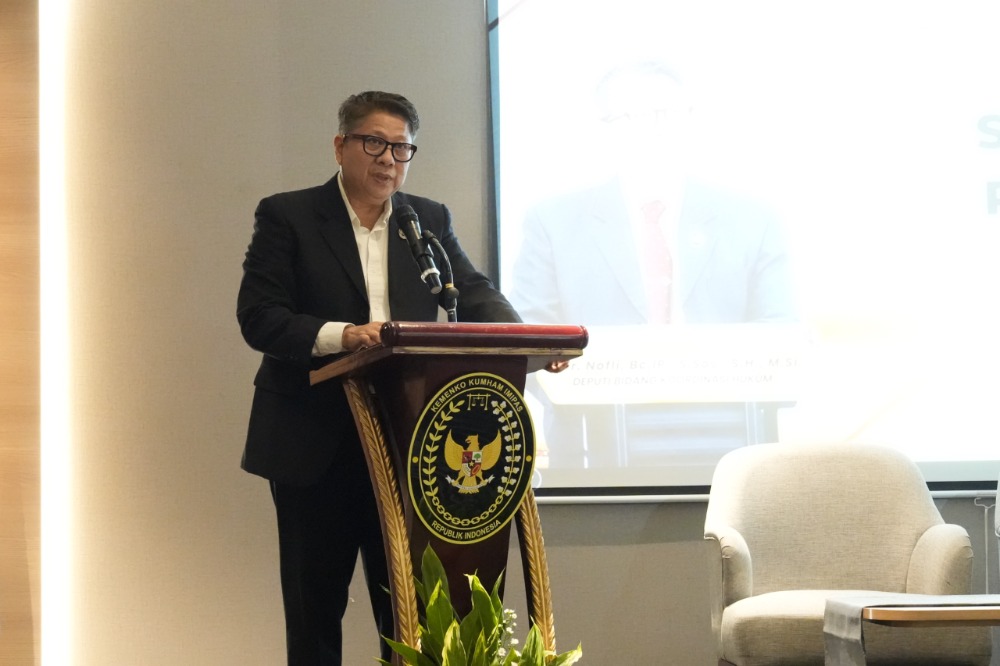
Jakarta, 23 June 2026 – The Coordinating Ministry for Law, Human Rights, Immigration, and Corrections (Kemenko Kumham Imipas) convened a seminar on the synchronisation and coordination of regulatory simplification and quality improvement to boost investment, ease of doing business, and economic growth. The event, held at Somerset Sudirman, Jakarta, from 23 to 25 June 2026, was organised by the Assistant Deputy for Coordination of Legislation and Litigation as a strategic forum to strengthen national synergy in driving quality regulatory reform and supporting the investment climate.
The seminar was attended by Deputy for Law Coordination Nofli, Expert Staff for Inter-Institutional Cooperation Cahyani Suryandari, Special Staff for Strategic Issues Karjono, Secretary of the Law Deputy Ramelan Supriadi, and Assistant Deputy for Coordination of Legislation and Litigation Fiqi Nana Kania as the organiser. Representatives from 40 ministries and agencies, as well as provincial and district/city governments across Indonesia, also participated, alongside business associations, academics, and other stakeholders.
In her report, Assistant Deputy Fiqi Nana Kania stated that the seminar aimed to identify regulations that potentially hinder investment and ease of doing business, while gathering evidence-based policy recommendations for regulatory reform based on real stakeholder needs. “This activity is expected to produce concrete, applicable, and sustainable regulatory simplification strategies to support the transformation of national regulatory governance,” Fiqi said.
In his opening remarks, Deputy for Law Coordination Nofli stressed that regulatory simplification is an urgent necessity to create legal certainty, enhance national competitiveness, and support economic growth. “Regulatory simplification aims not only to accelerate investment but also to build legal certainty, improve competitiveness, create jobs, and strengthen public trust in governance,” he stated.
During the first discussion session, Director of Legislation Planning at the Ministry of Law, Aisyah Lailiyah, highlighted the importance of transforming the legislative process through an evidence-based policy approach and the application of Regulatory Impact Assessment (RIA). She emphasised that regulations must be formulated based on data, impact analysis, and meaningful public participation to address hyperregulation, overlapping rules, and high compliance costs. Aisyah also explained the use of the Sirenkum application as an instrument for filtering and planning regulations in a more measurable manner.
Professor Telisa Aulia Falianty, Chair of the Institute for Economic and Social Research (LPEM FEB UI) at the University of Indonesia, underscored regulatory transformation as a key pillar for increasing investment, competitiveness, and national economic growth. She explained that achieving the 8% economic growth target requires adaptive regulations, legal certainty, digitalisation of licensing services, and strengthening of downstream industries and sustainable investment. Professor Falianty also stressed the importance of improving national investment efficiency to contribute optimally to economic growth towards the Indonesia Emas 2045 vision.
Eisuke Saito from TMI Associates, representing the Japan International Cooperation Agency (JICA), provided a foreign investor perspective. He explained that the main challenges faced by Japanese companies in Indonesia lie not in the number of regulations, but in the clarity of norms, delays in issuing implementing regulations, and consistency of enforcement on the ground. According to him, legal certainty and effective implementation are critical factors in long-term investment and business development decisions.
In the second discussion session, Roby Fadillah, Director of Industry, Trade, and Investment Promotion at the Ministry of National Development Planning/Bappenas, outlined the government’s strategy to build a friendly, transparent, and competitive investment climate. He explained that regulatory and institutional reform is a crucial foundation for realising the Indonesia Emas 2045 vision, including strengthening business entity administration services, improving regulatory quality, and enhancing ease of doing business indicators based on the World Bank’s Business Ready (B-READY) framework.
From the business sector, APINDO Vice Chairman Sanny Iskandar highlighted that investment challenges are currently dominated by licensing complexity, regulatory implementation uncertainty, and suboptimal inter-agency integration. Based on an APINDO survey, key obstacles faced by businesses include lengthy bureaucracy, differing interpretations of rules, disruptions in licensing systems, and high compliance costs. Sanny urged deregulation, policy harmonisation, strengthened government-business dialogue, and digitalisation of licensing services to improve Indonesia’s competitiveness.
Meanwhile, Dr. Andre Abraham, Head of the Legal Bureau at the Ministry of Investment and Downstreaming/BKPM, detailed the regulatory transformation steps for investment and business licensing undertaken by the government. He highlighted the refinement of the OSS system through Government Regulation No. 28 of 2025, simplification of derivative regulations, strengthening of Service Level Agreements (SLA), and harmonisation of investment policies to support the national investment target of Rp13,032.8 trillion for the 2025–2029 period. He stressed that consistent regulatory reform is key to creating a more effective, certain, and competitive business climate.