
Coordinating Ministry for Food prepares presidential regulation framework for strategic cocoa programme
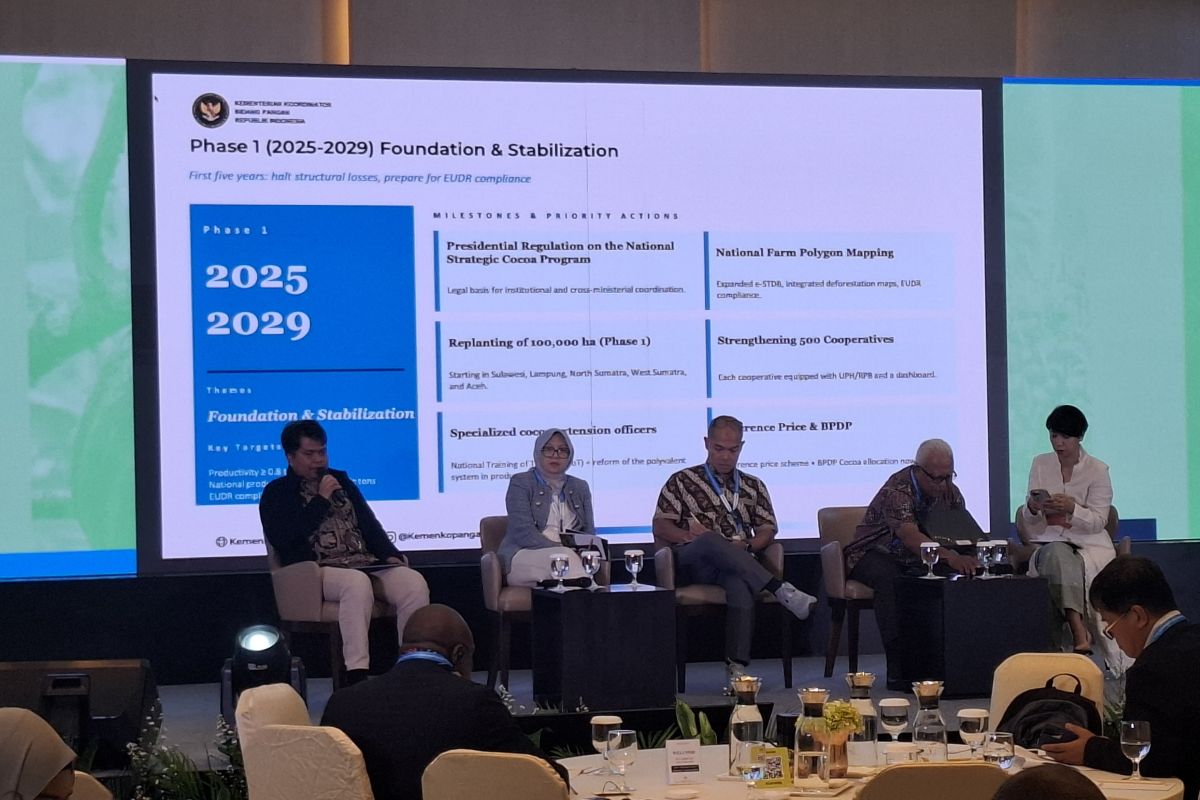
The Coordinating Ministry for Food is preparing a regulatory framework through a Presidential Regulation to strengthen the national strategic cocoa programme as a basis for cross-ministerial and institutional coordination up to 2045.
Assistant Deputy for Competitiveness Improvement of Plantation and Horticulture Products at the Coordinating Ministry for Food, Radian Bagiyono, said a regulatory framework is needed so that ministries, institutions and stakeholders have a common guide in developing national cocoa.
“So we are preparing several regulatory frameworks, particularly the most operational one using a Presidential Regulation,” Radian said during a panel discussion at the Regional Learning Forum on Sustainable Commodities in Jakarta on Thursday.
According to him, the national cocoa development strategy will be strengthened through a Presidential Regulation to serve as a reference for ministries and institutions towards the cocoa development targets for 2045.
The Coordinating Ministry for Food is also drafting a long-term strategic plan for cocoa development for the 2025-2045 period, divided into four phases.
The first phase in 2025-2029 involves strengthening foundations and stabilisation, including halting the decline in production and preparing the cocoa sector to meet sustainability demands in the global market.
At this stage, the government is targeting the rejuvenation of 100,000 hectares of cocoa plantations, starting in Sulawesi, Lampung, North Sumatra, West Sumatra and Aceh.
The government, Radian continued, is also preparing mapping of smallholder cocoa plantations to strengthen traceability, strengthening 500 cooperatives, and bolstering assistance to farmers in implementing good agricultural practices.
“This is actually to address the traceability issue that has been an obstacle for our farmers in marketing their products abroad,” he said.
The second phase in 2030-2034 is directed at acceleration and transformation through increasing the scale of rejuvenation, developing inclusive downstream processing, and strengthening cooperatives and farmer institutions.
In this phase, the government is also planning the development of cocoa geographical indications, the use of plantation funds to strengthen the upstream sector, and increasing the involvement of the younger generation in cocoa cultivation.
Furthermore, the 2035-2039 period is directed at making Indonesia one of the cocoa references in the Asian region.
The 2040-2045 period is aimed at building Indonesia as a sustainable cocoa hub with the strengthening of specialty cocoa and recognition of Indonesian cocoa brands in the global market.
Radian said strengthening the cocoa sector is closely linked to public welfare because most of Indonesia’s cocoa plantation areas are managed by smallholder farmers.
Coordinating Ministry for Food materials note that around 99 percent of cocoa plantation areas are managed by smallholder farmers. The cocoa area was recorded at around 1.72 million hectares in 2015 and around 1.37 million hectares in 2025.
National cocoa productivity is in the range of 0.7-0.9 tonnes per hectare, still below the yield potential of superior varieties which reaches 1.5-2 tonnes per hectare.
“If we can improve this cocoa commodity, we are also indirectly improving the welfare of farmers,” said Radian.
The government hopes that this series of policies can bring the national cocoa sector back to strengthening its position in the global market.