
Coordinating Ministry for Food opens trilateral cooperation opportunities for palm oil and cocoa
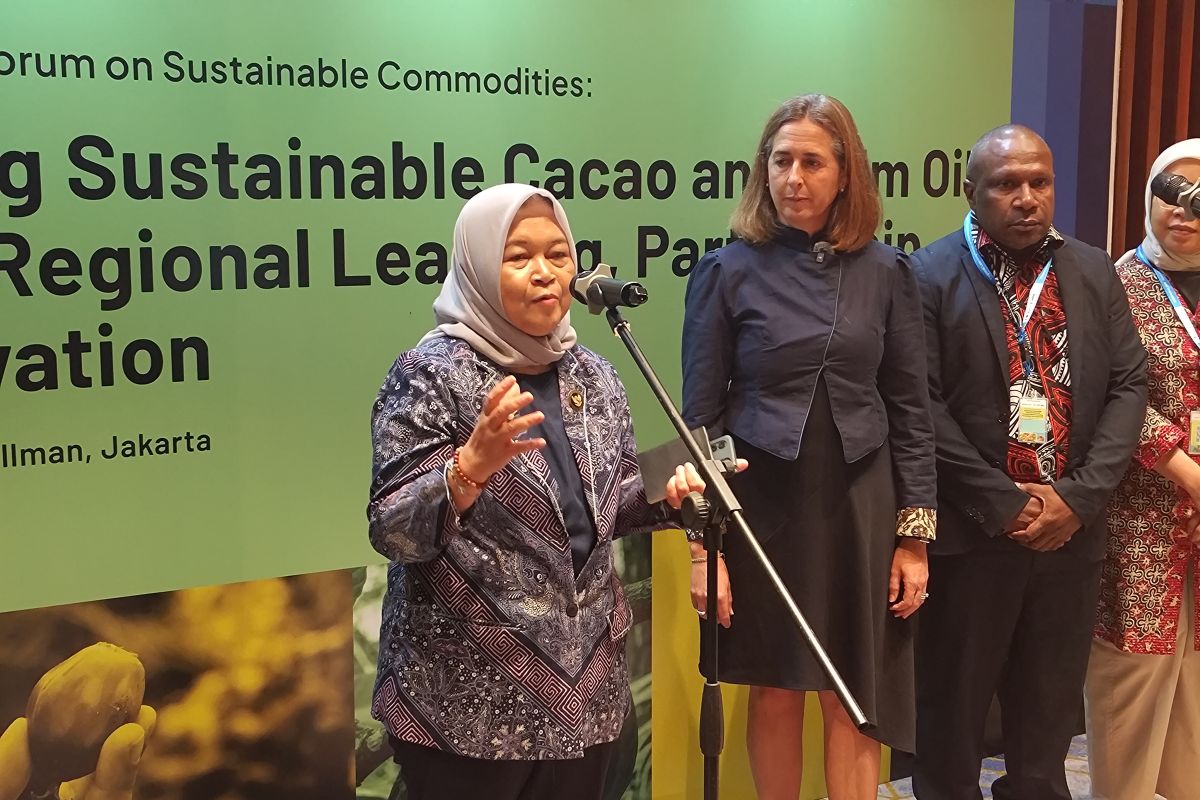
The Coordinating Ministry for Food has opened opportunities for developing cooperation between Indonesia, Malaysia and Papua New Guinea to strengthen sustainable cocoa and palm oil value chains. Deputy for Affordability and Food Security Coordination Nani Hendiarti said the two-day regional forum provided a space for the three countries to exchange experiences and identify best practices that could be developed together. “From this FOLUR, it is possible that from the discussions over the next two days, there will be proposals for cooperation as a follow-up,” Nani said at the Regional Learning Forum on Sustainable Commodities in Jakarta on Thursday.
Food Systems, Land Use and Restoration (FOLUR) Indonesia is a programme that supports the development of sustainable commodity value chains covering four commodities: palm oil, cocoa, coffee and rice. Nani said the cooperation opportunities could be developed more concretely by involving government, the private sector, academia, young people, smallholder farmers and development partners. She noted that FOLUR receives support from the Global Environment Facility (GEF). According to Nani, there is also an opportunity to prepare new proposals based on the findings from the forum to strengthen future collaboration.
“Going forward, there is an opportunity for new proposals. This could perhaps be packaged from the deepening discussions here into more concrete cooperation, which also involves the private sector and others,” she said. According to Nani, collaboration is necessary because the challenges of developing cocoa and palm oil do not stop at national borders, ranging from climate change and biodiversity loss to market dynamics and value distribution within commodity chains. Social aspects are also a concern because smallholder farmers play a role in the production of both commodities, so sustainable value chain development is expected to provide benefits to communities.
The Regional Learning Forum on Sustainable Commodities, held on 27-28 August 2026, also discussed experiences from FOLUR, the Sustainable Landscape Programme Indonesia (SLPI), Forests, Agriculture and Sustainable Trade (FAST), and the Green Commodities Programme (GCP). These initiatives cover integrated landscape management, institutional strengthening, traceability, market access and financing, sustainability certification, and capacity building for smallholder farmers. In addition to exchanging experiences, the forum featured a Sustainable Commodities Investment Business Forum, a business meeting bringing together government, businesses, producers, buyers, investors and project developers to explore collaboration opportunities.
For palm oil, sustainable initiatives from Indonesia, Malaysia and Papua New Guinea were connected with potential investors and buyers. For cocoa, Indonesia and Papua New Guinea offered investment opportunities, including for processing infrastructure and strengthening smallholder farmer capacity. The business meeting also included dialogue between buyers and producers on market needs, including traceability and sustainability requirements, as well as direct meetings between investors or buyers and project developers and businesses.
On the same occasion, United Nations Development Programme (UNDP) Indonesia Resident Representative Sara Ferrer Olivella said the three countries face similar challenges in building inclusive and sustainable commodity chains, although the solutions applied may differ. According to Sara, value chain transformation needs to be supported by access to financing for the private sector while keeping sustainability principles and the interests of smallholder farmers as a central part. “The private sector is very important in the transformation of commodities and these value chains,” Sara said.
Domestically, the government is strengthening palm oil governance through Presidential Regulation Number 16 of 2025 on the Indonesian Sustainable Palm Oil Certification System (ISPO), which covers plantation businesses, downstream industries and palm oil bioenergy businesses. Its implementation is regulated through Ministry of Agriculture Regulation Number 33 of 2025, which covers ISPO certification for plantation businesses and smallholders as well as mechanisms for facilitating certification financing for smallholders.
Ministry of Agriculture data records that national oil palm plantation area up to 2025 was around 16.83 million hectares spread across 28 provinces. Around 6.93 million hectares of this are smallholder plantations with around 3.04 million smallholders. In 2026, the government is targeting 50,000 hectares of smallholder palm oil replanting (PSR). As of 27 July 2026, PSR technical recommendations had reached 23,688 hectares, or around 47.4 percent of the target. The Ministry of Agriculture also recorded that Indonesia’s CPO production in 2025 reached around 51.6 million tonnes, an increase of around 7.5 percent compared with 2024’s 48.16 million tonnes.
For cocoa, preliminary data from the Directorate General of Plantations recorded national production in 2025 at 616,103 tonnes from an area of 1.36 million hectares with an average productivity of 714 kilogrammes per hectare.
Source: jawawa.id (https://jawawa.id/newsitem/coordinating-ministry-for-food-opens-trilateral-cooperation-opportunities-for-palm-oil-and-cocoa-1787809990)
Originally published by Antara (Indonesian) (https://www.antaranews.com/berita/5713179/kemenko-pangan-buka-peluang-kerja-sama-sawit-kakao-tiga-negara), translated from Indonesian