
Coordinating Ministry for Community Empowerment Collaborates with UT Alumni, Focusing on Boosting Jobs, MSMEs, and Community Education
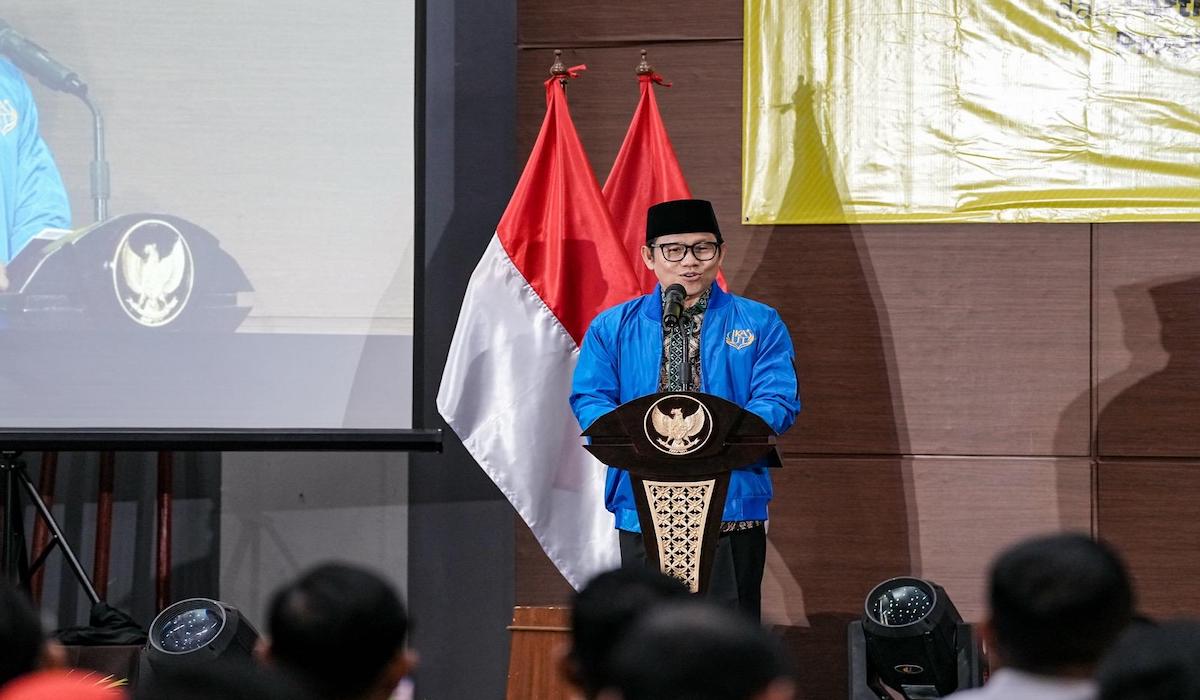
Coordinating Minister for Community Empowerment, Muhaimin Iskandar, has stressed that poverty alleviation cannot rely solely on social assistance patterns. The government, he said, is now promoting a sharper approach by shifting focus from charitable methods to empowerment that creates long-term impacts.
This assertion was made by Muhaimin when opening the National Seminar of the Universitas Terbuka Alumni Association (IKA UT) at Syariah Hotel Lorin, Sentul, Bogor, on Thursday (9/4). In the forum, he also underscored the strategic role of Universitas Terbuka alumni as a social force that can directly reach communities in various regions.
‘Poverty alleviation must be supported by job creation and broad business opportunities for the community,’ Muhaimin emphasised.
According to him, social assistance remains important as basic protection for vulnerable groups. However, without strengthening community capacity, access to education, business opportunities, and a broader work ecosystem, poverty reduction efforts risk stopping at short-term solutions.
In that context, the government views Universitas Terbuka alumni as a major asset. The number of alumni, which has reached around 2.3 million people, is considered a strong social capital to expand empowerment programmes to the lowest layers of society.
Muhaimin stated that the distribution of UT alumni across various sectors and regions in Indonesia can become an effective network to accelerate government programmes. He encouraged alumni not only to be part of the academic community but also to act as agents of change in society.
The government is also opening up more concrete collaboration spaces. Several areas being promoted include strengthening field-based research, providing scholarships for underprivileged communities, continuity of education for graduates of People’s Schools, development of alumni MSMEs, and expansion of preventive health services through free health check programmes.
Muhaimin said that alumni involvement is important so that empowerment programmes do not stop at the policy level but are truly present in the form of real interventions felt by the community.
‘We invite all Universitas Terbuka alumni to jointly realise an empowered Indonesia. Community empowerment is a constitutional mandate that we must carry out together,’ he said.
On the same occasion, the Coordinating Ministry for Community Empowerment and Universitas Terbuka signed a memorandum of understanding as a step to strengthen institutional synergy. This cooperation is directed to support the implementation of community empowerment policies, including supporting President Prabowo’s priority programmes.
Muhaimin also emphasised that the government’s future policy direction must be based on the principle of equity. He assured that every policy and state budget is aimed at expanding community capacity so that they can rise, become independent, and not be left behind in the development process.
‘Development must proceed with the principle of equity, so that no citizen is left behind,’ he concluded.
The Coordinating Ministry for Community Empowerment and Universitas Terbuka alumni are strengthening collaboration in community empowerment to create long-term impacts for the nation.
Coordinating Minister Muhaimin explained that this programme is part of efforts to strengthen national collaboration in poverty alleviation.
Indonesia has strong social capital in the form of the gotong royong tradition and solidarity that has become the nation’s identity.