
Coordinating Ministry and Telkom Promote National Readiness for Post-Quantum Cryptography
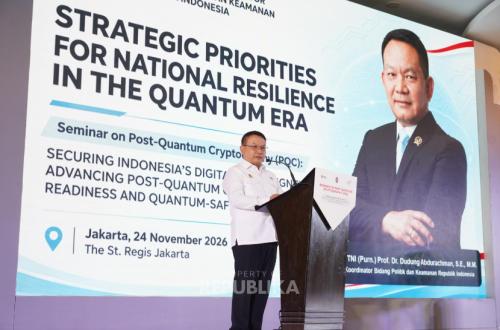
JAKARTA — Indonesia is beginning preparations to migrate to Post-Quantum Cryptography (PQC) to address the potential threat that quantum computing poses to national digital systems.
The preparations are being undertaken through the National PQC Migration Task Force, established by the National Cyber and Crypto Agency (BSSN). It has three working groups: technical, policy, and industry and talent.
PQC readiness was discussed at the International Seminar on Post-Quantum Cryptography, themed “Securing Indonesia’s Digital Sovereignty: Advancing Post-Quantum Cryptography Readiness and Quantum-Safe Infrastructure”. The seminar was held in Jakarta on Tuesday (24 November) by the Coordinating Ministry for Political and Security Affairs (Kemenko Polkam) and PT Telkom Indonesia (Persero) Tbk.
At the event, Kemenko Polkam, BSSN, the Ministry of Communication and Digital Affairs (Komdigi), the Ministry of Higher Education, Science and Technology (Kemdiktisaintek), Danantara Indonesia, the Financial Services Authority (OJK), Peruri, the National Research and Innovation Agency (BRIN), and Telkom declared their intent to collaborate on strengthening digital sovereignty through PQC readiness.
The collaboration is focused on three areas: raising understanding of the risks of quantum computing and the urgency of PQC; promoting readiness for system migration by identifying priority areas and strategic steps; and strengthening the innovation ecosystem through capability development, trials and PQC implementation.
Advances in quantum computing could threaten public-key cryptographic systems such as RSA and ECC, which are currently used to protect a range of digital systems, including government communications, financial transactions and citizens’ identities.
One risk under consideration is the “Harvest Now, Decrypt Later” approach. Under this scenario, encrypted data intercepted and collected today could potentially be decrypted in the future as quantum computing capabilities develop.
Coordinating Minister for Political and Security Affairs Dudung Abdurachman said the threat was directly related to national sovereignty and security.
“If our state secrets can be exposed by others without our knowledge, are we still fully sovereign? That is why this is not merely a technology issue. It is an issue of national sovereignty and security,” Dudung said.
BSSN has issued PQC migration guidance and is preparing a national roadmap. Under this framework, Kemenko Polkam will coordinate across ministries and agencies, while BSSN will lead the development of standards, technical guidance and the roadmap.
Kemdiktisaintek, BRIN and universities are expected to prepare research and talent. Danantara will set migration priorities for strategic state-owned enterprise assets, while Komdigi and OJK will prepare their respective sectors. Telkom and Peruri will act as pioneers in implementation.
Dudung also urged ministries and agencies to appoint officials responsible for the work, map critical systems and align their migration plans with BSSN’s guidance.
“The quantum threat has not fully arrived, but sovereignty is not protected by waiting, and we can choose to be ready for it. Sovereignty is protected by preparing through multi-stakeholder collaboration. Let us make Indonesia ready for the quantum era,” he said.
Telkom President Director Nanang Hendarno said readiness for the quantum era required coordination across institutions because cryptography underpins a range of digital services.
“Readiness for the quantum era cannot be built by a single institution, because cryptography is the foundation of almost all digital services, from networks and digital identities to financial transaction data and national strategic information. That is why Telkom sees PQC readiness as a shared ecosystem agenda, not merely a technology migration. It is part of our efforts to safeguard Indonesia’s digital sovereignty and national resilience over the long term,” Nanang said.
As a follow-up, the parties will carry out the task force’s agenda, inventory and assess cryptographic assets, draw up a roadmap and jointly monitor migration progress. These steps will be aligned with the national PQC migration roadmap being prepared by BSSN.
“Telkom operates networks, data centres, cloud services and other services that support the digital communications of government, industries, state-owned enterprises and, of course, the public. Telkom’s capacity as the national digital backbone can therefore provide practical support to the task force as it prepares quantum-safe national digital infrastructure,” Nanang concluded.
Source: jawawa.id (https://jawawa.id/newsitem/coordinating-ministry-and-telkom-promote-national-readiness-for-post-quantum-cryptography-1795575134)
Originally published by Republika (https://ekonomi.republika.co.id/berita/tp1d8r370/kemenko-polkam-dan-telkom-dorong-kesiapan-kriptografi-tahan-kuantum-nasional), translated from Indonesian