
Coordinating Minister Sugiono Praises PRR Task Force’s Work to Restore Sumatra
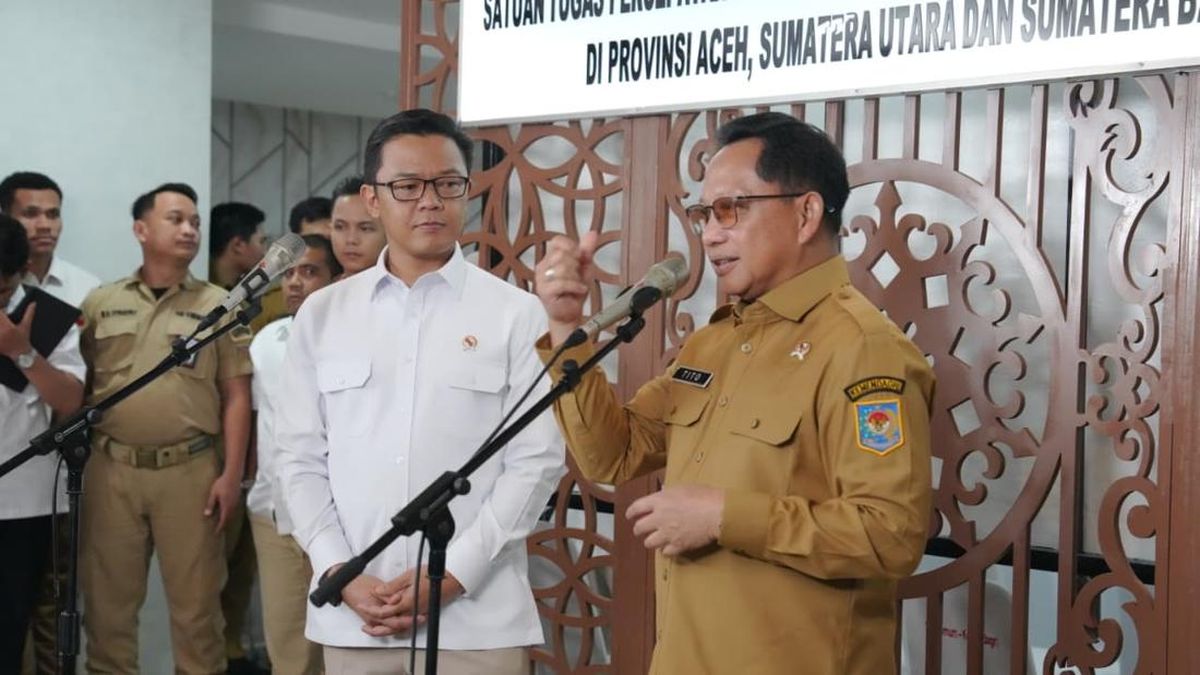
Coordinating Minister for Human Development and Culture Sugiono praised the work of the Rehabilitation and Reconstruction Acceleration Task Force (PRR Task Force) in restoring areas of Sumatra affected by disasters.
After around 11 months of recovery efforts, most rehabilitation and reconstruction work has reportedly been completed. Alongside this progress, Sugiono stressed the importance of factoring climate-change mitigation into recovery planning to prepare for future disaster risks.
Sugiono made the remarks during a visit to the National Post of the PRR Task Force for Post-Disaster Sumatra at the Ministry of Home Affairs headquarters in Jakarta on Monday (26 October).
On his first visit in his capacity as Coordinating Minister for Human Development and Culture and Chair of the PRR Task Force’s Steering Committee, Sugiono received an update on recovery efforts from Home Affairs Minister Muhammad Tito Karnavian, who chairs the task force. The briefing covered progress as well as continuing challenges.
Sugiono said the government’s efforts demonstrated its hard work in fulfilling its responsibility to serve communities in affected areas.
These efforts include issuing regulations, providing budget support, and restoring basic facilities and services in Aceh, North Sumatra and West Sumatra.
“I think this is extraordinary hard work that deserves recognition. Despite the various circumstances, the government led by President Prabowo Subianto has still been able to fulfil its responsibility to serve the public and address problems in disaster-affected areas,” Sugiono said.
As well as ensuring the recovery continues, Sugiono called for stronger preparedness for potential future disasters.
He said climate change could affect rainfall patterns in Indonesia. Areas north of the equator are expected to see increased rainfall, while areas to the south are likely to be drier than normal over the coming decades.
“Therefore, we must also factor mitigation efforts into our planning, so that if a disaster occurs we are better prepared and can carry out response and rehabilitation efforts as quickly as possible,” Sugiono said.
He emphasised that recovery efforts must continue to be strengthened through coordination between central and local governments and all relevant parties.
Accelerating the completion of outstanding work must go hand in hand with climate-change mitigation planning, so that the government and communities are better prepared for future disaster risks.
Tito said subsequent disasters remained one of the challenges facing rehabilitation and reconstruction efforts.
Heavy rainfall has triggered flooding again in several areas, including Padang and Solok in West Sumatra, Central Tapanuli in North Sumatra, and several parts of Aceh.
Tito explained that sediment build-up in affected rivers increases the risk of overflow during heavy rain, damaging some infrastructure that had already been repaired. River management therefore needs to be accelerated to reduce the risk of further flooding.
He said accelerating work on 137 rivers affected by sedimentation in Aceh, North Sumatra and West Sumatra should be part of efforts to reduce the risk of renewed flooding.
He called on the Ministry of Public Works to support and speed up river clearance and management, so that rehabilitation and reconstruction in affected areas can proceed more effectively.