
Coordinating Minister introduces BRIN's 'Lahsamor' to reduce organic waste
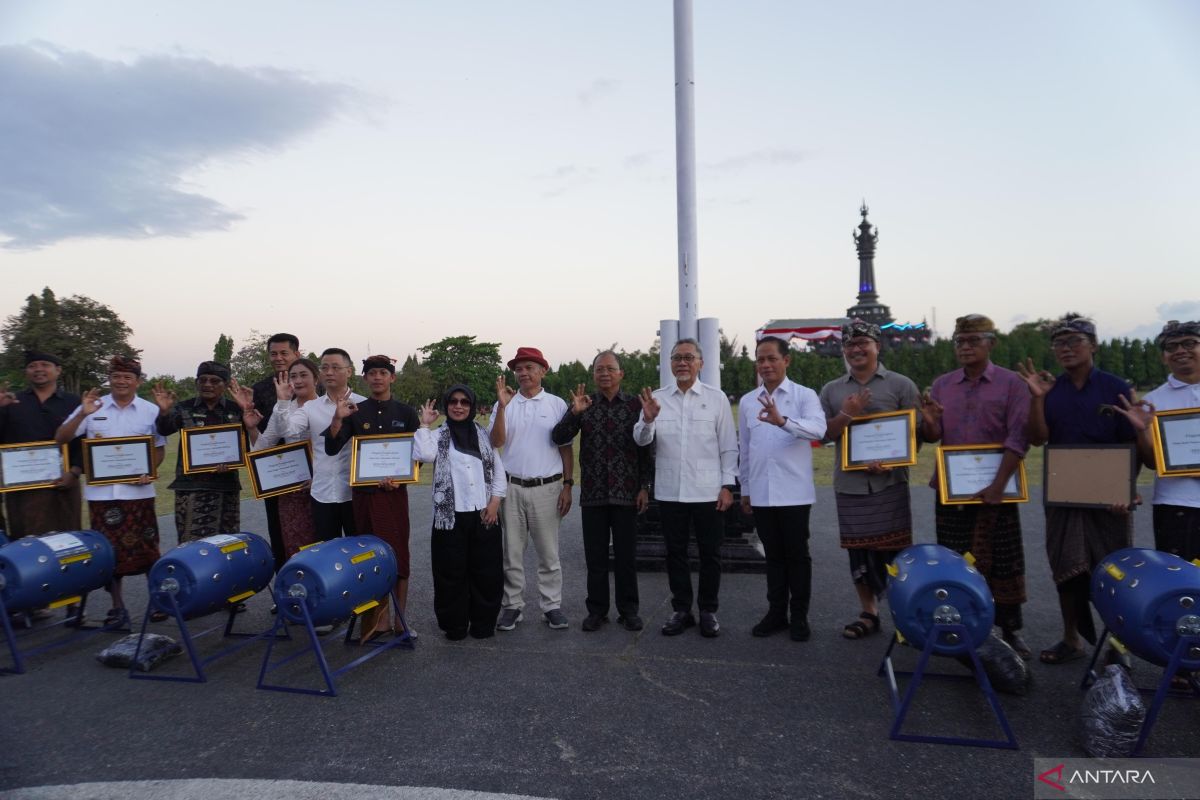
Denpasar (ANTARA) - The Coordinating Minister for Food Affairs, Zulkifli Hasan, has introduced organic waste processing technology, known as ‘lahsamor’, as an alternative solution to address waste management issues on the island of Bali.
“Today, we held a waste sorting assembly because the key lies in separating organic and inorganic waste. We have this tool here, which was created by BRIN,” Zulkifli stated in Denpasar on Tuesday.
During the Waste Sorting Alert Assembly at Renon Field, Zulkifli personally inspected the operational process of ‘lahsamor’, which is designed to process daily household organic waste.
Utilising drum-based technology, the device can reduce the amount of daily household waste sent to landfills by 40 per cent, although its current use is limited to a household scale.
“The device is small, but it can process 1 kg per day, and it won’t fill up for three years. However, I am also requesting larger versions. For example, a 50 kg capacity would be perfect for a single school,” said the Coordinating Minister for Food Affairs.
‘Lahsamor’ was initiated by the National Research and Innovation Agency (BRIN).
This innovation is not intended to replace existing methods, such as Bali’s ‘teba moderen’, but rather to serve as a supporting alternative for residents who are unable to implement ‘teba’ (compost pits) in their yards.
The technology works by inserting 0.5 kg to 1 kg of rotten organic waste per day and then rotating a lever five times.
What distinguishes it from the widely used compost bags is that compost bag results must be manually collected and require various mixing materials, whereas ‘lahsamor’ only requires opening and rotating the lever so that the compost falls out on its own.
Despite the emergence of various solutions, the Coordinating Minister for Food Affairs reminded that waste sorting remains the primary step in resolving waste problems.
He noted that if implementing this at home feels difficult due to the need to change habits, it should be easier to apply in schools, offices, or shopping malls, where systems are more organised.
Furthermore, once waste is sorted and organic waste is managed, larger technologies will be available to process inorganic waste, such as the Waste-to-Energy Plant (PSEL) which is scheduled to begin construction in Bali on 8 July 2026.
“We will launch the PSEL, or Waste-to-Electricity processing. This can resolve the issue of open dumping, which is currently our main problem and has reached an emergency category, as seen with the recent fire in Jatiwaringin and the tragedy in Bantar Gebang where seven people died,” Zulkifli added.