
Coordinating Minister: BPOM plays a major role in increasing Indonesia's healthy life expectancy
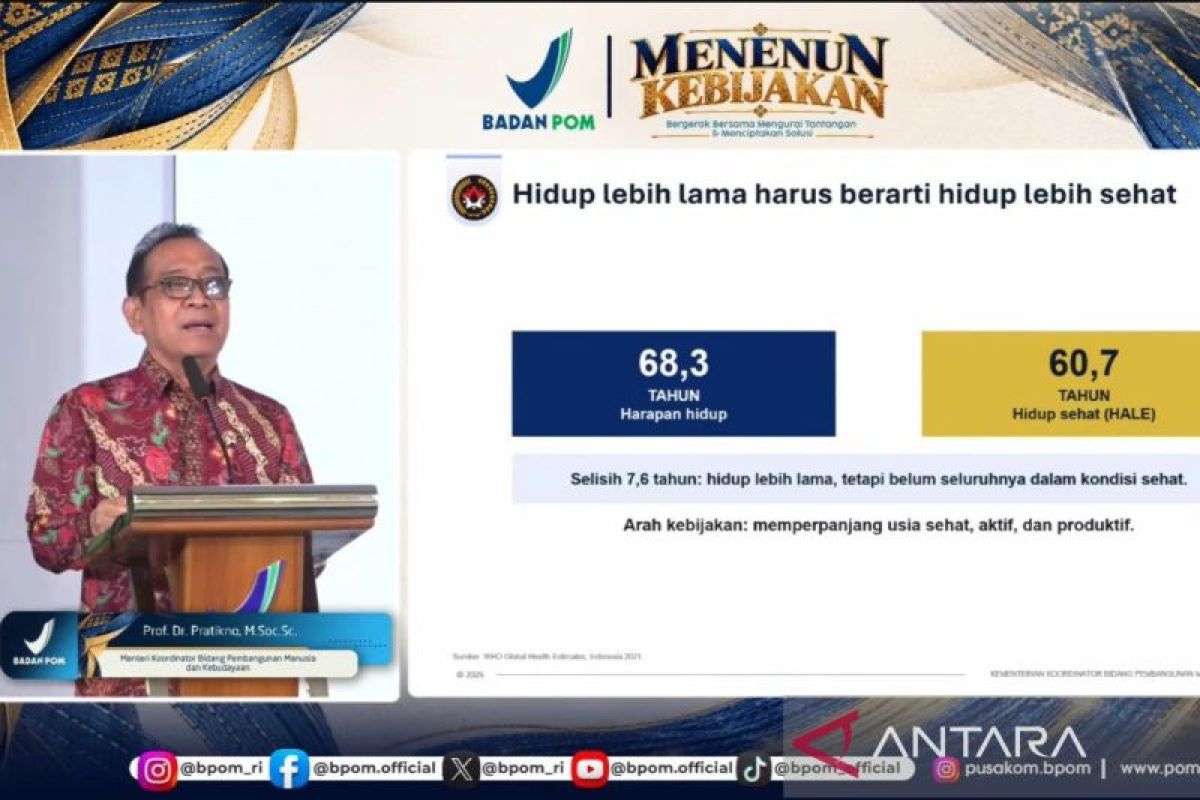
Jakarta (ANTARA) - The Coordinating Minister for Human Development and Cultural Affairs (Menko PMK), Pratikno, stated that his office is ready to coordinate efforts to strengthen the role and endeavours of the Indonesian Food and Drug Authority (BPOM) in increasing Indonesia’s healthy life expectancy and the national economy.
Speaking in Jakarta on Monday, Pratikno noted that according to data from the Central Bureau of Statistics (BPS), Indonesia’s life expectancy has risen significantly, reaching 77 years from 75.6 years in 2020. However, the challenge remains to narrow the gap between life expectancy and healthy life expectancy.
“Therefore, Healthy Life Expectancy (Hale) is a heavy task for us; we must ensure that long life expectancy does not result in a long period of inactivity and poor health,” he said.
He explained that living a long but inactive and unhealthy life would burden individuals, families, and even the state. Consequently, collaboration is required to improve Indonesia’s Hale.
The Coordinating Minister mentioned that Hale figures are closely linked to the consumption of drugs and food, two areas under BPOM’s supervision. He reminisced about his childhood, eating various fruits.
“I still love searching for kedondong when I return to my hometown, then clamping it in a door, as well as eating eels and so on. Is our food lacking? Our food might be lacking in variety, but our food was healthy,” he said.
In the past, he noted, there were no snacks like cimol or cireng. If one wanted something sweet, there was no refined sugar, so sugarcane was used. Even eating eels did not involve much oil.
Furthermore, he remarked that in the past, there were no gadgets, so children were physically active while playing games like gobak sodor. There were also no plastic bottles, meaning there was no risk of microplastics.
“There were no issues with sugar, salt, or fat that we monitor today; those problems did not exist. My point is that the presence of these modern elements often creates problems that must be supervised,” he said.
In his view, technological advancements and economic growth present new and heavy challenges for BPOM in ensuring public health through the oversight of drugs and food from upstream to downstream.
“Drugs and food must also contribute to the nation’s economy,” he added.
He pointed out that imports of medicinal raw materials still stand at 94 per cent. Similarly, imports of national medical devices are approximately 80 per cent.
“Medicines are a component of health sector consumption, and this continues to rise much higher than the growth of Gross Domestic Product (GDP). As GDP rises, health expenditure rises even faster. But where is that money going?” he questioned.
He added that BPOM’s heavy task also involves ensuring that such significant economic assets and rich biodiversity can be utilised for the people’s prosperity, such as through the development of phytopharmaceuticals.
He stated that his office is ready to support BPOM in increasing healthy life expectancy while simultaneously driving national economic development by strengthening the domestic drug and food industries.
Source: jawawa.id (https://jawawa.id/newsitem/coordinating-minister-bpom-plays-a-major-role-in-increasing-indonesias-healthy-life-expectancy-1789376821)
Originally published by Antara (Indonesian) (https://www.antaranews.com/berita/5739867/menko-pmk-bpom-berperan-besar-tingkatkan-umur-harapan-hidup-sehat-ri), translated from Indonesian