
Coordinating Minister Airlangga Pushes for IEU-CEPA Ratification, Germany Ready to Expand Investment and Technology Transfer
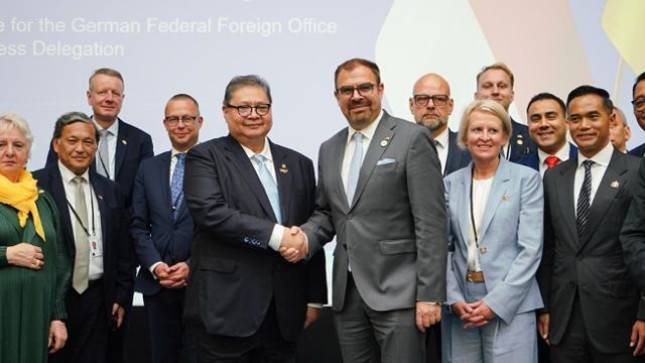
The Indonesian and German governments are strengthening their economic partnership amidst efforts to expand export markets and attract high-quality investment. A primary focus for both nations is the accelerated completion and ratification of the Indonesia-European Union Comprehensive Economic Partnership Agreement (IEU-CEPA), which is targeted for completion this year.
This commitment emerged during a meeting between the Coordinating Minister for Economic Affairs, Airlangga Hartarto, and a German business delegation led by the Minister of State at the German Federal Foreign Office, Florian Hahn, in Jakarta on Monday (15/6). The meeting was part of the state visit of German President Frank-Walter Steinmeier to Indonesia.
During the meeting, both parties discussed strengthening trade and investment, the implementation of the Joint Economic and Investment Committee (JEIC), and opportunities for cooperation in the green industry sector and human resource development.
Minister Airlangga assessed that the completion of IEU-CEPA is a strategic agenda that must be finalised promptly so that the economic benefits can be realised more quickly by both countries.
“One of the important matters this year is the ratification of IEU-CEPA,” said Minister Airlangga.
The free trade agreement is expected to eliminate tariffs on more than 98% of traded products. This move is viewed as a way to create greater space for increasing Indonesian exports to the European market while simultaneously strengthening investment flows from Germany.
Support for the completion of IEU-CEPA also came from the German Federal Government. Florian Hahn expressed optimism that the ratification process could proceed as expected.
“Indonesia is an extraordinary partner. We are ready to share expertise, innovation, and technology to realise tangible investment, including collaboration with Danantara in the future,” said Hahn.
According to him, German companies view Indonesia as a promising market and strategic partner, particularly in the renewable energy, healthcare, and various future industries sectors.
In addition to investment, the German business community also showed interest in expanding cooperation in the fields of vocational education and workforce development. The Chairman of the Indonesian Chamber of Commerce and Industry (Kadin), Anindya Bakrie, stated that Germany’s experience in producing skilled labour could serve as vital capital for the national downstreaming and industrialisation agenda.
Training programmes for the younger generation are considered to create benefits for both countries, while simultaneously strengthening the competitiveness of Indonesian industry amidst the need for high-quality human resources.
As a follow-up, the JEIC forum is scheduled to take place in September 2026 in Jakarta. The forum will be used to mature various implementation steps for economic and investment cooperation between the two nations.
Concluding the meeting, Minister Airlangga expressed his appreciation for Germany’s role as one of Europe’s economic engines. He hopes that the relationship between the two countries will not only increase trade value but also accelerate the green industrial transformation, technology transfer, and the development of more inclusive and sustainable future industries.
The strengthening of Indonesia-Germany relations serves as an important momentum for both nations to build a long-term economic partnership oriented towards sustainable growth and increased industrial competitiveness.