
Coordinating Minister Airlangga: One Day of Work from Home to Begin After Eid
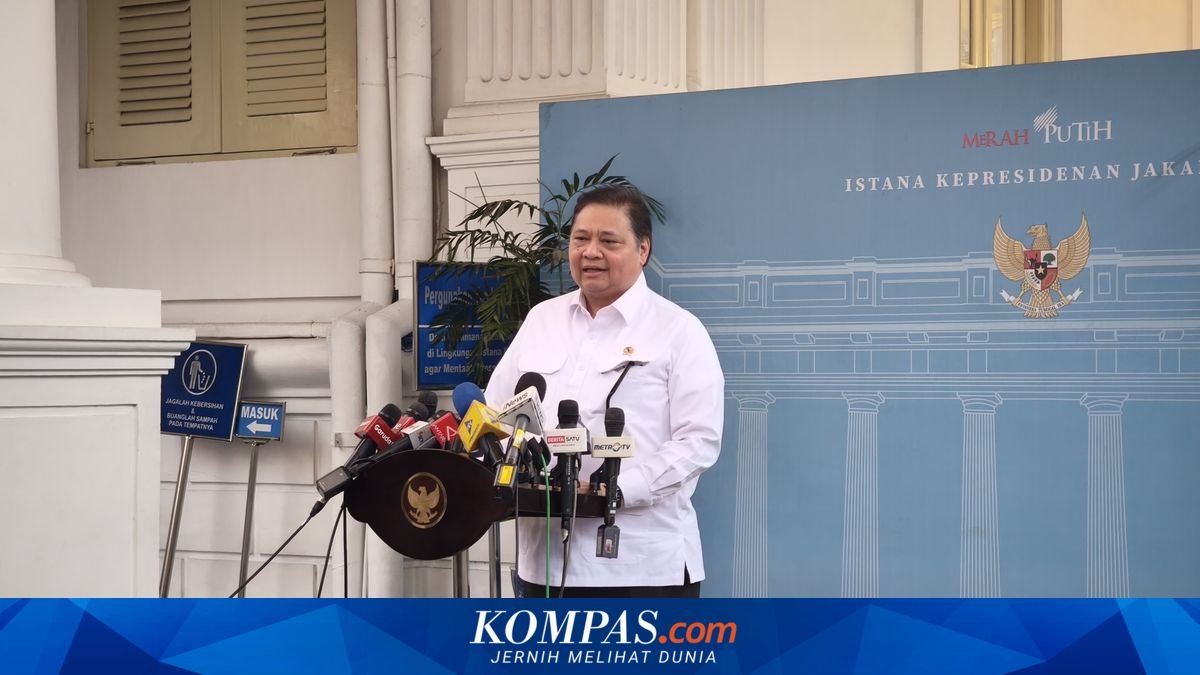
JAKARTA - The implementation of the work-from-home (WFH) policy for civil servants (ASN) and private sector employees will begin after Eid.
Coordinating Minister for the Economy Airlangga Hartarto stated that the technical aspects of the policy are still being refined.
Airlangga explained that the WFH policy for ASN and private workers is being developed to achieve savings due to the high global oil prices.
“With the high oil prices, efficiency in working hours is needed, where flexibility for work from home will be opened. For one day in every five working days,” he said.
He assured that the technical details of the WFH policy for ASN and private employees will be announced to the public once all preparations are complete.
“Well, the technicalities are being prepared, because this is expected to apply not only to ASN but also to the private sector and regional governments,” he added.
From his estimation, the policy could at least significantly save on petroleum fuel (BBM) usage.
Previously, President Prabowo Subianto planned to implement savings measures following the conflict in the Middle East after the United States (US) and Israel attacked Iran.
This was conveyed by Prabowo after explaining Pakistan’s budget-saving steps following that escalation, during a full cabinet plenary session at the State Palace, Presidential Palace Complex, Central Jakarta, on Friday (13/3/2026).
“So, I ask that this be discussed later, perhaps by the Coordinating Ministers, how many days we see. We think about it. Previously, we overcame Covid-19 successfully. And we were able,” Prabowo stated.
“For example, how many ASN and officials don’t need to go to the office, reducing traffic and carrying out major savings. Reducing working days must also be considered, and other saving measures,” he added.
On the same occasion, the Head of State asked the Indonesian government to study Pakistan’s approach, which has regarded the war between the US and Iran as a critical situation, referring to it as “critical measures”.
The former Minister of Defence explained that savings are still necessary even though the current situation has not reached the worst level.
In this way, the state budget deficit will not balloon further due to the rise in global oil prices following the conflict.
“I believe in two or three years we will be very strong, but we still need to save on consumption. In this way, we hope to always keep our deficit from increasing. Even, our aspiration is, if possible, to have no deficit,” Prabowo said.