
Coordinating Minister Airlangga: Industrial Estates Are National Economic Drivers
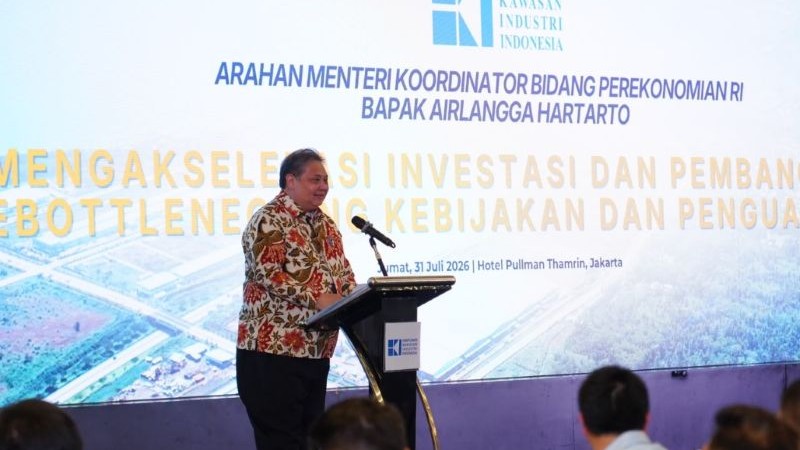
The industrial sector plays a strategic role as one of the key engines of national economic growth, through increased investment, job creation, added value and stronger competitiveness.
To support the achievement of the 8 per cent economic growth target, the Government continues to strengthen the development of industrial estates integrated with infrastructure and connectivity, whilst remaining adaptive to downstreaming, energy transition and digital transformation.
“HKI has grown into a strategic partner of national development since 1988. As we know, from Bekasi all the way to eastern Indonesia, we have built what is known as the North Java Corridor. The whole of the Northern Java Corridor is filled with industrial estates,” said Coordinating Minister for Economic Affairs Airlangga Hartarto, delivering closing remarks at the 38th Anniversary Thanksgiving Evening of the Indonesian Industrial Estates Association (HKI), part of a series of events for the Business Forum and the 25th National Working Meeting (RAKERNAS) of HKI in Jakarta on Friday (31/07).
The development of industrial estates is reflected in the existence of 129 industrial estates spread across 24 provinces, with a total land area of around 170,000 hectares. These estates host approximately 10,400 manufacturing companies and absorb around 4.5 million workers.
“Industrial estates drive the nation, create jobs and improve welfare,” the Coordinating Minister affirmed.
Amid increasingly dynamic global investment competition, Indonesia has a major opportunity to strengthen its position as one of the main investment destinations. Coordinating Minister Airlangga said a number of competing countries are beginning to face various constraints, from rising labour costs and increasingly limited land availability to energy needs.
These conditions present an opportunity for Indonesia to continue improving its competitiveness and attract quality investment. Coordinating Minister Airlangga also revealed the findings of a survey by the Japanese trade promotion body, the Japan External Trade Organization (JETRO), showing that around 70 per cent of companies investing in Indonesia record profits — the highest figure compared with a number of other countries.
Alongside technological developments, industrial estates must also become more adaptive to rapid digital transformation. Advances in Artificial Intelligence (AI) have driven increased demand for quality data and digital infrastructure, particularly data centres. The Government has anticipated these developments, among other things through the initiation of the ASEAN Digital Economy Framework Agreement (DEFA), which covers the development of the digital and AI ecosystem and is expected to further strengthen digital economic integration in the ASEAN region.
Furthermore, Coordinating Minister Airlangga affirmed that the Government will continue to promote the development of industrial estates so that industrial activity becomes better organised, has a strong ecosystem and is able to increase its contribution to national economic growth. The Government is also continuing to monitor the various challenges faced by industry players whilst pushing for the resolution of investment obstacles.
“So the Government hopes that with industrial estates, these will become better organised areas and the ecosystem will be better preserved,” the Coordinating Minister concluded.
On the same occasion, the Chairman of HKI, Akhmad Ma’ruf Maulana, said that industrial estate players remain committed to bringing in and realising investment across various regions of Indonesia.
Regarding the various issues still faced in the development of industrial estates, the Spokesperson for the Coordinating Ministry for Economic Affairs, Haryo Limanseto, reaffirmed the Government’s optimism in facing the challenges at hand.
“As the Coordinating Minister stated, today’s issues are indeed homework that needs to be resolved, and many countries face the same problems. Therefore, the Government will continue to carry out policy debottlenecking and strengthen collaboration with stakeholders so that these issues can be resolved quickly. The Government remains optimistic that these challenges will certainly be overcome,” added Haryo.
Source: jawawa.id (https://jawawa.id/newsitem/coordinating-minister-airlangga-industrial-estates-are-national-economic-drivers-1785725420)
Originally published by indonesiahousing.id (https://indonesiahousing.id/menko-airlangga-sebut-kawasan-industri-jadi-penggerak-ekonomi-nasional/), translated from Indonesian