
Coordinating Minister Airlangga: Batam Data Centre Industry Grows 22 Percent Annually
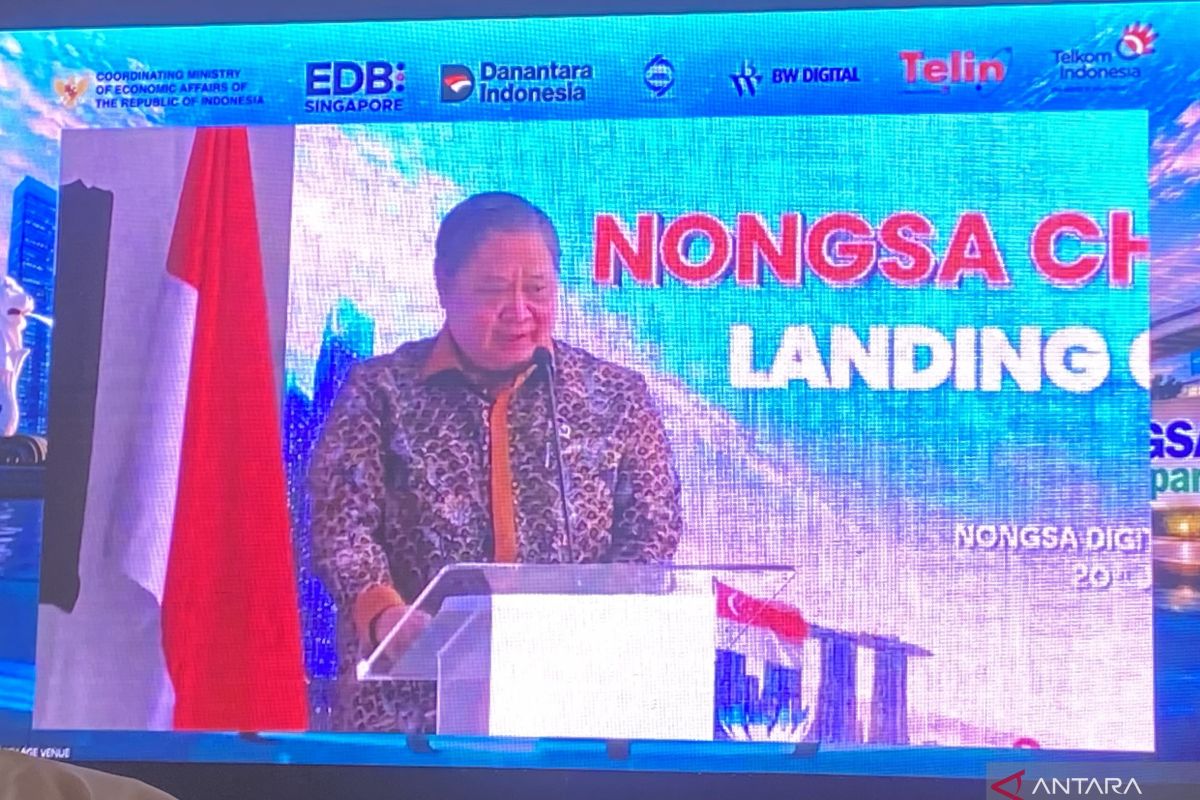
Batam (ANTARA) - Coordinating Minister for Economic Affairs Airlangga Hartarto stated that the data centre industry in Batam, Riau Islands, is growing by approximately 22 percent year-on-year (yoy), surpassing the national average growth rate of 19 percent.
Airlangga said this growth indicates that Batam is increasingly developing as one of Indonesia’s digital economy hubs, supported by international-scale investment.
“The expansion of the data centre industry in Batam is growing 22 percent annually, higher than the national average of around 19 percent. This is the right sector to drive Indonesia’s economic growth towards the eight percent target,” Airlangga said in Batam on Monday.
He made the statement after attending the inauguration of the Nongsa Changi Cable (NCC), an international undersea cable connecting Batam and Singapore to strengthen digital connectivity between the two countries.
According to Airlangga, Batam is now rapidly developing as Indonesia’s digital gateway, supported by the presence of the Nongsa Digital Park (NDP) area, which continues to attract data centre investment.
“The BW Digital facility in NDP, for example, has a capacity of up to 120 megawatts (MW). There is also a Singapore-based company, DayOne, which is developing a hyperscale data centre with a capacity of 450 MW,” he said.
Furthermore, he added, the American technology company Oracle has also chosen Batam as the location for developing a Cloud Region in the Nongsa Digital Park area.
“Batam is very quickly emerging as Indonesia’s new gateway. The incoming investment shows that this area is increasingly important in the regional digital ecosystem,” he stated.
Airlangga said this development is in line with the digital transformation that is one of the priorities of President Prabowo Subianto’s administration through the development of digital and physical infrastructure.
He explained that the world is now entering a new era marked by the utilisation of artificial intelligence (AI), thus requiring high-speed digital connectivity and large data centre capacity.
“In the AI era, humans and machines, as well as machine-to-machine interactions, require fast digital connections. Therefore, digital transformation must be supported by adequate infrastructure,” he said.
He added that Indonesia has great potential in developing the digital economy, with the number of internet users reaching 235.26 million people and approximately 99.5 million broadband subscribers.
“Indonesia is also the fourth largest potential market for artificial intelligence in Asia, after China, India, and Japan,” he added.
To support the growth of the digital industry, Airlangga said the government is also strengthening energy supply through the development of the energy mix.
“Digital infrastructure requires reliable energy and electricity. Indonesia is developing its energy and energy mix to supply these needs, such as geothermal energy in Sumatra and solar power in Batam,” he said.
In addition, Airlangga said the government is targeting an additional power generation capacity of up to 100 gigawatts (GW) in the coming years as part of the cooperation agenda between Indonesia and Singapore.