
Coordinating Minister AHY Maps Out Institutional Roles in Supporting Bali's Development
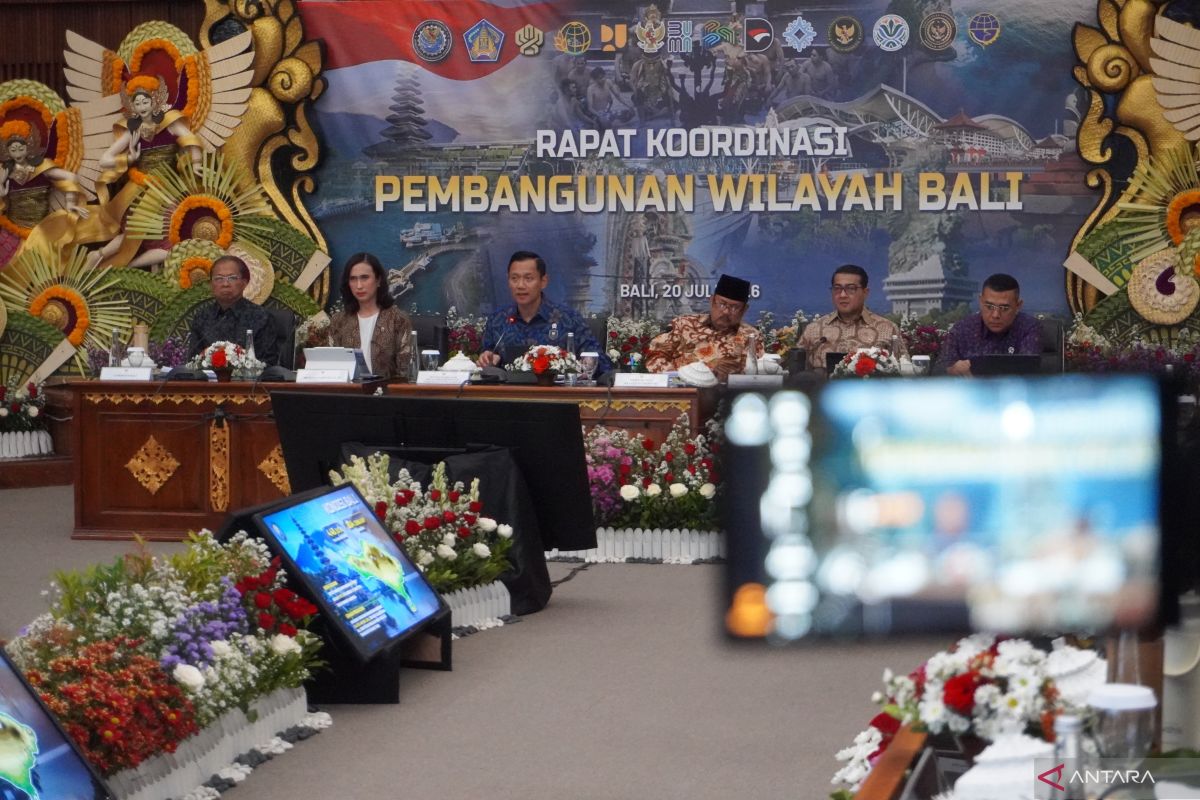
Coordinating Minister for Infrastructure and Regional Development Agus Harimurti Yudhoyono (AHY) has mapped out the roles and tasks of ministries and agencies in supporting Bali’s development.
“We are focusing on infrastructure, connectivity, and spatial planning as one inseparable, sustainable ecosystem package — this is the paradigm for Bali’s development going forward. I am laying out the specifics, which the various ministries and agencies can supplement,” said AHY.
Speaking in Denpasar on Monday, Coordinating Minister AHY began by outlining the role of the Coordinating Ministry for Food Affairs in coordinating and overseeing waste governance programmes as well as the new waste-to-energy (PSEL) technology in Bali.
In addition, it will protect food production land within the detailed spatial plan (RDTR) to safeguard food security.
Next, for the Ministry of National Development Planning/Bappenas, which was attended directly by Minister Rachmat Pambudy, AHY wants to ensure that Bali’s development is integrated between the National Medium-Term Development Plan (RPJMN) and the Regional Medium-Term Development Plan (RPJMD), while also pushing for funding facilitation.
“Without adequate funding, it will be difficult to develop and build up the region, especially in the infrastructure sector,” said Coordinating Minister AHY.
Third, to the Ministry of Tourism, which was attended by Minister Widiyanti Putri Wardhana, AHY requested the drafting of a masterplan for tourist dispersal to reduce the concentration of visits in South Bali, as well as integrating destination development with connectivity, basic services, environmental management, and community empowerment.
For the Ministry of Creative Economy, attended by Minister Teuku Rifky, Coordinating Minister AHY urged the development of certification and mentoring programmes for creative economy actors, and encouraged the growth of the creative economy in North, West, and East Bali.
Moving on, the Ministry of Agrarian Affairs and Spatial Planning (ATR)/National Land Agency (BPN), attended by Deputy Minister Ossy Dermawan, is tasked with ensuring that the Regional Spatial Plan (RTRW) accommodates the legality of land for strategic infrastructure projects, as well as addressing waste issues, protecting food-producing areas and subak (traditional rice terrace irrigation), and cracking down on commercial spatial planning violations that have encroached on coastal and river buffer zones.
The Ministry of Public Works, in supporting Bali’s development, was asked to support the construction of breakwaters in line with technical study findings, as well as a sea taxi service.
“This water taxi is expected to be one effective solution. The Coordinating Ministry for Infrastructure will follow up together with the Ministry of Public Works and the Ministry of Transport. We also hope the Ministry of Public Works will ensure the optimisation of Reduce, Reuse, Recycle waste processing facilities (TPS3R) and regional integrated waste processing facilities (TPST),” said AHY.
The Coordinating Minister for Infrastructure then requested the Ministry of Transport to assist with the feasibility study for the planned sea taxi network along Bali’s southern coast.
On infrastructure matters, Coordinating Minister AHY also asked PT Angkutan Sungai Danau dan Penyeberangan (ASDP), the ferry operator, to be involved in preparing the technical and operational assessment.
Meanwhile, for the Provincial Government of Bali, he asked that waste management education be integrated early on into environmental education and local content in schools.
“I believe this is everyone’s task. Many say it is indeed quicker to raise a nation’s intellectual capacity than to build a clean character and culture. We can learn from advanced nations and modern cities that are clean and orderly,” he said.
In addition, the regional government was asked to strengthen enforcement of waste management regulations, form a coordination unit between regional government and the ministries and agencies, synchronise regency/municipal RTRWs with the national plan, prepare land, permits, and operational support for priority projects, and strengthen control over land conversion.