
Coordinating Minister AHY Breaks Ground on Summarecon Transit Oriented Development at Bekasi Extension Station
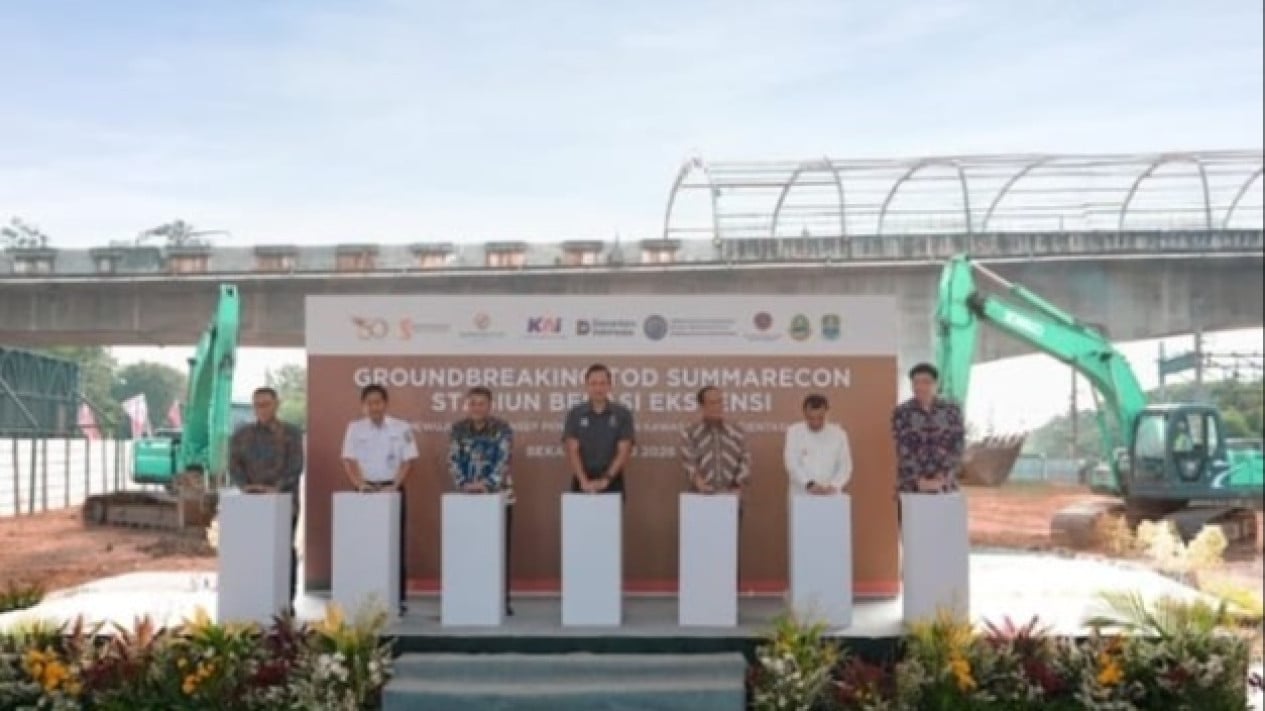
Coordinating Minister for Infrastructure and Regional Development, Agus Harimurti Yudhoyono or AHY, held a groundbreaking ceremony to mark the start of construction of the Bekasi Extension Station, which forms part of the Summarecon Transit Oriented Development (TOD).
AHY said he warmly welcomed the initiative, noting that the development of the Bekasi Extension Station is not merely physical infrastructure.
“The hope is that it will also become an increasingly productive area supporting mobility, ease of community activity, and development in line with the principles of Indonesia’s Transit Oriented Development (TOD),” AHY said in a statement on Saturday, 25 July 2026.
Adrianto P. Adhi, President Director of PT Summarecon Agung Tbk, said the construction of the Bekasi Extension Station as part of the Summarecon TOD reflects synergy between the private sector and the government in realising the concept of transit-oriented area development.
Previously, when it began developing Summarecon Bekasi in 2010, Summarecon built the one-kilometre K.H. Noer Ali Summarecon Bekasi flyover.
Built spanning the railway crossing, it has eased connectivity for Bekasi residents living on the northern and southern sides of the railway line, and served as a solution to easing the congestion that frequently occurred on Jalan Perjuangan.
“We are grateful that today Summarecon has once again been given the opportunity to play a role in meeting the needs of the Indonesian people, particularly in the Bekasi area,” said Adrianto.
He affirmed that Summarecon also wishes to play a part, through a partnership with the Government, in improving accessibility services for the public so that people can enjoy greater ease and comfort in accessing mass transport, namely the railway.
With the presence of the Bekasi Extension Station as part of the Summarecon TOD, he is confident that Bekasi residents will be spared the concentration of passenger build-up. This is because the Bekasi Extension Station, in his view, will serve passengers arriving from the west and south, while the existing Bekasi Station will primarily serve residents from the north and east.
“This initiative will support more efficient public mobility, improve connectivity across the area, and create a more sustainable urban environment,” he said.