
Cooperatives Trapped in Regulatory Maze, BULD of DPD RI Urges Immediate Alignment of Regulations
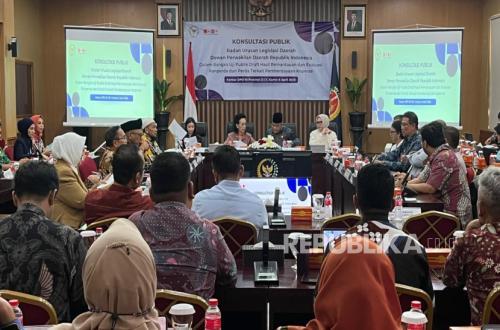
Concerns over the weakening condition of cooperatives in various regions emerged during the Public Examination of the Draft Monitoring and Evaluation Results on cooperative empowerment regulations, held by the Regional Legislative Affairs Body (BULD) of DPD RI at the DPD RI DIY Office on Thursday (9/4/2026). The forum spotlighted the emergency state of cooperatives in the regions, trapped in regulatory disharmony and the threat of mass inactivity.
Deputy Chair of DPD RI for Regional Autonomy, Politics, and Law, GKR Hemas, reminded that cooperatives are an essential foundation of the national economy that must not be neglected. She highlighted monitoring results from 38 provinces showing that the majority of cooperatives are inactive or in a “living dead” state.
“Monitoring results from the DPD’s Regional Legislative Affairs Body (BULD) in 38 provinces indicate that each province is experiencing erosion. We have found a painful irony amid technological advancements, many of our cooperatives are instead in a living dead state; the figure of 80-90 percent inactive cooperatives in various regions is not just a statistic, it is a danger signal for our economic democracy,” said GKR Hemas during her keynote speech at the event on Thursday (9/4/2026).
GKR Hemas spotlighted the main issues causing cooperatives to lose their vitality, one of which is overlapping regulations leading to confusion at the regional level. Cooperatives, she continued, are trapped between various unsynchronised policies.
“We are trapped in a regulatory labyrinth between the fast-paced spirit of the Job Creation Law and the outdated Cooperatives Law. We see confusion at the village level regarding the operations of KMP, Merah Putih cooperatives, and their position relative to Village-Owned Enterprises (BUMDES). Without a cooperative policy direction, cooperatives will only become historical artefacts and engines of demise,” she stated.
GKR Hemas also emphasised that cooperatives are not merely an economic concept but part of the nation’s struggle history. Therefore, their existence must be continuously maintained and strengthened. Cooperatives must not be left alone, let alone allowed to become living dead.
Therefore, GKR Hemas urged the central government to immediately harmonise regulations so that cooperatives have legal certainty and a clear development direction. She also asked local governments not to treat cooperatives merely as administrative objects but as primary subjects of economic development.
“To local governments, we remind you of the mandate not to view cooperatives only as administrative objects but as subjects of development. Formulate innovative policies, provide real assistance, and make cooperatives the vanguard in resolving poverty in respective regions,” she said.
GKR Hemas assured that the results of this public examination represent the voice of the regions that must be seriously followed up by the government. The recommendations produced are hoped to serve as a foundation in saving cooperatives from decline. The revival of cooperatives is a collective responsibility. She invited all parties to re-strengthen the spirit of collectivity in building a cooperative-based economy.
“This document is not just a pile of papers but a sacred mandate to save the people’s economy. Do not let the best recommendations for this nation merely be stored in bureaucratic drawers,” she revealed.
In agreement, Head of BULD DPD RI, Abdul Hamid, reminded that policies too focused on forming new cooperatives risk weakening existing ones. He assessed that consolidation is needed to keep the cooperative movement strong and sustainable.
“We have found significant disharmony between the Cooperatives Law and various technical regulations related to Merah Putih Village Cooperatives. Current central policies tend to focus on forming new units without strengthening existing cooperatives, which risks weakening the national cooperative movement consolidation,” said Abdul Hamid.
Abdul Hamid explained that BULD DPD RI monitoring results show that not all regions have adequate regulations as a basis for cooperative empowerment. On the other hand, central policies often produce technical rules that exceed legislative authority, thus triggering potential norm conflicts.
According to him, this condition not only creates legal uncertainty but also directly impacts cooperative performance in the field. Moreover, policies too oriented towards forming new cooperatives are seen as risking institutional fragmentation.
“Policies are still focused on forming new cooperatives without strengthening existing ones. This has the potential to cause institutional fragmentation and weaken the structure of running cooperatives,” he stated.
In addition, Abdul Hamid also highlighted the cooperative funding scheme that is not fully supported by human resource readiness and adequate governance. This is assessed to create new risks in cooperative management, especially at the village level. He emphasised the importance of quick steps from the central government to harmonise regulations, including accelerating the revision of Law Number 25 of 1992 on Cooperatives, which is deemed no longer relevant to current developments.
DPD RI, he continued, also encourages national policies to focus more on strengthening existing cooperatives before forming new ones. Thus, the sustainability and competitiveness of cooperatives can be maintained.
Not only that, he also stressed the importance of legal protection for village officials in implementing village fund-based cooperative programmes, as well as the need for integrated cross-sector policies to avoid overlapping authorities.
“We encourage national cooperative empowerment policies that focus on strengthening existing cooperatives, both primary and secondary, before forming new ones,” he said.
Member of BULD DPD RI, R.A. Yashinta Sekarwangi Mega, emphasised that DPD RI serves as a legislative bridge. This activity also gathers i