
Cooperatives Ministry Reports 2025 Budget Absorption Reaches Rp1 Trillion
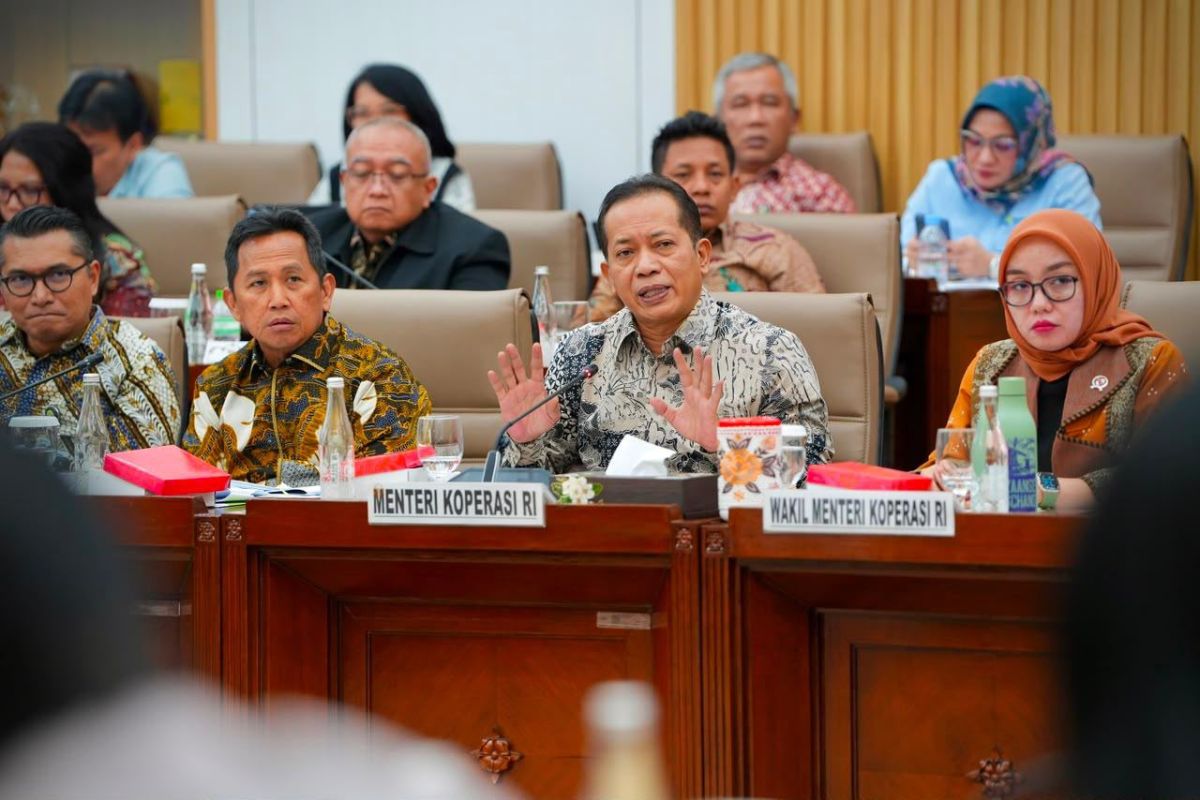
Jakarta (ANTARA) - The Ministry of Cooperatives reported budget realisation for 2025 of Rp1.006 trillion, or 87.25 per cent of its effective ceiling of Rp1.153 trillion, with additional funding focused on accelerating implementation of the Red and White Village/Urban Ward Cooperatives (KDKMP) programme.
Minister of Cooperatives Ferry Juliantono, speaking at a working meeting with Commission VI of the House of Representatives (DPR RI) in Jakarta on Wednesday, explained that the realisation was supported by additional spending of Rp744.44 billion and the unblocking of Rp91.38 billion in funds, bringing the ministry’s final ceiling to Rp1.217 trillion.
According to him, the additional budget was allocated to accelerate the implementation of various national priority programmes, especially the KDKMP programme.
He said the majority of work units at the central level recorded budget realisation above 93 per cent, with some even reaching around 97 per cent.
Nevertheless, Ferry acknowledged that absorption of Deconcentration Funds in the regions still faced challenges. By the end of 2025, realisation of the Deconcentration Funds stood at 81.22 per cent of the total Rp652.6 billion.
According to him, these funds were used for training KDKMP administrators and providing facilitators across all provinces.
“The workload and the distribution of KDKMP across Indonesia pose their own challenge for us in delivering facilitation and training, particularly for regions with very large areas,” he said.
Throughout 2025, the budget was used to train more than 15,000 KDKMP facilitators, 143,000 KDKMP administrators, and 206,000 cooperative human resources.
In addition, the budget was also used to integrate 69 cooperatives into the Free Nutritious Meals (MBG) programme ecosystem.
During the meeting, Commission VI of the DPR RI, in one of its concluding points, asked the Ministry of Cooperatives to accelerate the operationalisation of KDKMP by ensuring that cooperatives already established have business activities, access to financing, and adequate facilitation so that they deliver tangible economic benefits.
To date, only 1,061 KDKMP have been officially inaugurated and are operating in Central Java and East Java. The government aims to have 40,000 KDKMP operating by the end of this year.