
Cooking Plastic Waste into Diesel Fuel at a Waste Bank in Cimahi City
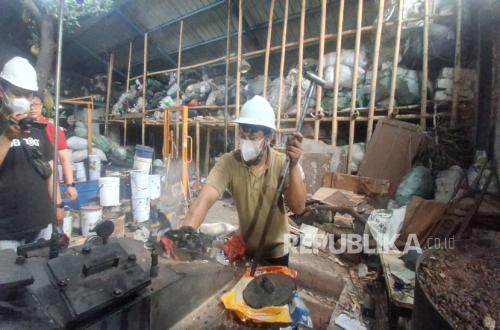
REPUBLIKA.CO.ID, CIMAHI – Plastic waste is considered a problem because it is difficult to decompose, but that does not mean there is no solution. In Cimahi City, West Java, even low-value plastics are converted into diesel fuel (BBM) that is highly sought after by buyers.
A warehouse in Melong Ward, South Cimahi Subdistrict, Cimahi City, has been transformed into the Main Waste Resource Bank (BSSI) - Melong 26. There, the process begins with low-value plastic waste arriving, followed by shredding, and then cooking using the Pieolisis Fastpol machine until it becomes diesel fuel or Petasol.
Republika had the opportunity to witness the process of converting low-value plastic waste into fuel on Tuesday (28/4/2026). The plastic waste sent by customers is shredded first and then fed into the machine for a cooking process that takes about 8 hours before finally becoming fuel.
“If here it’s only been running for almost a year. This Petasol is equivalent to premium diesel with the highest quality,” said Lionardo Sutandi, one of the founders of BSSI-Melong 26.
Adopting the method used by the Banjarnegara Waste Bank (BSB) in Central Java, which has been operating to process plastic waste into diesel fuel since 2014, Lionardo said the idea also stemmed from confusion over how to manage low-economic-value plastic waste.
In Banjarnegara, they developed a pyrolysis machine that, in principle, can convert plastic into gas. The pyrolysis machine consists of four main components, including a reactor, furnace heating system, condenser, and storage tank.
“Low-value plastic was confusing what to do with it, eventually burned. Well, we were restless, then tried to find a solution, and it turned out that plastic waste can be converted into fuel, can be processed into renewable fuel oil,” said Lionardi.
Their step to convert plastic into fuel is actually as simple as returning the item to its origin. Because plastic originates from petroleum and natural gas. Thus, when processed in the pyrolysis machine, in principle, they are returning the plastic to its source.
“Plastic has long carbon chains, thousands of carbon chains. We break it into short carbon chains, namely diesel, and it turns out it works. So, this tool breaks the long carbon chains originating from it into just 5-20 carbon chains, namely diesel. The form becomes liquid,” said Lionardi.
The diesel fuel they produce is named Petasol, which means Polyethylene to Alternative Solar or can be interpreted as plastic becoming alternative diesel through the series of processing mentioned earlier.
Lionardi stated that currently, the production capacity of Petasol through the sixth-generation pyrolysis machine reaches 75 kilograms of plastic waste every day. The type of waste they process is all types except those made from PVC. The total diesel produced in one production reaches 60-70 litres only.
“This machine has a capacity of 75 kilograms per day, but with the current raw material quality, on average we get 60-75 percent. So, approximately 60 to 70 litres of fuel that we can produce,” explained Lionardi.