
Controversy Over New Residents’ Contribution in Bantul, Nearly Half the Minimum Wage
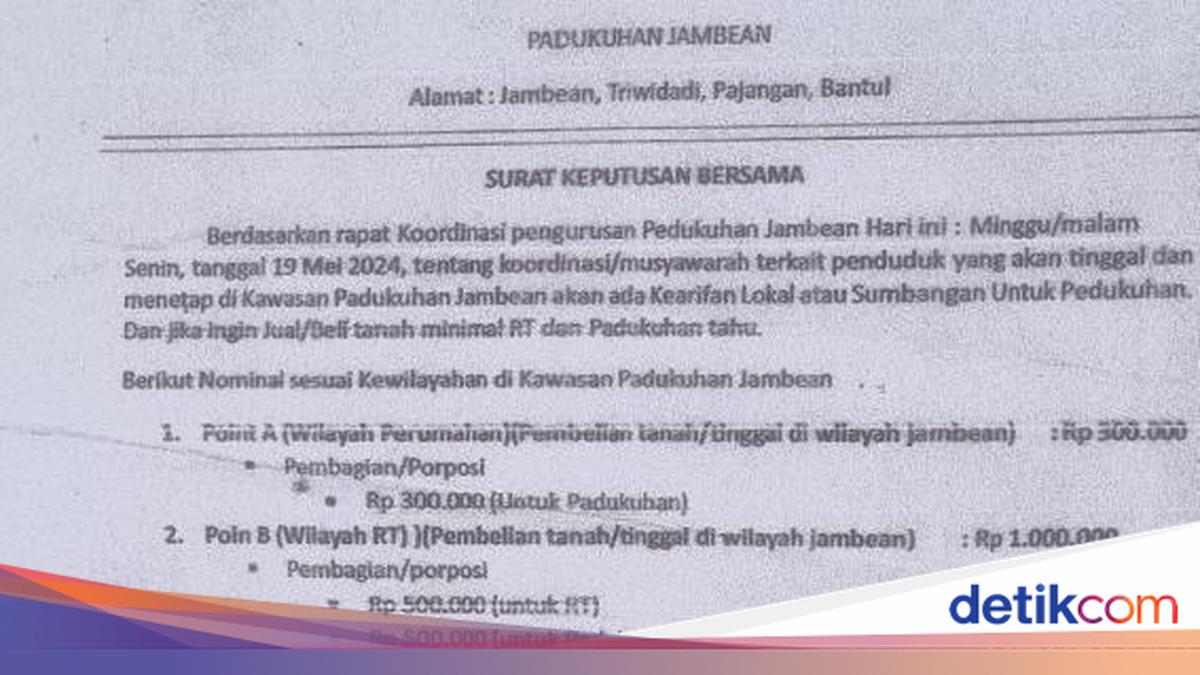
A social media post by a resident who objected to being asked to pay up to Rp300,000 to obtain a domicile certificate in Jambean, Triwidadi, Pajangan, Bantul, went viral. The local hamlet head clarified that the contribution was not compulsory.
Some contributions approach half the minimum wage
“Asked to pay Rp300,000 for a domicile certificate, alleged levy in Bantul exposed on Threads.” A Threads post recounted that someone’s friend had allegedly been asked to pay Rp300,000 while arranging a domicile certificate in Padukuhan Jambean, Triwidadi, Pajangan, Bantul. The post said the incident took place on 16 July 2026 and that payment was reportedly transferred to an account in the hamlet head’s name, without a receipt, according to the Instagram account @jogja.vibes, as seen by detikJogja on Monday (12 October).
“The same post also showed a document dated 14 May 2024 setting out an agreement on contributions from people buying land or settling in Jambean. It lists Rp300,000 for the housing estate and Rp1 million for the neighbourhood units. However, the connection between that document and the payment described has not been verified. There has been no official explanation from the parties concerned about the basis for the payment or the status of the agreement,” the account added.
A contribution of Rp1 million for a neighbourhood unit amounts to nearly half Bantul’s regional minimum wage (UMR). Bantul’s UMR for 2026 is Rp2,509,001.
Contribution intended for hamlet development
Triwidadi village head Slamet Riyadi said he had summoned the Jambean hamlet head. He said it had emerged that the payment was not for issuing a domicile certificate.
“We need to make clear that this has nothing to do with administrative services. I read on social media that it concerned someone seeking a domicile certificate and being charged Rp300,000,” he told reporters at the Triwidadi village office in Pajangan, Bantul, on Monday (12 October).
According to the hamlet head, the contribution was intended for development in Jambean, both physical and non-physical.
“So it was not a levy related to an application for domicile. It was an agreement reached between the community—in this case, the people of Jambean—and residents of the housing estate to contribute Rp300,000 towards development in the area,” he said.
Slamet said the complainant may have misunderstood the Jambean hamlet head. The latter had presented a joint decision on contributions to the development of Padukuhan Jambean while the resident was arranging a domicile certificate.
“The resident had not communicated properly, and the information happened to be conveyed by the hamlet head when they were applying for a domicile certificate,” he said.
Slamet also said the resident had not paid the Rp300,000. The domicile certificate was already being processed and was free of charge.
“The person concerned has not paid the Rp300,000, although some other residents have. We have also prepared the domicile certificate, and it is free,” he said.
Bantul regency says it was not an illegal levy
The Bantul Regency Government, through its regional inspectorate, said it had summoned the village head, the hamlet head and the residents’ association chair. It concluded that the contribution did not constitute an illegal levy.
“It has been dealt with. We summoned the complainant, the hamlet head, the neighbourhood head, the association chair and the village head. Based on the facts we examined, the statements and the evidence, we did not conclude that this was an illegal levy,” Bantul Regional Inspector Trisna Manurung told reporters at the inspectorate office on Tuesday (13 October 2026).
Trisna said an illegal levy is, in effect, a charge imposed without a regulatory basis and under compulsion. This could include a situation in which someone who did not pay was denied a service or forced to leave their home.
“After looking into it, we found there was no compulsion, and the complainant did not pay. We can debate the regulatory basis, even though one exists, but clearly there was no coercion, since only a few people had paid,” he said.
“It was also not linked to services provided by the neighbourhood or hamlet. The person concerned still received a domicile certificate, and there was no discrimination or prohibition on living there,” Trisna added.
On the rules governing the contribution, Trisna said it was based on a joint decision signed by the Jambean hamlet head, the heads of seven neighbourhood units and the housing association chair.
“The regulatory basis is a joint decision between the neighbourhood heads, the hamlet head and the association chair. The point now under debate is that, in the hierarchy of legal instruments, the basis should arguably be a village regulation,” he said.
Trisna said the joint decision had been reached by consensus, which he said satisfied democratic principles and involved no coercion.
“Perhaps the regulatory basis is not strong enough, but there was deliberation and consensus, which meet democratic principles. There was no coercion, and the complainant did not pay,” he said.
He added that the inspectorate had traced how the money collected from some residents was used.
“We also looked into it, and it was indeed distributed to the neighbourhood units,” he said.
Nevertheless, Trisna said the contribution should be reviewed and discussed again. His first recommendation was to consider formalising it through a higher-level regulation, such as a village regulation (Perdes).
His second recommendation was that an accountability report (SPJ) be provided to residents to demonstrate that the money was being spent for their benefit.
The third recommendation was to ensure that residents were fully informed about the contribution. Trisna said the most important step was to review the joint decision.
“What matters is reviewing the joint decision they made. If it is not suitable as a regulation, then raise it to the next level, such as a village regulation. Otherwise, discuss whether it should continue or be stopped,” he said.
Asked whether the contribution should continue, Trisna recommended suspending it while it was reviewed, with residents involved in deliberations.
“Our advice is: if possible, suspend it, evaluate it and discuss it first. Some may agree and others may not. Contributions should ideally be set out at least in a village regulation, but consensus and deliberation must also be respected,” he said.
Hamlet head says contribution was voluntary
Jambean hamlet head Hendi said the contribution was voluntary. From 2024 to 2026, he said, fewer than 10 people had contributed.
“Not everyone contributes in practice, and we do not force anyone. From 2024 to 2026, only four people have contributed, all of them from the housing estate,” he said at his home.
Hendi said the contribution had been agreed in 2024 with all local stakeholders, including neighbourhood representatives and the housing estate.
The joint decision set contribution amounts for new residents settling in the housing estate or in Jambean’s seven neighbourhood units, ranging from hundreds of thousands to millions of rupiah.
“For a neighbourhood unit, the contribution for a new resident is around Rp1 million,” Hendi said.
He said the contributions were solely for the hamlet’s needs, particularly operating costs for community activities. These included the Posyandu maternal and child health post, road repairs, neighbourhood events, Independence Day celebrations and some activities organised by Jambean’s youth.
Hendi said he did not pursue or pressure residents who chose not to contribute. He described the payment as voluntary, intended to help develop facilities already available in the area.
“Many people do not contribute, and in practice we do not chase them or ask them to pay. Why? Because it is the community’s right, and we do not force anyone,” he said.
He added that residents who did not contribute still received administrative services. The hamlet would process a domicile certificate without charge.
“We continue to provide services. The claim going viral—that people have to pay Rp300,000 for a domicile certificate—is not true,” he said.
Further discussions planned
Hendi said residents would meet to review the contribution. If residents did not want it, the joint decision would be revoked.
“We will discuss it with all residents first, because it must be decided through deliberation,” he said.
Hendi said he felt he had been judged by the public over the contribution. He said its purpose was to encourage new residents to take part in developing their area.
“But again, if people say it should be revoked, and the Inspectorate and residents want that, we will revoke it. But we need to deliberate and discuss it first,” he said.
Source: jawawa.id (https://jawawa.id/newsitem/controversy-over-new-residents-contribution-in-bantul-nearly-half-the-minimum-wage-1792299021)
Originally published by detikJogja (https://www.detik.com/jogja/berita/d-8712235/polemik-aturan-warga-baru-jambean-bantul-harus-sumbang-kampung-nyaris-separo-umr), translated from Indonesian