
Controlled Distribution Keeps Food Prices Stable Despite Rise in Non-Subsidised Fuel Prices
The National Food Agency (Bapanas) has assured that controlled distribution is keeping national food prices stable despite the rise in non-subsidised fuel prices. Deputy for Food Availability and Stabilisation at Bapanas, I Gusti Ketut Astawa, conveyed this at the beginning of this week.
Ketut assessed that smooth distribution is a key factor in mitigating the impact of rising energy costs on food prices. As long as transport tariffs do not undergo adjustments, price pressures at the consumer level can be contained.
“We have met with the Indonesian truck operators’ association. As long as subsidised fuel is not increased, there will be no rise in transport tariffs. If distribution costs remain unchanged, food prices are still relatively safe,” he stated in Jakarta, quoted on Wednesday (22/4/2026).
This stability is reflected in the price movements of several food commodities, which remain controlled without significant spikes. Bapanas’ Food Price Panel data shows comparisons between the periods 19 February–20 March 2026 and 21 March–18 April 2026 are still within a stable range.
Medium rice was recorded to have dipped slightly from Rp 13,383 per kilogram to Rp 13,379 per kilogram. SPHP rice hovered around Rp 12,442–Rp 12,444 per kilogram. Garlic fell from Rp 38,634 to Rp 38,310 per kilogram, while curly red chillies moved from Rp 44,220 to Rp 43,281 per kilogram.
Several other commodities experienced limited fluctuations. Chicken eggs rose slightly from Rp 31,561 to Rp 31,648 per kilogram, while consumption sugar moved from Rp 18,317 to Rp 18,618 per kilogram. These movements remain within the corridor of stability.
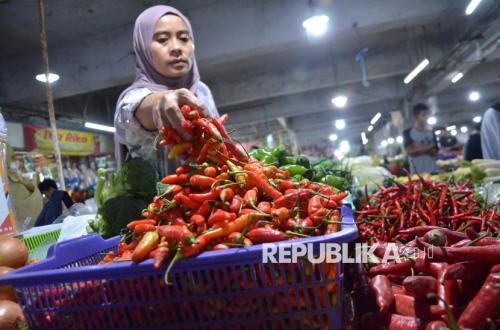
Attention is still focused on red cayenne peppers, which are at around Rp 75,726 per kilogram, or about 32 percent above the government’s reference price. Nevertheless, the price trend has begun to show a decline in recent times.
Ketut explained that the rise in red cayenne pepper prices was triggered by weather factors that hindered harvests, thus affecting market supply. “Initially, red cayenne pepper prices were high due to weather factors. During Ramadan, it rained instead, preventing farmers from picking chillies even though stocks were available. Now the price is still around Rp 70,000s and the trend is declining,” he clarified.
The government continues to maintain supply balance to support price stability. Interventions are carried out through market operations, food aid, and strengthening distribution by state-owned food enterprises.
The Head of the National Food Agency, Andi Amran Sulaiman, emphasised that food price stability is a mandate that must be upheld amid global dynamics and energy cost pressures.
“Stability of staple food prices is the President’s directive. In heated geopolitical conditions, business actors must not take excessive profits,” Amran asserted firmly.
The government has summoned importers to ensure no unjustified price surges occur. Evaluations are prepared for parties that violate regulations.