
Consumers Must Know! Understand the Technology Behind EVs Before Buying
Jakarta, CNBC Indonesia - The decision to purchase an electric vehicle often begins with the same questions: battery safety, range and distance, and durability. According to Luther Panjaitan, Head of Public and Government Relations at PT BYD Motor Indonesia, these questions are reasonable. To address them, BYD has prepared technology hidden behind each of its products.
“When the majority of global automotive manufacturers still depend on battery supply chains from third parties, BYD has already mastered the entire process itself, from battery cell chemistry to vehicle software,” he stated on Monday (6/7/2026).
He explained that this vertical approach is not merely about cost efficiency. It is a structural advantage that cannot be copied in one or two years. He added that the fear of EV batteries catching fire is not paranoia. However, BYD’s Blade Battery answers this in the most concrete way.
“In official testing, when the battery cell was pierced with a steel nail, there was no smoke, no fire, and the surface temperature remained under control,” Luther revealed.
He explained that the battery features a flat, elongated cell design arranged without intermediate modules, distributing heat evenly and significantly suppressing the risk of thermal runaway.
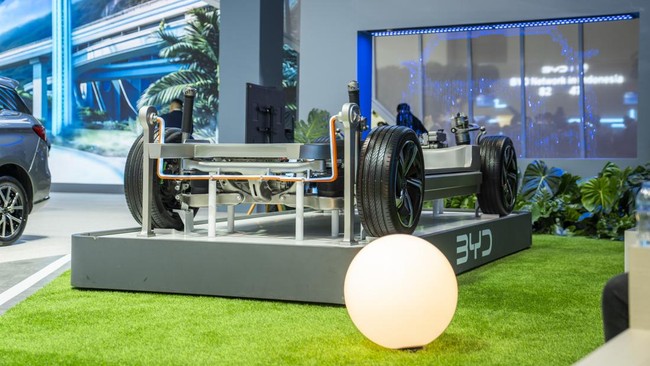
Concerns also arise regarding range, especially for users who frequently travel inter-city routes. In this regard, BYD offers an integrated innovation, the e-Platform 3.0, which unifies the motor, battery, and drive system designed to maximise energy efficiency in every condition.
“A Jakarta-Bandung trip is no longer a matter of stressful charging calculations,” he clarified.
Furthermore, according to Luther, BYD products pay attention to the driving feel of the electric vehicle on the road. BYD’s Cell-to-Body (CTB) technology integrates the battery directly into the body structure, rather than simply placing it under the floor.
“The result is a lower centre of gravity, a more solid body when cornering, and more responsive steering. This is a consequence of a design that treats the battery as part of the vehicle’s architecture, not an additional component,” he explained.
Another innovation is DiLink, which intuitively connects the driver to the vehicle. DiPilot works actively as a driving assistance system, providing lane-keeping, adaptive cruise control, and automatic emergency braking without taking over control.
“It is present in the background, works when needed, and does not feel intrusive. Ultimately, the best technology is the one that makes users not have to think about the technology. Just drive, the rest is taken care of,” Luther concluded.