
Constitutional Court warns education budget must not be reduced
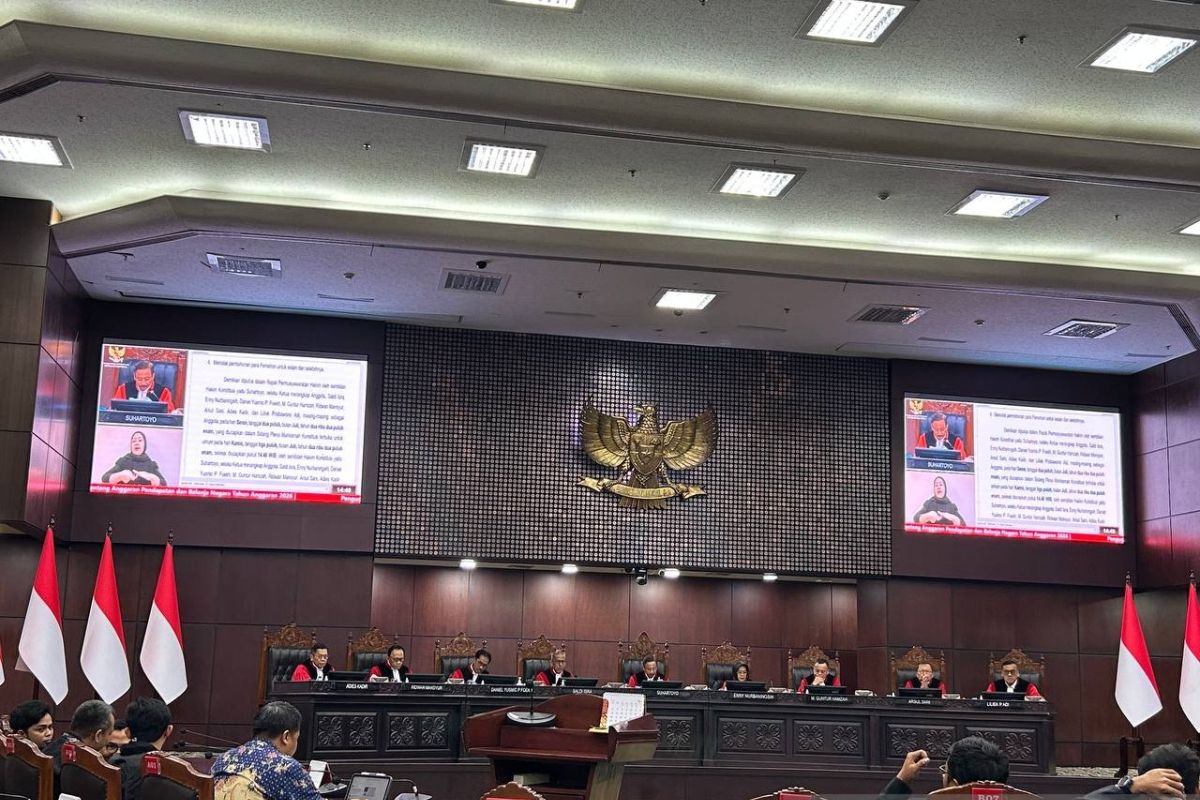
Jakarta (ANTARA) - The Constitutional Court (MK) has issued a reminder regarding the state’s obligation to fulfil the constitutional mandate concerning the priority capacity of the education budget, which must be at least 20 per cent of the State Budget (APBN) and must not be reduced regardless of any budgetary constraints.
“This clarification is essential because, regardless of any limitations the state faces in determining the APBN, the operational budget for education for fundamental purposes, as considered above, should not be affected or reduced,” stated Constitutional Judge M. Guntur Ahmad. He was reading the court’s considerations during the verdict hearing for judicial review number 40/PUU-XXIV/2026 regarding the budget for the Free Nutritious Meal (MBG) programme within the 2026 APBN in Jakarta on Thursday.
The Constitutional Court partially granted the petition regarding Law Number 17 of 2025 concerning the 2026 State Budget, which included the MBG programme budget within the education budget allocation.
In its decision, the Court also considered that maintaining the priority capacity of the education budget at a minimum of 20 per cent of the APBN is a necessity to ensure the state fulfils its constitutional mandate. This includes the government’s constitutional obligation to fund primary education as a priority, in accordance with Article 31, paragraph (2) of the 1945 Constitution of the Republic of Indonesia.
The Court stated that the state must be firm and consistent in determining the primary components directly related to the implementation of education. Using budget prioritised for educational operations for other programmes outside these components constitutes a violation of the constitutional mandate, specifically Article 31, paragraph (4) of the 1945 Constitution.
Such budget diversions could hinder the execution of the state’s obligations as commanded by Article 31, paragraphs (1) and (2) of the 1945 Constitution. The Court emphasised that the essence of the constitutional principle regarding education must be met: first, the state must ensure that no citizen’s right to education is obstructed; second, all citizens must be able to fulfil their rights and obligations in receiving primary education, fully funded by the government.
The Court noted that the success of these goals depends on essential elements of educational implementation, such as adequate and accessible educational institutions, competent and professional educators, and a fair and legally certain curriculum. These elements are directly linked to the availability of good and equitable infrastructure, teacher welfare, and optimal, inclusive access for students.
Regarding this matter, the inclusion of the nutritious meal programme as part of educational operations in the explanation of Article 22, paragraph (3) of Law Number 17 of 2025 is not only inconsistent with the definition of educational operations but also causes an imbalance in the proportional education budget. The MBG programme, which utilises the education budget, is a high-priority state programme requiring a massive budget.
“In fact, within that minimum 20 per cent education budget, there is also funding for primary education, which is a constitutional obligation of the government that has not yet been fully realised,” the judge added.
Consequently, the broad scope of the programme, which prioritises the equalisation of nutritional rights for all targets, creates an imbalance by disrupting the proportionality of the education budget, as a portion of it is diverted to the MBG programme.
The Court’s clarification aligns with legal facts revealed during the trial: if the education budget allocated for the MBG programme were removed from the education budget post, the overall 20 per cent education budget target would not be met. In the 2026 APBN, the 20 per cent education budget is only achieved because the MBG budget is included as a component of the education budget.
Constitutional Judge Daniel Yusmic P. Foekh added that due to the vast scope of the MBG programme, its funding should be determined separately or specifically outside the education budget prioritised for educational operations. Given the importance of national educational goals, not every programme targeting students, educators, or institutions can be categorised as educational operations, especially if the substance is unrelated to educational functions.
“Therefore, according to the court, the explanation of Article 22, paragraph (3) of Law Number 17 of 2025 has created legal uncertainty and has led to the failure of the state’s obligation to meet the priority of the education budget as commanded by the constitution,” said Daniel.