
Constitutional Court Ruling on IKN Law Affirms Jakarta's Status as National Capital
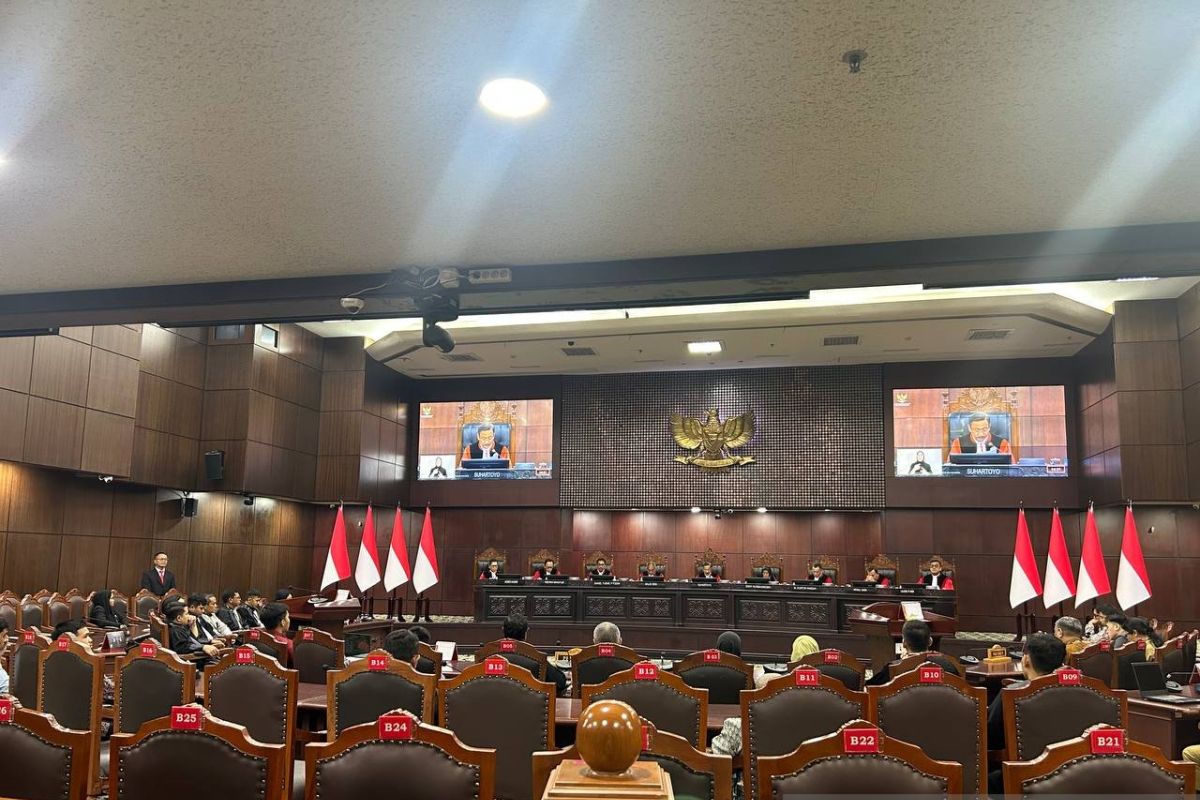
Jakarta (ANTARA) - The Constitutional Court (MK) has rejected the substantive review of Law No. 3 of 2022 on the State Capital (UU IKN) and affirmed the status of the Special Region of Jakarta (DKJ) as the national capital.
In the court’s considerations, read by Constitutional Justice Adies Kadir, as heard from the video of the ruling pronunciation for case number 71/PUU-XXIV/2026 in Jakarta on Wednesday, the petitioner’s argument that the norm of Article 39 paragraph (1) of Law No. 3/2022 conflicts with Article 1 paragraph (3) and Article 28D paragraph (1) of the 1945 Constitution is conditional insofar as it is interpreted in line with the petitioner’s petitum formulation, namely: “Until a presidential decision on the relocation of the national capital is established, Jakarta remains positioned as the Capital of the Republic of Indonesia to ensure certainty and continuity of the state structure.”
Regarding the constitutional issues alleged by the petitioner in Law 3/2022, Adies stated, these are provisions that arise due to the absence of a specific law regulating the national capital in Indonesia.
In this regard, the norm of Article 39 paragraph (1) of Law 3/2022 states: “The position, function, and role of the national capital remain in the Province of DKI Jakarta until the date of the determination of the relocation of the national capital from the Province of DKI Jakarta to the Nusantara Capital by presidential decision.”
According to the Court, the aforementioned norm serves as the legal basis and provision regulating the relocation of the national capital from the Province of DKI Jakarta to the Nusantara Capital, marked by the establishment of a presidential decree (Keppres) concerning the relocation.
“This means that legally and politically, the Nusantara Capital has been designated as the national capital, but the relocation process is still awaiting the presidential decision. Thus, within reasonable reasoning, until the presidential decision concerning the relocation of the national capital from the Province of DKI Jakarta to the Nusantara Capital is established, the national capital remains positioned in Jakarta,” said Adies.
Case number 71/PUU-XXIV/2026, filed by Zulkifli, challenges the provisions of Articles 39 and 41 of the IKN Law, which stipulate that the relocation of the national capital must be determined through a presidential decree.
However, to date, such a decree has not been issued, while the Law on the Special Region of Jakarta Province (UU DKJ) or Law No. 2 of 2024 (2/2024) has been enacted and removes Jakarta’s status as the national capital.
The petitioner highlighted the lack of synchronisation between Article 39 paragraph (1) of the IKN Law (3/2022) and Article 2 paragraph (1) of the DKJ Law (2/2024), which creates a constitutional status vacuum for the national capital, implying implications for the validity of government actions, including the issuance of state administration decisions, state administration activities, and government administration implementation.
Regarding the petitioner’s concerns, the MK explained in its considerations that in interpreting the norm of Article 2 paragraph (1) of Law 2/2024 in question, it must be read and interpreted in connection with the norm of Article 73 of Law 2/2024, which states: “This law shall take effect upon the establishment of a presidential decree regarding the relocation of the State Capital of the Unitary Republic of Indonesia from the Province of DKI Jakarta to the IKN.”
“The understanding of ‘effective’ in Article 73 of Law 2/2024 has binding force and is substantive or material in the norm of relocating the national capital when the presidential decree regarding the relocation of the State Capital of the Unitary Republic of Indonesia from the Province of DKI Jakarta to the IKN is established by the president,” said Adies.
Regarding the aforementioned time, Adies stated, it is explained in the legal considerations of the MK ruling number 38/PUU-XXIV/2026, which was pronounced earlier, affirming: “If placed in the context of relocating the national capital, in Law 2/2024 juncto Law 151/2024, there are provisions regarding the timing of relocating the State Capital of the Unitary Republic of Indonesia.”
“That is, it depends on the time of establishing the presidential decree regarding the timing of relocating the State Capital of the Unitary Republic of Indonesia, namely depending on the time of establishing the presidential decree regarding the relocation of the national capital of the NKRI from the Province of DKI Jakarta to the Nusantara Capital,” he said.
Such determination is also possible based on Article 87 of Law No. 12 of 2011 on the Formation of Legislation, which essentially states that legislation takes effect and has binding force on the date of promulgation unless otherwise specified in the relevant legislation.
“This means that in the context of the present petition, the effectiveness of the time for relocating the national capital to the Nusantara Capital depends on the establishment and effectiveness of the aforementioned presidential decision,” he said.
Adies continued, based on those legal considerations, linked to the petitioner’s petitum, according to the court, without interpretation of Article 39 paragraph (1) of Law 2/2024 as requested by the petitioner, the position, function, and role of the national capital remain in the Province of DKI Jakarta until a presidential decree is established regarding the relocation of the State Capital of the Republic from the Province of DKI Jakarta to the Nusantara Capital.
Therefore, the petitioner’s argument, which essentially states that the norm of Article 39 paragraph (1) of Law 3/2022 conflicts with Article 1 paragraph (3) and Article 28D paragraph (1) of the 1945 Constitution, is legally unfounded.
Meanwhile, in the operative part of the ruling read by MK Chief Justice Suhartoyo at the hearing on Tuesday (12/5), it states that the substantive review petition of the IKN Law is rejected in its entirety.
“The operative part of the ruling decides to reject the petitioner’s petition in its entirety. Thus decided in the judges’ deliberation meeting by nine constitutional justices,” said Suhartoyo.