
Constitutional Court Ruling: Judicialisation of Politics or Politicisation of the Judiciary?
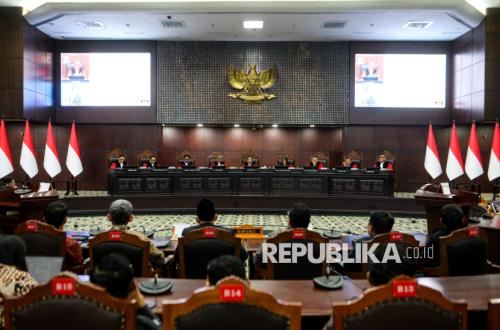
Indonesia’s constitutional order is once again being tested by debate over the legality of national leadership at the Constitutional Court (MK). When a petition seeking the electoral disqualification of the Vice-President was filed with the Court, the public was presented with a final ruling of Niet Ontvankelijke Verklaard (N.O.), meaning that the case was inadmissible. At the same time, however, the Court set out facts established in the proceedings and pointed towards mechanisms available to other institutions.
The seemingly unresolved ruling has prompted a crucial question in the philosophy and sociology of law: is the Court pursuing the judicialisation of politics by bringing a political dispute within the domain of legal certainty, or is it instead practising the politicisation of the judiciary by using the courtroom to clear a path for a particular political agenda?
The myth of judicial restraint
As a matter of doctrine, an N.O. ruling usually indicates that a claim is formally defective or falls outside the court’s jurisdiction (incompetentia rationalis). The standard logic of procedural law holds that if a case fails to meet formal requirements from the outset, a judge should halt it at an early stage through an interlocutory ruling or by upholding a preliminary objection. There is no need to expend resources examining evidence on the substance of the case. In this context, judicial restraint means that a judge refrains from extending the court’s authority.
In practice, however, proceedings involving high politics do not always follow the straight line of procedural law. When the Court chooses to continue examining the substance of a case—hearing evidence and witnesses, and evaluating the validity of documents such as diplomas and educational qualifications—it actively uses the courtroom to establish facts on the record.
If, after all the facts have been aired publicly, the Court then delivers an N.O. ruling on the grounds that it lacks the authority to disqualify an incumbent official, a logical question arises: why examine the substance of the case in the first place?
Political ammunition
At this point, the boundary between the judicialisation of politics and the politicisation of the judiciary becomes blurred. In legal theory, the judicialisation of politics occurs when the public and political actors agree to bring a political conflict within purely legal standards and procedures. The judiciary is chosen as a final bulwark against arbitrariness, through clear limits on the exercise of power.
But when a court includes substantive findings in its legal reasoning—which, technically, may constitute obiter dicta, or incidental observations—in a ruling that is formally an N.O. decision, the impact is no longer confined to the legal sphere. Those incidental observations take on a legitimising role. Rather than providing legal certainty to resolve a political conflict, the Court opens the way to a new one.
By not directly ordering disqualification, the Constitutional Court has shielded its institutional position from direct confrontation with the executive. Yet by endorsing or setting out facts concerning administrative qualifications in an open hearing, it has at the same time handed powerful ‘legal ammunition’ to the political arena.
In effect, this process shifts the hot potato from the Constitutional Court building on Jalan Merdeka Barat to the parliament building in Senayan. The House of Representatives (DPR) and political forces opposed to the Government now have both a moral basis and a legitimate legal argument for initiating political oversight, potentially including impeachment proceedings.
A judicial strategy
The Court’s move can be read as judicial hedging, a strategy for protecting itself amid a struggle for power. On the one hand, the Court demonstrated respect for the limits of its constitutional authority. On the other, it did not entirely ignore concerns about compliance with state administration requirements.
The public cannot, however, disregard the fact that using the process of presenting evidence to establish legal facts which the Court itself does not enforce amounts to the politicisation of the judiciary. Proceedings cease to be merely a means of resolving a legal dispute and instead become an instrument for designing a legal runway for political movements and developments outside the court. Rather than serving as the final bulwark for resolving political conflict, the judiciary opens the way for a contest in the political arena.
Ultimately, does the Court’s approach strengthen or weaken legal certainty in Indonesia? For those seeking formal justice, a ruling that appears suspended between the examination of facts and an N.O. disposition may feel like an injury to justice. Yet in the dynamics of checks and balances, the case shows how law and politics can constrain and influence one another in Indonesia’s constitutional arena.
Source: jawawa.id (https://jawawa.id/newsitem/constitutional-court-ruling-judicialisation-of-politics-or-politicisation-of-the-judiciary-1791723054)
Originally published by Republika (https://rejogja.republika.co.id/berita/tmqs5o291/putusan-mk-yudisialisasi-politik-dan-politisasi-yudisial), translated from Indonesian