
Constitutional Court Ruling Does Not Halt IKN, But Rather Legitimises Basis for Relocation
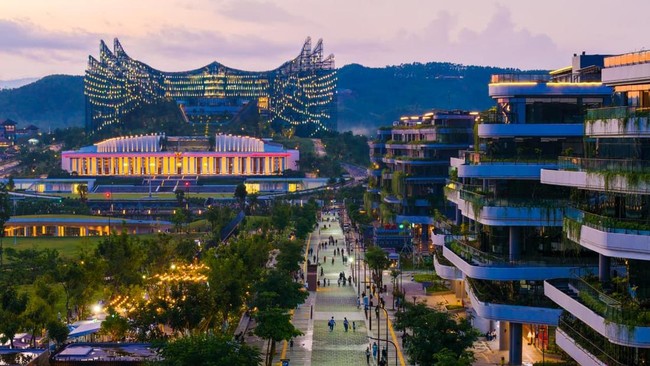
It can be argued that I have extensively analysed the substantive regulatory requirements for relocating the capital from Jakarta to Nusantara (IKN). Since 2024, my work has covered the urgency of the IKN Presidential Decree, the status of the capital, the deregulation of IKN as a prerequisite for becoming a ‘Political Capital’, and the administrative readiness for moving state apparatus to IKN.
Following the issuance of Constitutional Court Decision Number 71/PUU-XXIV/2026 on Tuesday, 12 May 2026, certainty regarding the relocation of the national capital has received constitutional reinforcement. In this ruling, the Constitutional Court emphasised that the relocation of the capital from Jakarta to IKN depends on a presidential decision through the instrument of a Presidential Decree (Keppres). This means that until such a decree is issued, Jakarta retains its status as the capital of Indonesia.
The Court made this clarification in its decision to reject all judicial review petitions against Law Number 3 of 2022 concerning IKN. Both explicitly and implicitly, the ruling positions the Presidential Decree as the final instrument determining the effective date of the capital’s relocation.
However, amidst public discourse on various social media platforms, a viral misinterpretation emerged suggesting that the Constitutional Court’s decision would serve as a basis to halt IKN’s construction. Such a view is clearly erroneous. The Constitutional Court’s ruling does not mention halting IKN’s development at all. On the contrary, the decision affirms that the certainty of the capital’s relocation rests in the final stage of a presidential decision via a decree, as an authoritative constitutional power.
Furthermore, an analysis of political will suggests that the commitment to the sustainable development of Nusantara is becoming clearer. President Prabowo Subianto conducted a working visit to IKN in East Kalimantan on 12-13 January 2026. This visit reaffirmed the continuity of this national strategic project, specifically through the accelerated development of the legislative and judicial zones, intended to function as the political capital by 2028 and continue through 2029.
This direct attention from the President, coupled with the Constitutional Court’s ruling reinforcing the Presidential Decree as the final instrument, demonstrates that the IKN development agenda has not stopped. Instead, the state’s policy direction shows consistency in continuing the process of transforming the national government centre towards IKN in a gradual, measurable, and constitutional manner.
In terms of administrative law, a Presidential Decree is a ‘beschikking’—a legal instrument used by the President to establish decisions that are concrete, individual, and final in exercising executive authority. While laws provide a general normative framework, a Presidential Decree serves as the administrative execution tool to ensure a policy becomes effectively operational. Unlike Presidential Regulations (Perpres) which regulate general norms, a Presidential Decree focuses on establishing a specific legal state that produces direct legal consequences. In the context of relocating the capital, the decree serves as the official marker of when the transition is administratively and constitutionally valid.
Therefore, the IKN Presidential Decree cannot be a mere formality; it is a crucial turning point that determines the change in the legal status of the capital from Jakarta to Nusantara. The impact extends beyond governance to include fiscal, institutional, economic, political, and public service aspects. Consequently, its issuance cannot be done haphazardly but must involve careful calculation, administrative prudence, and alignment with the national priority agenda set by the President.
Based on recent developments, the strategic decision regarding the project’s continuity has gained new political legitimacy under President Prabowo’s administration. The development of IKN in North Penajam Paser, East Kalimantan—a legacy of President Joko Widodo’s policy—is not only continuing but is being positioned as a strategic component of the new administration’s agenda. This is evidenced by the issuance of Presidential Regulation Number 79 of 2025 regarding the Update of the 2025 Government Work Plan, which explicitly states that the planning, development, and relocation of capital functions are directed towards realising IKN as the Political Capital by 2028.
Chronologically, the policy direction indicates that the government’s current agenda is to ensure IKN first functions as the national political centre, particularly through the readiness of the legislative and judicial zones. Once those stages are met, the official change in the status of the national capital will be determined via a Presidential Decree, as affirmed by Constitutional Court Decision Number 71/PUU-XXIV/2026. The authority to issue this decree rests with the President, who will determine when the relocation from Jakarta to IKN is legally and effectively enacted. This means that before the official designation, the government will continue to accelerate IKN’s development in a gradual and sustainable manner, covering physical, institutional, and supporting ecosystem aspects.