
Constitutional Court Rules Unused Internet Quota Must Remain Active Without Extra Charges
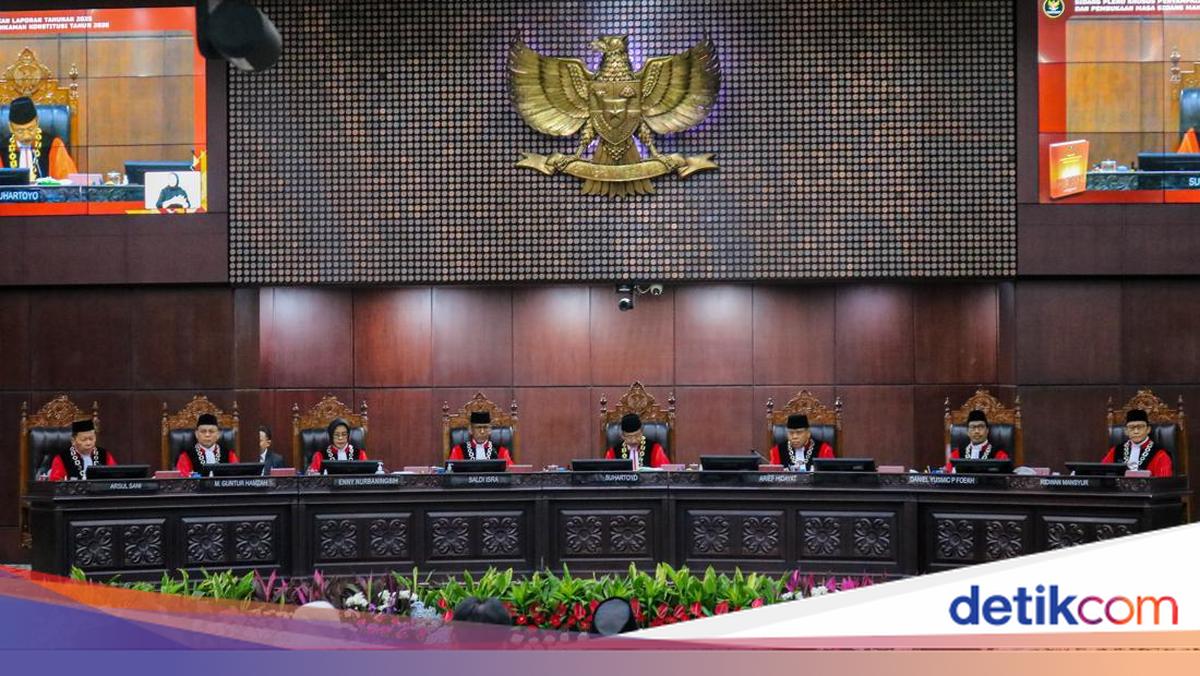
The Constitutional Court (MK) has provided a breakthrough in the case of forfeited internet quota. The court partially granted the lawsuit and ordered that internet quota already purchased must be usable until it runs out without any additional charges whatsoever.
Summarised on Thursday (23/7/2026), there were several lawsuits related to the issue of forfeited internet quota handled by the MK. At least four previous lawsuits regarding forfeited internet quota were not accepted by the court.
A different ruling was then delivered in lawsuit number 273/PUU-XXIII/2025, filed by online motorcycle taxi driver Didi Supandi, online culinary trader Wahyu Triana Sari, and lecturer/advocate Rega Felix. The MK partially granted the petitioners’ request.
“Adjudicating, granting the petitioners’ request in part,” said chief justice Suhartoyo in the ruling seen on the MK’s YouTube channel on Thursday (23/7/2026).
He added that Article 28 paragraph (1) in Article 71 number (2) of Law Number 6 of 2023 concerning Job Creation contradicts the 1945 Constitution and has no conditionally binding legal force as long as it is not interpreted to mean that ‘the tariff rates of telecommunications network operators and/or telecommunications service providers are determined by the telecommunications network operators and/or telecommunications service providers based on a formula set by the central government with the obligation to provide telecommunications service options that guarantee the remaining quota belonging to telecommunications service users remains active and can be used’.
In its considerations, the MK stated that internet quota already purchased must be usable by consumers until it is exhausted. The court emphasised that no additional charges may be imposed.
“In real terms, quota that has not been fully used or enjoyed must remain protected as the property rights of telecommunications service users, enabling them to use it until the quota is exhausted without being burdened with additional fees/costs under the pretext of extending the active period or for any other reason,” said justice Adies Kadir during the pronouncement of Ruling Number 273/PUU-XXIII/2025 at the MK building in Central Jakarta on Thursday (23/7).
The MK stated that tariff formulas and telecommunications service schemes must not be placed solely within the commercial perspective of telecommunications operators. The court stressed that existing regulations must guarantee reasonable protection for telecommunications service users.
According to the MK, this form of protection does not have to be a single, uniform service model. The court stated that protection can be provided through the provision of various flexible package options.
The MK provided options to prevent internet quota from simply expiring, including quota accumulation or rollover, active period extension, benefit transfer, compensation, refund, or other forms of protection.
Justice Adies Kadir said the government must be more adaptive to technological developments, business models, and the economic needs and capabilities of the public. The MK stated that tariff policies must be based on the principles of protection and fair legal certainty over the ownership of telecommunications service users.
In the event of a ‘tariff adjustment’, according to the MK, the central government and telecommunications operators must involve parties concerned with telecommunications services and consumer protection agencies. The MK also considers it important for telecommunications operators to increase transparency and ease of access to information for service users regarding pricing, quota volume, validity period, usage segmentation, fair usage policies, service termination, and the treatment of remaining quota, all of which must be conveyed in a simple, clear, and easy-to-understand manner.
To this end, telecommunications operators must also provide channels that make it easy for service users to monitor their usage, including the remaining quota of the chosen service. This protection must be accompanied by an effective, easily accessible complaint handling mechanism and periodic evaluation.
The MK noted that telecommunications operators and the Association of Indonesian Telecommunications Operators (ATSI), as related parties, did not object to this. In fact, the court said, operators and ATSI had conveyed a kind of agreement as a solution to the petition questioning the constitutionality of the norm in Article 28 paragraph (1) in Article 71 number 2 of the Job Creation Law appendix.
Justice Liliek Prisbawono Adi stated that, within the bounds of reasonable reasoning, the aspect that needs to be protected is not the internet quota itself, but the economic value and service benefits that have been paid for but not yet fully enjoyed by the consumer. He said the real issue is not whether the data held by the telecommunications service user is considered an object or not, but whether the consumer has the right to the economic benefits of the service that has been paid for.
“In this context, the remaining unused quota still holds economic value, because the telecommunications service user has paid a sum of money to obtain access to a service in a certain volume. Therefore, when placed in the context of telecommunications provision, the payment made by the telecommunications service user to obtain a data package essentially gives rise to the right to enjoy the service benefits in accordance with the applicable terms and conditions, which must be positioned as a property right in the form of an intangible good,” Liliek explained.