
Constitutional Court rules petition for teacher involvement in free nutritious meals programme inadmissible
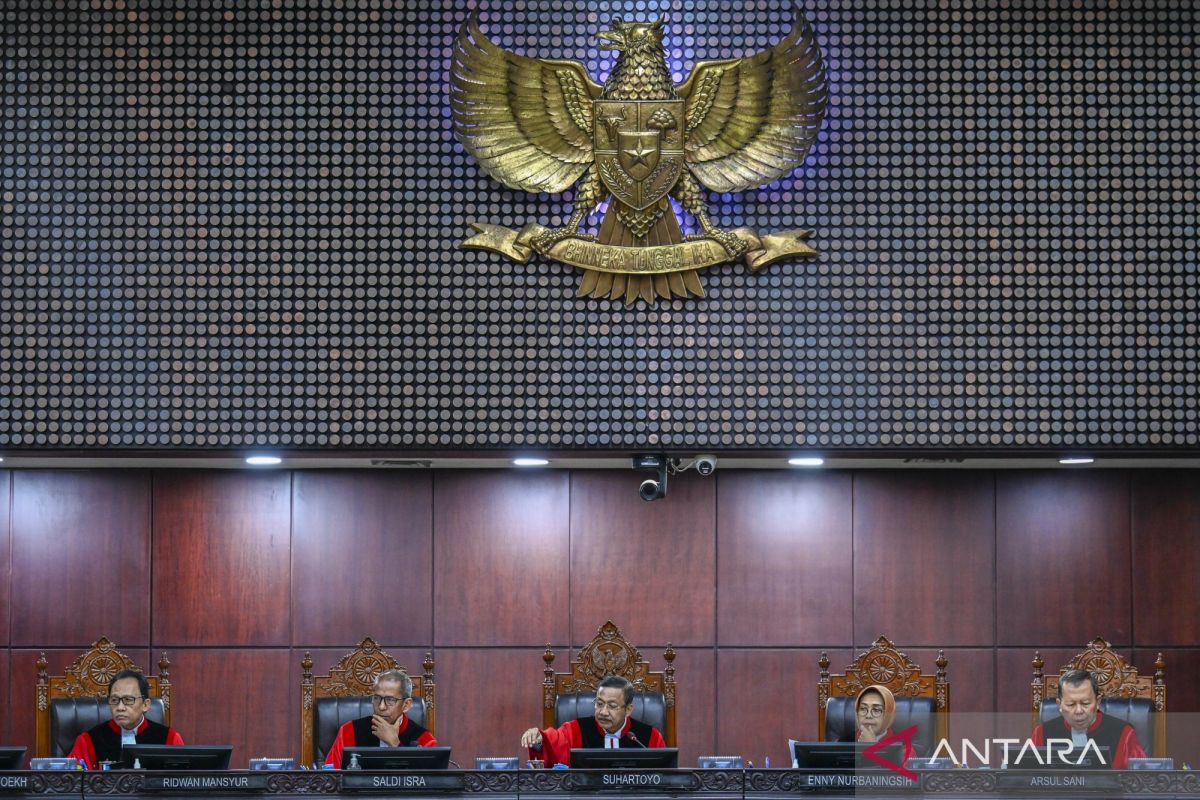
Jakarta (ANTARA) - The Constitutional Court (MK) has ruled that petition Number 301/PUU-XXIV/2026, filed by Herifuddin Daulay regarding the involvement of teachers as supervisors in the free nutritious meals programme (MBG), is inadmissible.
In addition, the Court also ruled that petition Number 290/PUU-XXIV/2026, concerning judicial review of the new Criminal Procedure Code (KUHAP), is inadmissible.
“The ruling of the Court is that petition Number 290/PUU-XXIV/2026 and petition Number 301/PUU-XXIV/2026 are inadmissible,” said Chief Justice Suhartoyo during the pronouncement of the verdict in the main courtroom of Building I of the Constitutional Court in Jakarta on Monday.
Case Number 301/PUU-XXIV/2026, a challenge to Law Number 17 of 2025 on the 2026 State Budget (APBN), was filed by Herifuddin Daulay, who requested that teachers be involved in the national nutrition fulfilment programme, which he argued would require an additional budget for oversight of the programme.
Regarding the judicial review of the MBG budget, in the Court’s considerations read out by Deputy Chief Justice Saldi Isra, he explained that the norm requested for review under petitum point 1 — namely Article 22 paragraph (3), the Elucidation of Article 22 paragraph (3), and Annex point 1, Annex 1 point 2.75.2 of Law Number 17 of 2025 — does not accord with the full Elucidation of the Court’s ruling.
With respect to the review of the Elucidation of Article 22 paragraph (3) of the APBN Law, the Court has already issued ruling Number 40/PUU-XXIV/2026, which essentially results in a change to the substance of the Elucidation of Article 22 paragraph (3) of the APBN Law.
“Therefore, the request for a fresh review of the Elucidation in question does not accord with the full Elucidation of the Court’s ruling, as the substance submitted for review is not the same as that already decided by the Constitutional Court,” said Saldi.
Then, in the posita section, he said, the petitioner did not set out clearly, sufficiently, and specifically the conflict between the norm submitted for review and the grounds for review used.
The petitioner devoted most of his account to the type of curriculum, the cognitive academic load of the curriculum, essential brain nutrition, technical problems with the MBG programme, the absence of teacher involvement in MBG oversight, and cost calculations for teacher supervision within the MBG programme.
According to the Court, that account does not demonstrate clarity regarding the connection and continuity with the constitutional problem of the norm being contested by the petitioner.
Meanwhile, regarding the review of the KUHAP concerning whether a corporate responsible officer can be held liable in cases involving a corporation, the Court considered that the petition did not clearly and sufficiently set out the conflict between the norms submitted for review.
Petitioner Andri Yanto challenged the norm of Article 326 paragraph (1) of the new KUHAP against the articles used as grounds for review, namely Article 27 paragraph (1), Article 28D paragraph (1), and Article 28G paragraph (1) of the 1945 Constitution.
The Court stated that the formulation of the petitioner’s petitum does not provide a definite boundary regarding the construction of the norm actually being requested by the petitioner. Moreover, petitum point 5 actually creates uncertainty regarding the normative grounds actually used by the petitioner in requesting an interpretive change from the word “and” to the phrase “and/or” in the norm of Article 326 paragraph (1) of the KUHAP and Article 49 of Law Number 1 of 2026.