
Constitutional Court rules partially in favour of women's electoral quota challenge
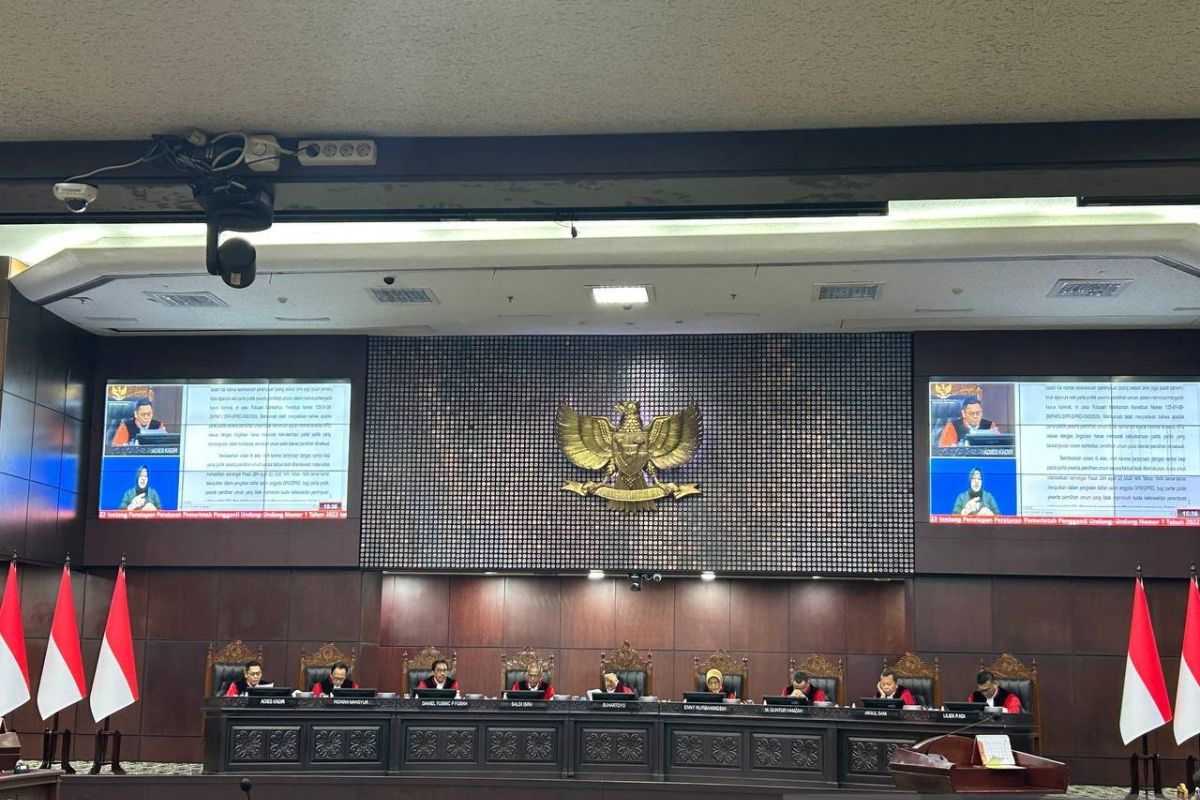
Jakarta (ANTARA) – The Constitutional Court has partially granted a petition concerning the material review of Article 245 of Law No. 7 of 2017 on General Elections, which challenges the 30% women’s representation quota in legislative elections. In its ruling, the Constitutional Court stated that Article 245 of Law No. 7 of 2017 conflicts with the 1945 Constitution and is conditionally unenforceable unless interpreted as: ‘The list of candidates as per Article 243 must include at least 30% women, and if this quota is not met, the General Election Commission (KPU), provincial KPU, and regency/city KPU must disqualify or exclude the political party from the relevant electoral district.’ ‘The ruling is to partially grant the petitioners’ request,’ said MK Chief Suhartoyo during the verdict reading for case No. 128/PUU-XXIV/2026 at the Plenary Courtroom of MK Building I in Jakarta on Monday. The material review petition was filed by four women: Maya Novita Sari (Petitioner I), Imas Dion Febriani (Petitioner II), Cahya Camila (Petitioner III), and Fatati Nailul Munadia (Petitioner IV). The petitioners argued that the lack of strict sanctions for political parties failing to meet the 30% women’s representation quota, as mandated by Article 245 of the Election Law, has created legal uncertainty. In their petition’s reasoning (posita), the petitioners also cited Article 23(1) as a point of contention. They argued that using state funds to process registrations of political parties that fail to meet the women’s quota constitutes irresponsible use of national resources and contradicts the principle of effective state management as stipulated in Article 23(1) of the 1945 Constitution. During the preliminary hearing on 15 April 2025, the petitioners stated that Article 245 of the Election Law has proven to be a ‘lex imperfecta’—a law without enforceable sanctions. In practice, the Election Commission has approved political parties with no female candidates in their final lists, merely issuing administrative warnings without disqualification penalties. They cited examples in Trenggalek 2, Tulungagung 6, and Tulungagung 1 electoral districts, where political parties submitted only male candidates, automatically failing the 30% quota, yet their registrations were still accepted. The petitioners argued that challenging Article 245 of the Election Law aims to achieve gender justice and equality, ensuring women are active participants in policy-making. Sociologically, despite women making up a large portion of voters, their representation remains suboptimal. Legally, the 30% quota is a constitutional guarantee of non-discriminatory equality. However, without enforcement mechanisms in Article 245 of the Election Law, the provision is ineffective in practice. In the court’s reasoning delivered by Justices Asrul Sani and Adies Kadir, the Constitutional Court held that Article 245 of the Election Law, which fails to prescribe sanctions when political parties do not meet the 30% women’s representation quota in candidate lists, contravenes principles of people’s sovereignty, fair and honest elections, legal certainty, special treatment rights, and non-discriminatory treatment as outlined in Articles 1(2), 22E(1), 28D(1), 28H(2), and 28I(2) of the 1945 Constitution, as claimed by the petitioners. This argument was deemed legally valid. ‘However, as the Court’s interpretation differs from the petitioners’ request, their claim is legally valid only in part,’ said Justice Adies Kadir. In its ruling, the Constitutional Court ordered the publication of the verdict in the State Gazette as required and rejected the petitioners’ other claims.