
Constitutional Court Rules Mining Permits for Mass Organisations Cannot Be Directly Appointed, Bahlil Prepares Derivative Regulation
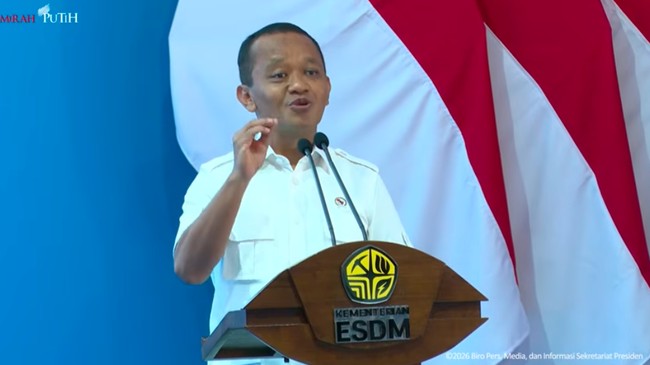
Jakarta, CNBC Indonesia - Minister of Energy and Mineral Resources (ESDM) Bahlil Lahadalia said his ministry plans to issue implementing regulations, particularly following the Constitutional Court’s (MK) ruling that the granting of Mining Business Permits (IUP) to cooperatives, SMEs and religious community organisations (ormas) cannot be carried out through direct appointment.
According to Bahlil, the regulations will take the form of a Ministerial Regulation (Permen) or Ministerial Decree (Kepmen). He assured that the MK ruling does not remove the phrase ‘priority allocation’. The Court simply asked that permits be granted through a more transparent mechanism.
“The MK ruling states that the priority allocation still exists. Being designated does not mean there should be no mechanism or rules, which is why we will draw up the implementing regulations in the form of a Permen or Kepmen. So priority is still given. The Court did not cancel the priority, but governance must be improved so that the principles of transparency and accountability can truly be upheld,” Bahlil said at the State Palace, quoted on Tuesday (21/7/2026).
“And I think what the MK has decided is something good, because we want everything to be transparent,” he added.
As is known, the Constitutional Court officially ruled that the granting of Mining Business Permits (IUP) to religious community organisations and SMEs must not be carried out through direct appointment. The decision aims to ensure the mining permit process continues to follow fair procedures.
This follows a challenge against the phrase ‘priority allocation’ for mass organisations, universities and cooperatives set out in Article 51 (1) and Article 60 (1) of Law Number 2 of 2025 concerning the Fourth Amendment to Law Number 4 of 2009 on Mineral and Coal Mining, vis–vis the 1945 Constitution of the Republic of Indonesia.
Article 51 (1) of Law No. 2 of 2025 reads:
“Metal mineral WIUPs are granted to Business Entities, cooperatives, individual companies, small and medium enterprises, or business entities owned by religious community organisations by auction or by way of priority allocation.”
Article 60 (1) of Law No. 2 of 2025 reads:
“Coal WIUPs are granted to Business Entities, cooperatives, individual companies, small and medium enterprises, or business entities owned by religious community organisations by auction or by way of priority allocation.”
The MK ruling is set out in Constitutional Court Decision Number 160/PUU-XXIII/2025 concerning the Petition for Judicial Review of Law Number 2 of 2025 on the Fourth Amendment to Law Number 4 of 2009 on Mineral and Coal Mining against the 1945 Constitution of the Republic of Indonesia.
The petitioners in the case were Imam Rohmatulloh (private business operator), Abdullah (SME business operator), Eko Prasetyo (lecturer), Abdullah Faqih (student) and Pendi (Chairman of the Pagar Nusa Student Forum Across the Archipelago/FMPSN).
The petitioners challenged the provisions on the allocation of Mining Business Permit Areas (WIUP) for metal minerals and coal in the Mining Law. The phrases contested were ‘by auction’ or ‘by way of priority allocation’ for various entities, such as business entities, cooperatives, SMEs and religious community organisations.
The challenge focused on Articles 51 and 60 of the Mining Law, which also referred to other paragraphs as well as Article 75. In essence, the permit allocation mechanism was deemed problematic in its arrangement within the law.
The petitioners considered the regulation to create legal uncertainty and injustice, as the utilisation of mineral and coal resources was not maximised for the people’s prosperity. This condition was deemed to violate the mandate of Article 28D paragraph (1) and Article 33 paragraph (3) of the 1945 Constitution, which require natural wealth to be managed for the benefit of the wider public.
In the MK ruling received by CNBC Indonesia, quoted on Friday (17/7/2026), in its ruling the Court stated that the phrase ‘priority allocation’ in the Mineral and Coal Mining Law cannot be interpreted as an automatic right to obtain a permit without strict procedures.
The MK affirmed that priority allocation must be based on clear parameters through an objective, transparent and accountable assessment process. This is intended to ensure the priority mechanism is not misunderstood as an act of direct appointment that ignores the selection standards that should apply.