
Constitutional Court Rules: Mining Permits for Mass Organisations Cannot Be Directly Appointed
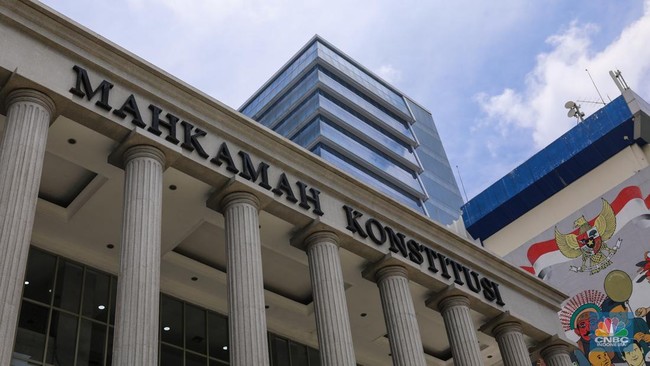
Jakarta, CNBC Indonesia — The Constitutional Court (MK) has officially ruled that the granting of Mining Business Permits (IUP) to religious mass organisations (ormas) as well as SMEs must not be carried out through direct appointment.
The decision is intended to ensure that the mining permit allocation process continues to follow fair procedures.
The ruling follows a challenge against the phrase “granting of priority” for mass organisations, universities and cooperatives, as set out in Article 51 (1) and Article 60 (1) of Law No. 2 of 2025 on the Fourth Amendment to Law No. 4 of 2009 on Mineral and Coal Mining, tested against the 1945 Constitution of the Republic of Indonesia.
Article 51 (1) of Law No. 2 of 2025 reads:
“Metal mineral WIUPs shall be granted to business entities, cooperatives, individual companies, small and medium enterprises, or business entities owned by religious mass organisations by means of auction or by means of priority allocation.”
Article 60 (1) of the same law reads:
“Coal WIUPs shall be granted to business entities, cooperatives, individual companies, small and medium enterprises, or business entities owned by religious mass organisations by means of auction or by means of priority allocation.”
The Court’s ruling is contained in Constitutional Court Decision No. 160/PUU-XXIII/2025 concerning the Petition for Judicial Review of Law No. 2 of 2025 on the Fourth Amendment to Law No. 4 of 2009 on Mineral and Coal Mining against the 1945 Constitution of the Republic of Indonesia.
The petitioners in the case were Imam Rohmatulloh (a private businessman), Abdullah (an SME business owner), Eko Prasetyo (a lecturer), Abdullah Faqih (a student), and Pendi (Chairman of the Pagar Nusa Student Forum of the Archipelago/FMPSN).
The petitioners challenged the provisions on the granting of Mining Business Permit Areas (WIUP) for metal minerals and coal under the Mining Law. The phrases at issue were “by means of auction” or “by means of priority allocation” for various entities, such as business entities, cooperatives, SMEs and religious mass organisations.
The petition focused on Articles 51 and 60 of the Mining Law, which also referenced other paragraphs as well as Article 75. In essence, the permit allocation mechanism was considered problematic in its regulation within the law.
The petitioners argued that the provisions created legal uncertainty and injustice because the utilisation of mineral and coal resources was not maximised for the prosperity of the people. This was deemed to violate the mandates of Article 28D (1) and Article 33 (3) of the 1945 Constitution, which require natural wealth to be managed for the benefit of the wider public.
In the ruling received by CNBC Indonesia, quoted on Friday (17/7/2026), the Court stated in its rulings that the phrase “granting of priority” in the Mineral and Coal Mining Law cannot be interpreted as an automatic right to obtain a permit without strict procedures.
The Court affirmed that any priority allocation must be based on clear parameters through an objective, transparent and accountable assessment process. This is intended to ensure that the priority mechanism is not misinterpreted as an act of direct appointment that ignores the selection standards that should properly apply.
The key points of the Court’s ruling were as follows:
The petitioners’ request is granted in part.
The phrase “by means of priority allocation” in the norm of Article 51 (1) of Law No. 2 of 2025 on the Fourth Amendment to Law No. 4 of 2009 on Mineral and Coal Mining (State Gazette of the Republic of Indonesia Year 2025 No. 29, Supplement to the State Gazette No. 7100) is contrary to the 1945 Constitution and has no binding legal force conditionally, insofar as it is not construed as: “by means of priority allocation which may only be granted with clear parameters through an objective, transparent and accountable assessment process, so that such priority allocation is not forthwith understood as an act of direct appointment”.
The phrase “by means of priority” in the norms of Article 51 (3), Article 51 (4), Article 51 (5) and Article 51 (6) of the law is contrary to the 1945 Constitution and conditionally has no binding legal force under the same construction.
The phrase “by means of priority allocation” in the norm of Article 60 (1) of the law is contrary to the 1945 Constitution and conditionally has no binding legal force under the same construction.
The phrase “by means of priority” in the norms of Article 60 (3), Article 60 (4), Article 60 (5) and Article 60 (6) of the law is contrary to the 1945 Constitution and conditionally has no binding legal force under the same construction.
The phrase “receives priority” in the norm of Article 75 (3) of the law is contrary to the 1945 Constitution and conditionally has no binding legal force, insofar as it is not construed as: “receives priority in obtaining an IUPK only where granted with clear parameters through an objective, transparent and accountable assessment process, so that such priority allocation is not forthwith understood as an act of direct appointment”.
The phrase “by means of priority” in the norms of Article 75 (5) and Article 75 (7) of the law is contrary to the 1945 Constitution and conditionally has no binding legal force under the same construction.
The phrase “means of priority” in the norms of Article 51A (1), Article 51A (3), Article 51A (5), Article 60A (1), Article 60A (3), Article 60A (5), Article 75A (2), Article 75A (3) and Article 75A (5) of the law is contrary to the 1945 Constitution and conditionally has no binding legal force under the same construction.
The Court orders that this ruling be published in the Official Gazette of the Republic of Indonesia as appropriate.
The petitioners’ requests are rejected in all other respects.
The ruling was decided in the Justices’ Deliberation Meeting by nine Constitutional Justices on Wednesday, 1 July 2026. It was then pronounced at a public plenary session of the Constitutional Court on Thursday, 16 July 2026, concluding at 14.44 WIB by the nine Constitutional Justices.
The nine Constitutional Justices were:
Suhartoyo, as Chair and Member,
Saldi Isra, Member
Enny Nurbaningsih, Member
Ridwan Mansyur, Member
Arsul Sani, Member
Daniel Yusmic P. Foekh, Member
M. Guntur Hamzah, Member
Adies Kadir, Member
Liliek Prisbawono Adi, Member.