
Constitutional Court Rules Mining Permit Priorities Must Have Clear Parameters
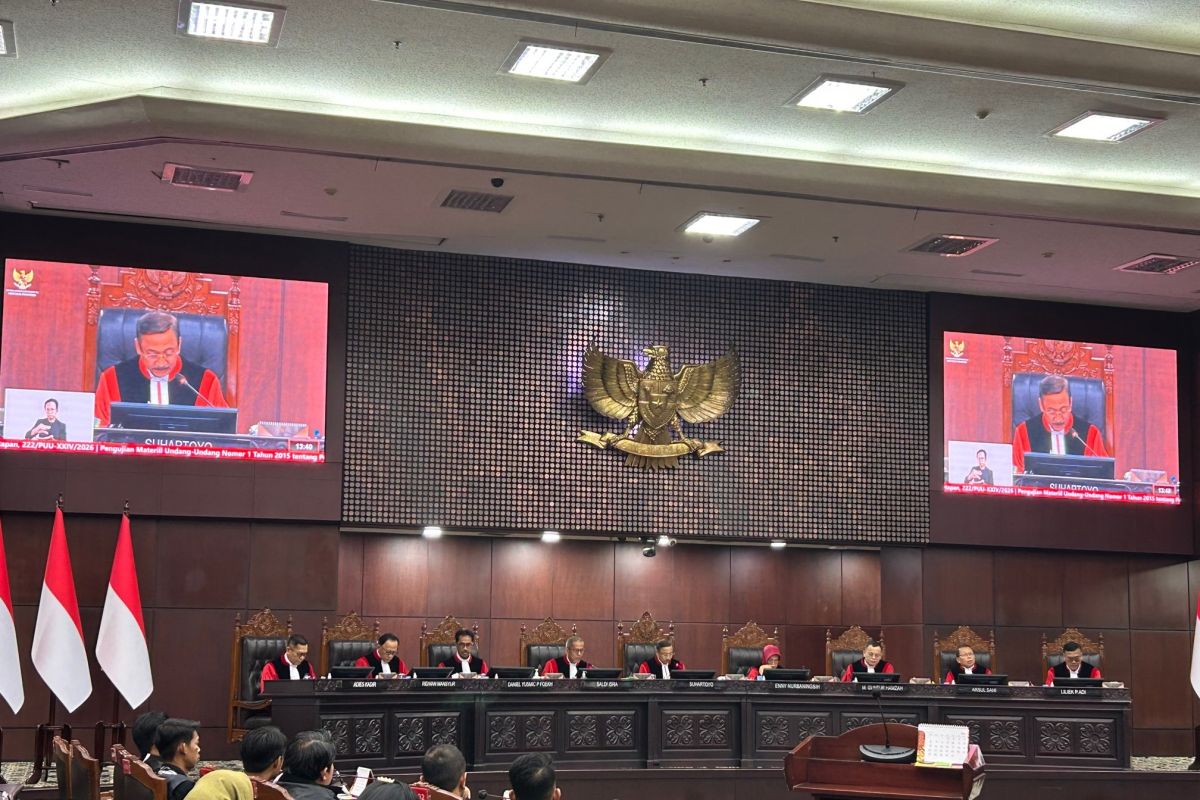
The Constitutional Court (MK) has affirmed that the method of granting priority for mining business permit areas (WIUP) under the Minerba Law must be based on clear parameters to ensure mineral and coal management aligns with Article 33 paragraph (3) of the 1945 Constitution. This affirmation was contained in the ruling for case number 160/PUU-XXIII/2025, which reviewed the phrase ‘by auction’ or ‘by priority’ for granting WIUP for metallic minerals and coal to business entities, cooperatives, sole proprietorships, small and medium enterprises, or business entities owned by religious organisations.
Constitutional Justice Enny Nurbaningsih stated that, driven by the spirit of equitable prosperity for all Indonesians, the government’s affirmative policy of granting such priority must only be given with clear parameters. She noted that these clear parameters must involve an objective, transparent, and accountable assessment process so that the granting of priority is not simply understood as a direct appointment. ‘Furthermore, a clear commitment is needed, especially to avoid environmental damage in the management of mineral and coal mining,’ she said.
In its considerations, the Court stated that the method of granting WIUP priority in the norms of Article 51 and Article 60 of the Minerba Law did not clearly specify how the government determines the granting of priority. Consequently, the Court assessed that there was room for broad and potentially subjective assessment in exercising discretion to determine which institutions, bodies, or entities would receive the WIUP. The Court held that the auction and priority methods cannot be applied simultaneously because one method necessarily negates the other. ‘A competitive and procedurally fair auction cannot be achieved if there are parties who should be participating in the auction but instead obtain a priority route or are outside the auction,’ Justice Enny stated.
She further emphasised that even with the priority route, not all permit applicants can be guaranteed to obtain a WIUP due to limited mining areas. The absence of clear parameters in granting WIUP via the priority route, as argued by the petitioners, means there is no guarantee that granting WIUP will have a positive impact on welfare or prosperity. The Court reasoned that a proper selection process should be conducted for the priority WIUP route to ensure justice and equal treatment for all applicants, as not all applicants have the same level of ability or capacity to compete in the mining business.
The Court also stressed that affirmative policies in the form of granting priority must remain within the spirit of Article 33 paragraph (3) of the 1945 Constitution, implemented through periodic evaluation. If the execution of a priority permit is proven to violate licensing principles and causes loss or environmental damage, the permit must be reviewed or revoked. In its ruling, the panel of judges partially granted the petition and declared the phrase ‘by way of granting priority’ in Article 51 paragraph (1) and Article 60 paragraph (1) of the Minerba Law unconstitutional, unless interpreted as ‘by way of granting priority which can be given with clear parameters through an objective, transparent, and accountable assessment process so that the granting of priority is not simply understood as a direct appointment’.