
Constitutional Court Rules Mining Business Permits Cannot Be Granted Through Direct Appointment
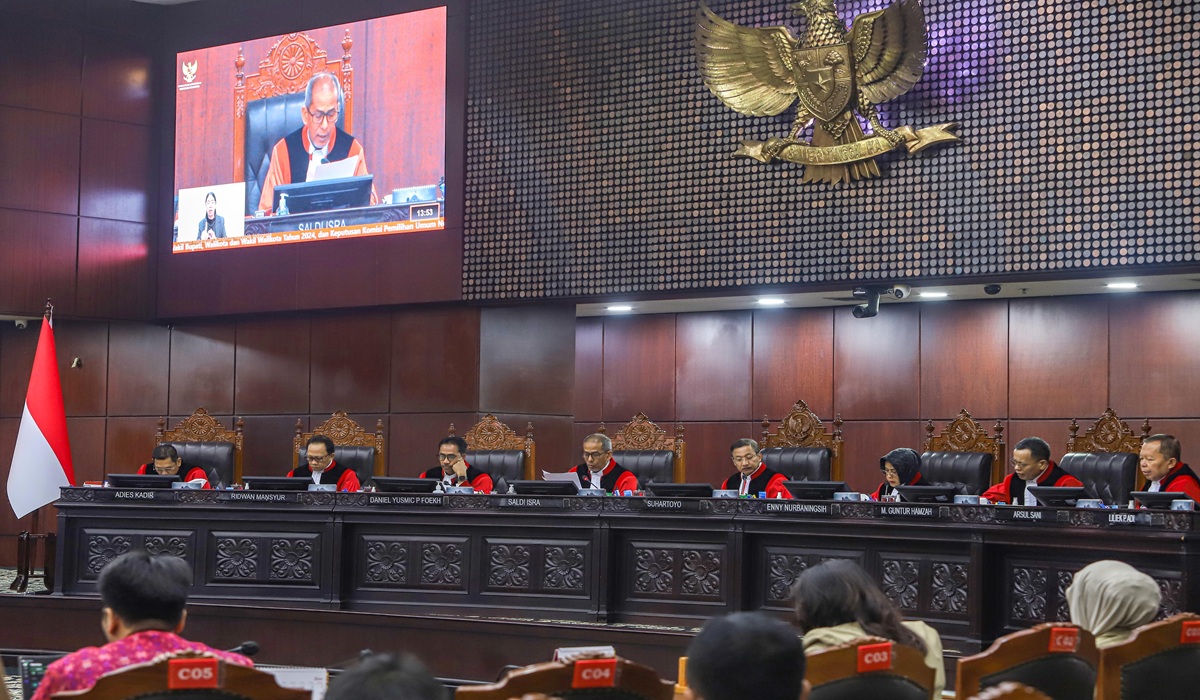
The Constitutional Court (MK) has ruled that the granting of priority Mining Business Permits (IUP) cannot be carried out through direct appointment, but must instead use clear parameters through an objective, transparent, and accountable assessment process. The ruling was delivered in the pronouncement of Decision Number 160/PUU-XXIII/2025. The court partially granted a petition for judicial review of Law Number 2 of 2025 concerning the Fourth Amendment to Law Number 4 of 2009 on Mineral and Coal Mining (UU Minerba).
Constitutional Justice Enny Nurbaningsih stated that a priority granting mechanism without clear measures could potentially open space for government subjectivity in determining which parties receive Mining Business Permit Areas (WIUP). "Without clarity of parameters, it is feared that elements of subjectivity will dominate, resulting in increased environmental damage," Enny said while reading the legal considerations of the ruling in Jakarta on Thursday (16/7).
According to the Court, although the government can implement affirmative policies through priority granting, this mechanism must not be interpreted as a right to directly appoint permit recipients. Given the limited number of mining areas, a fair selection process remains necessary for all applicants. The Court noted that the provisions in Article 51 and Article 60 of the Minerba Law did not explain in detail the mechanism for determining priority recipients. This regulatory vacuum was deemed to open up too much discretionary space and potentially give rise to non-transparent practices.
The Court emphasised that priority policies should be directed towards empowering cooperatives, small and medium enterprises (SMEs), and strengthening regional economies. However, this goal can only be achieved if permit recipients are selected through measurable criteria. "In the spirit of equitable prosperity for all Indonesian people, the government's affirmative policy in granting priority permits must be based on clear parameters through an objective, transparent, and accountable assessment process, so that the granting of priority is not understood as a direct appointment," Enny stated.
Furthermore, the Court reminded that mining permits are part of the state supervisory regime. Therefore, permits must be granted selectively, have rational time limits, be subject to periodic supervision, and be revocable if companies violate provisions or cause environmental damage. The ruling declared that several phrases regarding the "method of granting priority" in various articles of the Minerba Law are conditionally unconstitutional and lack binding legal force unless interpreted to mean that priority granting can only be done through clear, objective, transparent, and accountable parameters, and must not be understood as direct appointment.