
Constitutional Court Rules Internet Quota Cannot Expire, Operators Must Offer Consumers Choice
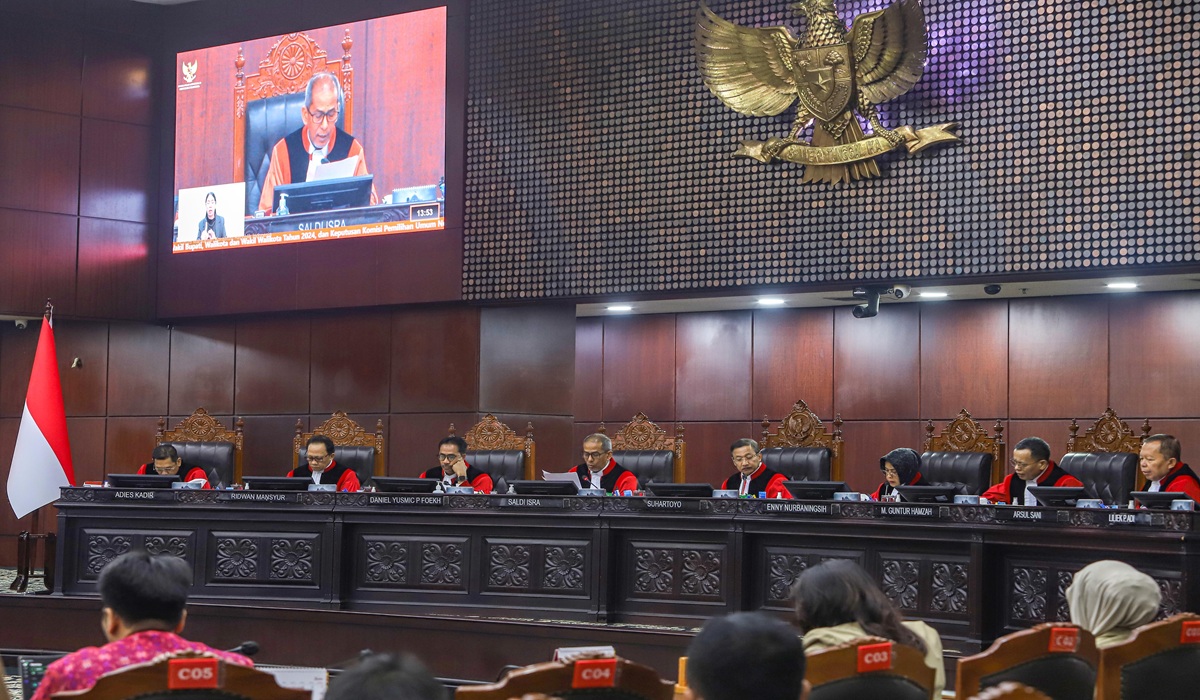
The Constitutional Court (MK) has affirmed that telecommunications operators can no longer simply allow customers’ remaining quota to expire without providing options that protect consumers. This was stated in its ruling on the judicial review of Law Number 6 of 2023 on Job Creation concerning internet quota policy.
Through Decision Number 219/PUU-XXIV/2026, the Court declared Article 28 paragraph (1) in Article 71 point 2 of the Annex to the Job Creation Law conditionally contrary to the 1945 Constitution.
“The petitioners’ request is granted in part,” said Chief Justice Suhartoyo when reading the ruling at the MK building in Jakarta on Thursday (23/7).
The Court then declared that the norm in the article remains constitutional insofar as it is interpreted to mean that the setting of telecommunications service tariffs must be accompanied by an obligation for operators to provide service options guaranteeing that customers’ remaining quota stays active and usable.
In the dictum of its ruling, the Court stated that the norm must be interpreted as follows: “The tariff for telecommunications network provision and/or telecommunications service provision is set by the network and/or service provider based on a formula determined by the Central Government, with the obligation to provide telecommunications service options that guarantee that the remaining quota of telecommunications service users remains active and usable.”
In its legal considerations, Constitutional Justice Adies Kadir explained that the core issue in this case was not merely whether internet quota constitutes goods, but whether consumers hold rights over the economic benefits of a service they have already paid for.
According to the Court, once a customer pays for a data package, the internet quota obtained can no longer be seen merely as a service facility, but has become intangible property to which ownership rights attach for the user.
“Because internet quota can only be obtained after the telecommunications service user pays a sum of money that belongs to that user, the internet quota in question must be positioned as an intangible object to which ownership rights attach,” said Adies.
The Court considered that such ownership rights receive constitutional protection as regulated in Article 28H paragraph (4) of the 1945 Constitution, which guarantees that private property may not be taken arbitrarily.
“The State must protect the acquisition and utilisation of the internet quota in question, so that protection of telecommunications service users’ rights over the quota they have obtained is at the same time a tangible form of protection of private property rights,” said Adies.
The Court assessed that, to date, the provisions of the Job Creation Law have not provided adequate protection for the economic value of remaining internet quota that has been paid for by consumers but not yet used.
According to the Court, if the benefits of a service simply end without adequate information, without service options, or without a proportionate protection mechanism, this not only destroys the consumer’s economic value but also creates legal uncertainty.
“If the benefits of the service subsequently end or disappear without adequate information, without suitable options for the telecommunications service user, and without a proportionate protection mechanism, this not only implies the loss of economic value lawfully paid by the telecommunications service user, but also the loss of protection of private property rights,” said Adies.
Furthermore, the Court emphasised that the real problem lies not in the status of quota as goods, but in consumers’ rights over the benefits of a service they have purchased. (H-4)